
1/2/Both switch bust?

One does the have to add a third "emergency combining" switch so that the circuits can be paralleled and operated from just one battery, or from both, if the need arises.

The third switch adds a lot of value to the system. It allows for emergency starting from the domestics or emergency domestic supply from the engine battery. It's presence also means that either bank can be used to run the whole boat, should a bank need to be quickly isolated. A very simple and foolproof system when everything is working as it should, but a highly flexible setup when things hit the fan.

One also has to separate the alternator output from the starting and engine supervisory circuits and use a VSR, a low loss splitter , Sterling A2B charger or some other means of independently charging two batteries at the same time.

No need to separate the alternator output if using a VSR.

There are ways of simplifying such a set one. Eg by using a BEP VSR switch cluster or a Blue Sea dual circuit switch with battery combining. The latter is a neat way of simplifying the switching. reducing it to just one switch but retaining the advantages of the multiple switch arrangement.

The BEP cluster is pretty expensive for what it is and it's connected in a less than ideal way. The default connections don't allow a bank to be isolated, easily fixed though. The basic cluster is about £150 and only consists of three switches and a VSR. The "distribution panel" consists of the same components, mounted in a panel, for a shocking £250. I designed a panel that fits over the hole left by the Vetus 1-2-B switch, which takes three BEP or Durite switches, the panel, three switches and a Victron VSR come to a total of £142. This is an example, it doesn't cover the hole, for a reason, although it usually would.
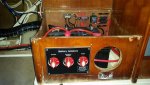
20180119_151430.jpg

The BlueSea switch is a nice bit of kit, vastly better than the 1-2-B switch. My only minor criticism is that it doesn't easily allow for a bank to be isolated, one would have to take a battery lead off. Unless switchable breakers where used in place of battery fuses. Nonetheless, a minor point.
 
You mean like Brent who is adamant that his method is the only proper way and all other ways are flawed.

There is a good deal around that, generally introduced with "the market has moved on". Beats me why people get so precious about how other people do their hobbies. It suggests a significant lack of self-confidence.
 
The difference is, with two battery banks and a single 1-2-B you cannot keep the two banks separate and have them powering the circuits they were intended for. IE, the engine battery powering engine circuits and the domestic bank powering domestic circuits, both on at the same time, both isolated from one another.

Which raises the question of why two separate circuits are needed. That's how I rewired my boat, but more out of a sense of symmetrical neatness than anything else. As long as there is some provision (manual or automatic) for an engine starting battery which doesn't get run down when the domestic batteries are in heavy use, I don't think it matters much.
 
Which raises the question of why two separate circuits are needed. That's how I rewired my boat, but more out of a sense of symmetrical neatness than anything else. As long as there is some provision (manual or automatic) for an engine starting battery which doesn't get run down when the domestic batteries are in heavy use, I don't think it matters much.

It does of course depend on the boat and what systems are fitted. Boats whose entire electrical systems can be run from a single battery don't necessarily need two circuits, provided there is provision for emergency engine starting (as you say). If two similar batteries are fitted, either of which is adequate for all electrical needs, then a 1-2-B switch works OK if the user is happy to manually ensure both batteries get charged. The only real downside here is if he makes an error. This could of course be simplified in terms of user input, with no downside to reliability, by fitting a simple VSR to keep the batteries charged without user input, the user then only needs to decide which battery to use today and it matters not what his decision is.

As things move towards greater amounts of equipment, bigger domestic banks etc things change. The power requirements of the engine remain the same, whilst the domestic needs are vastly greater. The 1-2-B switch then becomes a nonsense. When you have a moderately sized starter battery and a large domestic bank (sometimes consisting of deep discharge batteries) it really makes no sense to be running the domestic systems from the small starter battery or to be starting the engine from the domestics. This is where we need to be looking at separate circuits, each dedicated to the job it is intended for.

The average cruising yacht, with different size battery banks definitely works better with separate circuits. Even Rogers use of two 1-2-B switches is designed around two circuits with three battery banks. It's not a common configuration, but fulfills his needs and he's familiar with it.

It doesn't stop there though. I often advocate the use of a VSR, which in many cases offers a simple and low cost method of keeping all of the batteries charged up. This isn't the be all and end all though, as systems grow the VSR becomes as much a nonsense as a 1-2-B switch. I'm currently re-wiring a 60ft classic motor yacht, twin diesels, a pair of 12v starter batteries in series (24v), four Rolls deep cycle batteries in series (24v) for domestics, DC generator for charging, mains charging, several things running on 12v and an inverter to fit. A VSR didn't come into the equation here, neither did a 1-2-B. But the whole system, from a user input perspective, is just as simple as turning a switch on/off.
 
Which raises the question of why two separate circuits are needed. That's how I rewired my boat, but more out of a sense of symmetrical neatness than anything else. As long as there is some provision (manual or automatic) for an engine starting battery which doesn't get run down when the domestic batteries are in heavy use, I don't think it matters much.

The alternative, which does have some merits is to do things the way the Americans seem to prefer and as I beleive described in Calders book. That is to power everything from one large battery bank and to have an emergency battery that is kept charged by a VSR but not normally used.
 
The alternative, which does have some merits is to do things the way the Americans seem to prefer and as I beleive described in Calders book. That is to power everything from one large battery bank and to have an emergency battery that is kept charged by a VSR but not normally used.

That's a pretty good scheme.
 
The alternative, which does have some merits is to do things the way the Americans seem to prefer and as I beleive described in Calders book. That is to power everything from one large battery bank and to have an emergency battery that is kept charged by a VSR but not normally used.

Mount it a bit higher than normal and add a couple of switchable auxiliary circuits to the VHF and an interior light or two, and you'd have a decent emergency power system :encouragement:

Pete
 
The alternative, which does have some merits is to do things the way the Americans seem to prefer and as I beleive described in Calders book. That is to power everything from one large battery bank and to have an emergency battery that is kept charged by a VSR but not normally used.
I suggested such heresy a while ago and got ripped apart by the solent grumpies... ;)
 
Our hi tech set up has not one, but two, ancient bakelite twist to make cut off switches, one atop each battery connected with a thick U shape of flat bar. It looks very much like the set up is the same half century vintage as the boat itself. I know I should change it, but somehow I cannot bring myself to do so. The old domestic lightswitch that operates the bilge pump however, is not long for this boat.

Make sure you do not inadvertently switch both to off while the engine is running.

A good procedure to follow:

When ready to start the engine switch the domestic battery off and the starter-battery on

Start the engine

Allow the starter battery to recharge and when done ( indicated by ammeter and/or voltmeter)
switch the domestic battery on THEN switch the starter battery off.

Keep the domestic battery on until not needed or you need to start the engine again

When next starting the engine switch the domestic battery off and the starter battery on.

Repeat the above sequence​

Golden rule: Only the skipper is allowed to operate the battery switches!
 
Make sure you do not inadvertently switch both to off while the engine is running.

A good procedure to follow:

When ready to start the engine switch the domestic battery off and the starter-battery on

Start the engine

Allow the starter battery to recharge and when done ( indicated by ammeter and/or voltmeter)
switch the domestic battery on THEN switch the starter battery off.

Keep the domestic battery on until not needed or you need to start the engine again

When next starting the engine switch the domestic battery off and the starter battery on.

Repeat the above sequence​

Golden rule: Only the skipper is allowed to operate the battery switches!

Exactly. And the last line is why I use a VSR and 3 isolator switches on my main boat, with an alarm if the engine battery is on but not charging - I want the systems on that boat usable by anybody on board.
 
A good procedure to follow:

When ready to start the engine switch the domestic battery off and the starter-battery on

Start the engine

Allow the starter battery to recharge and when done ( indicated by ammeter and/or voltmeter)
switch the domestic battery on THEN switch the starter battery off.

Keep the domestic battery on until not needed or you need to start the engine again

When next starting the engine switch the domestic battery off and the starter battery on.

Repeat the above sequence​

Golden rule: Only the skipper is allowed to operate the battery switches!

Seems a huge faff compared to:

When ready to start the engine, press the "on" button at the binnacle and then the "start" button.

To stop the engine, press the "stop" button and then the "off" button.

Pete
 
Seems a huge faff compared to:

When ready to start the engine, press the "on" button at the binnacle and then the "start" button.

To stop the engine, press the "stop" button and then the "off" button.

Pete

Maybe those who like complexity are frustrated pilots who miss going through the pre flight checks, or even Rolls Royce Silver Ghost (1907 -23) owners - but of course they would have a "man" to do all that for them.
 
Seems a huge faff compared to:

When ready to start the engine, press the "on" button at the binnacle and then the "start" button.

To stop the engine, press the "stop" button and then the "off" button.

Pete

Maybe but it was intended as advice for the OP on how to operate the system in his boat without risking the alternator diodes. Not as though swapping batteries was something one did frequently.

Exactly the same arrangement as the Berwick I used to crew. Never any issues with it especially as I was not allowed to operate the switches.

The biggest nuisance was their location, in the battery compartment under my feet when I was in my bunk!

You stick to the system you have, I'm not suggesting you change it

The OP can follow the above and safely operate his existing system until he feels like faffing about to alter it.
It works therefore no real need to fix what's not bust
 
Seems a huge faff compared to:

When ready to start the engine, press the "on" button at the binnacle and then the "start" button.

To stop the engine, press the "stop" button and then the "off" button.

Pete

Sounds like the same number of switch presses/turns to me for start/stop. Just split one action if you want engine to charge domestics. VicS phrased it more carefully but it could have been phrased as

When ready to start the engine turn switch to one then the start button

When engine running for a few minutes turn switch to 2

To stop the engine press the "stop" button (with no messing around with this "off" switch)
 
Battery switches within reach of the helm are a new one on me :p

Pete

And how does that matter at all? The idea of being in the cabin before starting the engine is highly likely anyway and you don't need to be in the cabin to stop it?

Of course you can spend a lot more money on a non 1-2-b system to make give you something with more points of failure but that does provide the idiot proof system that you and your crew clearly need.
 
Sounds like the same number of switch presses/turns to me for start/stop. Just split one action if you want engine to charge domestics. VicS phrased it more carefully but it could have been phrased as

When ready to start the engine turn switch to one then the start button

When engine running for a few minutes turn switch to 2

To stop the engine press the "stop" button (with no messing around with this "off" switch)

I was of course suggesting how the Op should operate a system with two isolators, rather than a 1,2 b switch

The all important thing is not to switch both isolators or a 12b switch to OFF while the engine is running.

BTW in IMHO operating the cold start button was more of a "faff" as that involved opening up the engine compartment, crawling in on top of the engine and then groping for it in the dark, oily, rat infested space at the back of the engine.
If the boat had been mine I would have considered altering that, but the skipper could always put his hand on it no problems.
 
I was of course suggesting how the Op should operate a system with two isolators, rather than a 1,2 b switch

The all important thing is not to switch both isolators or a 12b switch to OFF while the engine is running.

BTW in IMHO operating the cold start button was more of a "faff" as that involved opening up the engine compartment, crawling in on top of the engine and then groping for it in the dark, oily, rat infested space at the back of the engine.
If the boat had been mine I would have considered altering that, but the skipper could always put his hand on it no problems.

My current boat has the cold start button in a similar place but accessible by just opening a hinged door in one of the rear cabins - and the dipstick is in the same place too so all easy and clean. I have never actually used the cold start in 7 years though.
 
Top