1-2-Both-Off question

kevsbox

Well-Known Member
Joined
10 Jun 2020
Messages
212
Location
Portsmouth, UK
www.kevsbox.com
Hey all


I have recently purchased a different yacht (Westerly Centaur) which has two batteries

1 – Engine starter battery

2 – House battery

I am now trying to make sure I understand fully how this is supposed to work

Engine on (charge mode)

Both, 1 or 2 > both batteries get charged

Off > Never when engine is running


Engine off (discharge mode & solar panel also charging both)

Both > Both batteries will discharge using lights, radio and other 12v fittings

1 > Engine battery will discharge using lights, radio and other 12v fittings

2 > House battery will discharge using lights, radio and other 12v fittings

So if this correct? When engine is on set to both and when engine is off set to 2?
 
If wired in the conventional way a 1, 2, both, off switch merely selects which batter is in service for starting, charging and domestic use. Except when both is selected, then both batteries are connected in parallel.

OFF = both are disconnected
1 = no.1 battery is connected
2 = no.2 battery is connected
BOTH = both batteries are connected

You may have things directly connected to one or other of the batteries and not controlled by the switch eg battery charger, solar or an emergency bilge pump. The latter being unlikely / unnecessary in a Centaur..
You may have some kind of split charging which charges both batteries regardless of the switch setting.

The rule you must observe is never switch to OFF if the engine is running or you may blow the diodes in the alternator
Avoid using BOTH except in an emergency or when changing from one battery to the other while the engine is running.

Our procedure was

Select 1 and start the engine.
Allow the battery to recharge ( as indicated by a volt meter and ammeter) then switch to 2 via the BOTH position.
Leave on 2 until next starting engine, or switching all OFF before leaving the boat
 
I bnasically have two of the same type / size batterys via a 1-both-2-Off switch.

I start on 1 ... engine running - switch to both .... once engine stopped I switch to 2 for domestic use.

The main thing to remember whatever sequence or set you use .. is to NOT use BOTH when only domestic - as then you risk running both batterys down and not starting engine when you need it.

Regardless of anything else ... get into the habit of only ONE battery in use when engine stopped.
 
I bnasically have two of the same type / size batterys via a 1-both-2-Off switch.

I start on 1 ... engine running - switch to both .... once engine stopped I switch to 2 for domestic use.

The main thing to remember whatever sequence or set you use .. is to NOT use BOTH when only domestic - as then you risk running both batterys down and not starting engine when you need it.

Regardless of anything else ... get into the habit of only ONE battery in use when engine stopped.

As post #3 "Avoid using BOTH except in an emergency or when changing from one battery to the other while the engine is running."

Leaving on both while motoring leaves you open to losing all power. If one battery suffers a catastrophic failure you could lose both batteries. You won't know this while the engine is running, because everything can run from the alternator. When you stop the engine, everything goes off.
 
The rule you must observe is never switch to OFF if the engine is running or you may blow the diodes in the alternator
.....
This only true if you use the starting cabling to carry the charging current to the batteries via the switch.

I have my alternator connected to blocking diodes and onwards to the house and starter batteries.

The 1 2 b off..only selects which bank is used to start the engine.
 
Last edited:
This only true if you use the starting cabling to carry the charging current to the batteries via the switch.

I have my alternator connected to blocking diodes and onwards to the house and starter batteries.

The 1 2 b off..only selects which bank is used to start the engine.
Ordinary silicon diodes will drop the voltage by about 0.7 volt with the result that the batteries will never fully charge unless the alternator is battery sensed . A low loss splitter ( Victron for example), a VSR or Schottky diodes will overcome the problem with a machine sensed alternator.
 
Last edited:
Ordinary silicon diodes will drop the voltage by about 0.7 volt with the result that the batteries will never fully charge unless the alternator is battery sensed . A low loss splitter ( Victron for example), a VSR or Schottky diodes will overcome the problem with a machine sensed alternator.
My batteries went in in 2005. Two years ago I put in two new house batteries and moved one of the old house bats to the engine starter. Everything still works. I guess losses in voltage are not so critical.

Cables are thick and distances are not great. When I changed the setup two years ago I compressed everything into one cabinet so almost no losses from cables.

Alternator was bought in a truck shop in Spain in 2005. It is nothing special...

The 1 2 b switch came from my previous boat which I had rewired with a vsr etc...never liked it and it went wrong at least once....

I also had a CQR 😊
 
Just to add one point - you need to understand what YOUR 12B Off switch does. i.e. does it select battery to receive charge, supply load or both.

Typically it would select both - i.e. where both the output from alternator etc went and where the power was drained from. As these are now considered old tech it is quite possible that previous owners have added new devices that change this - e.g. solar with controllers that have an output to both batteries, mains battery chargers with dual outputs, even smart alternator regulators / VSRs etc that control where alternator output goes.

If they have done this then the method of use changes so find that out and then ask. I won't suggest that you update!!!!!
 
Not absolute and certain fact, what follows but I’m almost certain, the norm in such a set up (although I’ll caveat all of the following by suggesting that the preferred set up would likely mean a split charge controlled set up instead), the following is the usual assumption;
Battery one means you’re directly fed from your starting battery (which should be supplying starter and perhaps some essential navigation systems like lights and occasionally a plotter or similar)
Battery two means you are not connected to the starting battery or systems and isolated from it, instead being now directly connected to a leisure battery and it’s dependents, like cabin lights, fridge etc etc
Both would mean that you are directly connected to both batteries and the systems are now all common to each other. Usually meaning that the batteries will try and level out and or take, feed or even weaken the other, should they be in a varied state of health or condition. Also means that should you have any sustained or accidental left on, high demand for power, with the engine not running, you could drain both batteries and end up without the ability to start the engine.
So, generally to start the engine, you would have on position 1 (or both if you need a bit of a boost after a long time unused perhaps). Once the engine is running you might argue for or against having the selector then in position “both”, meaning you are charging both batteries. Perhaps it could be argued that this may not be ideal if you have two dissimilar batteries like a high cca dedicated starter battery and the other a deep cycle leisure type. Ideal would be if they were both identical dual purpose batteries perhaps.
Then should you find yourself at an idyllic spot, on anchor…you’d switch to position 2, giving you power from just the leisure battery. Should it for some reason drain, you will always have the banked and charged starter battery to start the engine, when you select position one.
Lastly…some set ups just have one common supply feed to all systems entirely. Which is fed by either battery one, or battery two, or when both selected, both.
Position off..in all cases, should mean complete isolation and disconnection from any battery at all.
Should you wish to check and make certain of what you currently have set up, you could look at the inner side of the switch selection unit. It has 3 terminal posts. One is labelled “common” and the other two are labelled “1” and “2”. Common may be used to feed off to all systems around the boat, depending on set up. 1 and 2 will go to battery 1 and battery 2 respectively.
 
Leaving on both while motoring leaves you open to losing all power. If one battery suffers a catastrophic failure you could lose both batteries. You won't know this while the engine is running, because everything can run from the alternator. When you stop the engine, everything goes off.
@PaulRainbow I have been thinking about this overnight and wonder if the same would apply to a VSR?

Perhaps my lack of understanding of a VSR, are both circuits isolated from each other when charging both?
 
Hey all


I have recently purchased a different yacht (Westerly Centaur) which has two batteries

1 – Engine starter battery

2 – House battery

I am now trying to make sure I understand fully how this is supposed to work

Engine on (charge mode)

Both, 1 or 2 > both batteries get charged

Off > Never when engine is running


Engine off (discharge mode & solar panel also charging both)

Both > Both batteries will discharge using lights, radio and other 12v fittings

1 > Engine battery will discharge using lights, radio and other 12v fittings

2 > House battery will discharge using lights, radio and other 12v fittings

So if this correct? When engine is on set to both and when engine is off set to 2?

I'm not keen on the names Engine Battery and House Battery for this setup. On 1, battery 1 will do everything, lights, radio, engine start/run (hence charge) and battery 2 will be sat idle, not connected to anything. Vice versa when on 2.

If this was my setup, in the short term I'd use one of the batteries all the time; if you're day sailing, one battery should run all the house circuits for a few hrs, and then be able to start the engine and charge up. Then occasionally (once a week, every other weekend) switch to both for an hour when motoring to ensure the unused battery is charged. I'd also be planning to upgrade to a VSR, and separate the engine and house circuits.
 
@PaulRainbow I have been thinking about this overnight and wonder if the same would apply to a VSR?

Perhaps my lack of understanding of a VSR, are both circuits isolated from each other when charging both?

The VSR does parallel both banks, once the voltage reaches the setpoint. But, if the voltage falls below a certain voltage the VSR will open, so you can't flatten both banks.
 
The VSR does parallel both banks, once the voltage reaches the setpoint. But, if the voltage falls below a certain voltage the VSR will open, so you can't flatten both banks.
That is as I understood @PaulRainbow.

Just trying to work out your statement in post 5, I wondered if people might interpret it to mean that with the alternator generating power and if you had a catastrophic battery failure a VSR would protect the second bank.

I have always looked at a VSR in the same way as a 1-both-2 switch, i.e. running on both when the alternator is generating power. All the VSR does is mitigate user error in not switching to either 1 or 2 when they turn off the engine and use the house bank.

I had a 1-both-2 switch on my old boat and currently have a VSR. There is always a small niggle at the back of my mind; what if the VSR failed.
 
There is always a small niggle at the back of my mind; what if the VSR failed.
I have two seperate key switches for batt 1 & batt 2, plus a VSR to charge them. I guess if the VSR fails and batt 2 does not charge I still have batt 1.

If batt 1 failed I'd have to move the pos+ cable from there to batt 2 temporarily to allow engine starting.
 
I have two seperate key switches for batt 1 & batt 2, plus a VSR to charge them. I guess if the VSR fails and batt 2 does not charge I still have batt 1.

If batt 1 failed I'd have to move the pos+ cable from there to batt 2 temporarily to allow engine starting.
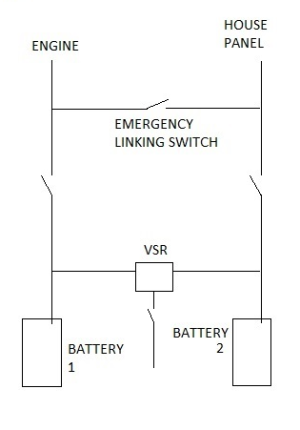
You need to add an emergency linking switch.
1682153983728.png

If connected, as above, on the switched side of the isolators it will allow a failed battery to be isolated and all systems to operate on the good one.

The switch in the VSR negative is optional but if fitted it allows the VSR to be disabled in the event of a catastrophic battery failure.
.
 
You need to add an emergency linking switch.
View attachment 155291

If connected, as above, on the switched side of the isolators it will allow a failed battery to be isolated and all systems to operate on the good one.

The switch in the VSR negative is optional but if fitted it allows the VSR to be disabled in the event of a catastrophic battery failure.
.
Yes, that'd be a good idea alright.

I had thought of fitting an emergency linking switch, but not of one to disable the vsr. Again, a very salient point.
 
As post #3 "Avoid using BOTH except in an emergency or when changing from one battery to the other while the engine is running."

Leaving on both while motoring leaves you open to losing all power. If one battery suffers a catastrophic failure you could lose both batteries. You won't know this while the engine is running, because everything can run from the alternator. When you stop the engine, everything goes off.
We use both regularly when motoring. It is not a thing to be avoided. You just need to remember they are connected together when you turn the engine off.
There are lots of ways you can do this. Hang a sign in the saloon. Install large display led battery volt meters for both banks. Wire an interconnector warning light.
If one battery suffers a catastrophic failure whilst motoring? Really? So we have Victron battery voltage display on the phone, led panel meters for volts and current. We know if we have a huge discharge or charge state. If all else fails we can start the generator and charge the domestic bank. I suppose a catastrophic battery failure whilst motoring is not impossible but really not likely. Most of us do have sailing boats as well so we have sails as a back up😄
 
Personally I would rate the risk of catastrophic failure lower than the risk of leaving a switch set to Both, hence having isolated circuits with a dedicated engine start battery and a dedicated domestic bank / battery.

As to emergency parallels- I think the priority is to be able to start the engine. Once that is started your domestic bank should start charging and even if basically knackered the alternator will provide the power to run chart plotter, instruments, lights etc. switching that on to enable you to carry on using domestic load is a step in a sequence of events that ends up with “and that’s why we needed a tow into …..”
 
Top