1-2-Both-Off question

When I first had my boat I motored over to a boatyard for liftout, and the battery failed. The alternator was way overcharging and it was so hot the sides had begun to bow. She only had a one battery set up then. So it can happen!!

If it happened again I suspect that both batteries would suffer the same fate as a vsr does not have an upper volt limit, as far as I am aware.
 
Personally I would rate the risk of catastrophic failure lower than the risk of leaving a switch set to Both, hence having isolated circuits with a dedicated engine start battery and a dedicated domestic bank / battery.

As to emergency parallels- I think the priority is to be able to start the engine. Once that is started your domestic bank should start charging and even if basically knackered the alternator will provide the power to run chart plotter, instruments, lights etc. switching that on to enable you to carry on using domestic load is a step in a sequence of events that ends up with “and that’s why we needed a tow into …..”


We can all add the 'potential failures' ad infinitum to the list .... I appreciate the suggestion that BOTH is possibly not best ... but in using BOTH position while motoring - I am quietly confident I have enough on both batterys for whatever needs during the evening / next day ...

I used to start on BOTH or #1 ..... then switch to #2 .... but I forgot so often to top up #1 after using to start engine .. luckily my Perky starts easily .. but still - that little bit of power used may just be the deciding factor later !
I then decided to go BOTH while motoring to avoid forgetting.

Before anyone shouts VSR ... I have already considered a VSR and decided that my boat is old ... and I'm similar ... so happy enough to stay as is.
 
The age of the boat or the owner has no impact on the useful properties of a VSR if you and the boat have 2 banks of batteries.
 
We use both regularly when motoring. It is not a thing to be avoided. You just need to remember they are connected together when you turn the engine off.
There are lots of ways you can do this. Hang a sign in the saloon. Install large display led battery volt meters for both banks. Wire an interconnector warning light.

If one battery suffers a catastrophic failure whilst motoring? Really? So we have Victron battery voltage display on the phone, led panel meters for volts and current. We know if we have a huge discharge or charge state. If all else fails we can start the generator and charge the domestic bank. I suppose a catastrophic battery failure whilst motoring is not impossible but really not likely. Most of us do have sailing boats as well so we have sails as a back up😄
If the charging is done via a vsr you don't have to remember to do this or hang warning notices anywhere, or fit any additional intrumentation or warning lights.

Out of interest how would you wire a warning light? I can't think of a simple way to do that.
 
If the charging is done via a vsr you don't have to remember to do this or hang warning notices anywhere, or fit any additional intrumentation or warning lights.

Out of interest how would you wire a warning light? I can't think of a simple way to do that.
If the cable from each battery bank also operated a relay then one could arrange a circuit that went via both relays and was only on when both relays were on. It could then operate a light. A physical version of a logical AND operation.

Why one would do that rather than have a VSR and isolators is a totally different question!!!
 
If the cable from each battery bank also operated a relay then one could arrange a circuit that went via both relays and was only on when both relays were on. It could then operate a light. A physical version of a logical AND operation.

Why one would do that rather than have a VSR and isolators is a totally different question!!!
Both cables would be at12 volts (or more) all of the time . Both relays would therefore be closed all of the time
.
 
Last edited:
The age of the boat or the owner has no impact on the useful properties of a VSR if you and the boat have 2 banks of batteries.

OK ...

I read so many posts about bridging switches .... Switch A ... Switch B .... isolating and so on ...

I agree that VSR to sort out making sure both batterys are charged ... but then reading on with those switches etc. to swap batterty in case one fails for starting engine ... for separating / etc.

Think I'll stay with my antique old fuddy duddy switch thank you.
 
OK ...

I read so many posts about bridging switches .... Switch A ... Switch B .... isolating and so on ...

I agree that VSR to sort out making sure both batterys are charged ... but then reading on with those switches etc. to swap batterty in case one fails for starting engine ... for separating / etc.

Think I'll stay with my antique old fuddy duddy switch thank you.
What could be simpler than this
IMG_20230223_132529.jpg

One switch for engine, one for house and one for combine, plus VSR all in one neat little pre-wired package for £160. Third one I have fitted, first one in 1992, so I guess would be considered a bit old fashioned by some.
 
What could be simpler than this
A 1,2 both switch ;)

Seriously have you considered re-configuring the cluster so that the linking switch parallels the engine and house circuits instead of the batteries so that a failed battery can be isolated and both circuits operate on the good battery alone.
 
....................................
..............
........
A 1,2 both switch ;)

Seriously have you considered re-configuring the cluster so that the linking switch parallels the engine and house circuits instead of the batteries so that a failed battery can be isolated and both circuits operate on the good battery alone.
Don't you do that by taking the positive lead off the failed battery?
 
You can but its a lot easier to do it with the switches
Really? A single 13mm spanner. Turn a couple of times and it's off. How often do you expect a failed battery? If it failed you would likely be investigating anyway. The battery box lid would be off. Its really no hardship to remove a battery cable in the unlikely event
 
A 1,2 both switch ;)

Seriously have you considered re-configuring the cluster so that the linking switch parallels the engine and house circuits instead of the batteries so that a failed battery can be isolated and both circuits operate on the good battery alone.
Yes, I did and Paul gave me the details of rewiring it. However it is a tight fit to change the wires and to be quite honest in all the time I have had this type of switch cluster I have never used the parallel switch. Remember I have an Odyssey AGM for start and an engine that starts instantly and this is charged by a trickle charger off the house bank so the chances of a flat start battery in the next 10-15 years are pretty much zero.

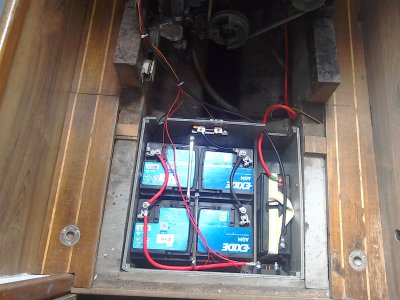
As for connecting the starter positive to the house bank, they are physically close, but different types of terminals and free terminal end not convenient so easier just to have a jump lead. Photo before installation complete and now all leads go to bus bars to the right behind where the switch cluster is located.IMG_20220413_150908.jpg
 
Really? A single 13mm spanner. Turn a couple of times and it's off. How often do you expect a failed battery? If it failed you would likely be investigating anyway. The battery box lid would be off. Its really no hardship to remove a battery cable in the unlikely event
You've forgotten the Smilley!
 
Really? A single 13mm spanner. Turn a couple of times and it's off. How often do you expect a failed battery? If it failed you would likely be investigating anyway. The battery box lid would be off. Its really no hardship to remove a battery cable in the unlikely event

The battery has been boiling its nuts off because of a shorted cell and you are going to disconnected a lead ?

Think i'll turn a switch and keep my eyes and face.
 
. Most of us do have sailing boats as well so we have sails as a back up😄
Try sailing a 31 ft boat into Bradwelll creek, then into the marina & down between the row of pontoons into one's berth when there is F5 one miserable morning at 05-30 .
I did it some years ago with my son & a friend, having run out of fuel. NEVER again. It was the most "bum squeak" manouver I have ever tried.
It was OK with son & mate saying, "go for it dad" . But Dad was not a happy bunny, until those ropes were tied up :rolleyes:
What gets me is that the mini transat boys do it all the time as a matter of course.
 
Try sailing a 31 ft boat into Bradwelll creek, then into the marina & down between the row of pontoons into one's berth when there is F5 one miserable morning at 05-30 .
I did it some years ago with my son & a friend, having run out of fuel. NEVER again. It was the most "bum squeak" manouver I have ever tried.
It was OK with son & mate saying, "go for it dad" . But Dad was not a happy bunny, until those ropes were tied up :rolleyes:
What gets me is that the mini transat boys do it all the time as a matter of course.
I found Bradwell enough of a challenge with an engine with a particularly difficult wind. Not one of my favourite places.
 
Really? A single 13mm spanner. Turn a couple of times and it's off. How often do you expect a failed battery? If it failed you would likely be investigating anyway. The battery box lid would be off. Its really no hardship to remove a battery cable in the unlikely event
I think the issue is more about speed. It's unlikely that it will happen BUT if it does one can almost guarantee that it will happen when it is most inconvenient and when the engine is needed NOW i.e. the becalmed boat and a large ship on a collision course in an area where it can't really manoeuvre. ( Think Brambles turn in the Solent!) - Flick a switch and you can start the engine in seconds. If you have to head below, grab a spanner, get access to the battery box, remove a lead and then move to the other bank and then head back to the cockpit and you could be 5 minutes.
 
Top