Yet another DS practical question

It always seems than when this topic airs, there are an awful lot of people who don't understand the ability gap between a Day Skipper Practical Course and a Coastal Skipper Practical course.

This also applies to the theory courses as well.
 
I know someone who (successfully) did DS alongside someone else doing CS who “failed” - they had been sailing for 30+ years on their dads boat and dad had told them not to waste their time with DS (needed certificate to charter). But whilst he’d been crewing for dad for years, including taking watches he hadn’t actually been in charge at all and hadn’t done theory course so by day 2 was told he wouldn’t be getting CS.

You can't run a DS course alongside a CS course - the RYA are crystal clear in this, however it seemingly doesn't stop some sailing schools from doing it. The two courses should be very different, and I suspect that this is at least part of the reason why there are some on here who are not impressed with the CS course.

However, in the above case, it would seem the CS candidate was not an experienced skipper would struggle even to get DS, if his theory wasn't up DS standard.
 
Not sure how someone could fail competent crew either. I was mile building whilst a mate did CS and his partner Competent Crew. Four of us on board. She was spectacularly useless at almost everything but the school did still give her a certificate. I had a quiet word with the instructor about this and he said he wasn't too concerned as it bolstered her confidence and she was hardly going to be able to charter a boat with just a CC cert.
 
People do DS for all sorts of reasons: to learn how to sail, flotilla charter, bareboat charter, to reassure themselves when they buy a boat, to save a little on insurance, to get the first rung on the commercial endorsement ladder. It’s a competitive market place, with online reviews making it difficult to keep disasterous experiences quiet. So I’m fairly sure that most DS courses are pretty well run with positive experiences for the students, with most gaining the completion certificate. I don’t know what your sailing experience is or your future ambitions but i wouldn’t see DS as “the flotilla course” or let others put you off.
I just dont have a certificate with sailing written on it. My wife has occasionally talked about a flotilla holiday before our son gets too old, but for various reasons now unlikely to happen, when I have asked the charter companies they are happy to accept a day skipper sailing or ICC but my yacht master offshore (power) isn't together with my RN BWC, ONC, FNOC all done in the days on trad navigation methods before GPS. We've had our own yacht for 6 years and I have done a fair few miles, including three RTIR races. Someone I know with a DS cert who is allowed to charter a yacht in the Mediterranean once asked if it was safe for me to sail at night as his DS didn't allow. I could go and do the ICC but that would expire in 5 years against the DS Cert which I believe runs in perpetuity. That hopefully explains why I dont have the appetite to do a DS.
 
I just dont have a certificate with sailing written on it. My wife has occasionally talked about a flotilla holiday before our son gets too old, but for various reasons now unlikely to happen, when I have asked the charter companies they are happy to accept a day skipper sailing or ICC but my yacht master offshore (power) isn't together with my RN BWC, ONC, FNOC all done in the days on trad navigation methods before GPS. We've had our own yacht for 6 years and I have done a fair few miles, including three RTIR races. Someone I know with a DS cert who is allowed to charter a yacht in the Mediterranean once asked if it was safe for me to sail at night as his DS didn't allow. I could go and do the ICC but that would expire in 5 years against the DS Cert which I believe runs in perpetuity. That hopefully explains why I dont have the appetite to do a DS.
If you don't think you would gain anything from DS course, then it feels like your options are CS course (which you may or may not think worthwhile either) or the ICC. It will need renewing (paying fee, not retesting) every 5 years - current price is less than about 1/8th of the typical cost of a DS course... so unless you plan to charter for over 40 years its not ecconomic sense unless you think you will learn stuff.
 
Not sure how someone could fail competent crew either. I was mile building whilst a mate did CS and his partner Competent Crew. Four of us on board. She was spectacularly useless at almost everything but the school did still give her a certificate. I had a quiet word with the instructor about this and he said he wasn't too concerned as it bolstered her confidence and she was hardly going to be able to charter a boat with just a CC cert.
My daughter did CC when she was about 12. We were warned before that sometimes kids that age just don't get it, if she didn't do what was required she would still get the "start yachting" certificate. In the end she was absolutely fine, but I can see how a reluctant partner dragged along, or someone who really has no intention to sail again and so no interest in learning could "fail". The critical things seemed to be the ability to get back to a MOB - some people apparently lack the confidence to do that.
 
You can't run a DS course alongside a CS course - the RYA are crystal clear in this, however it seemingly doesn't stop some sailing schools from doing it. The two courses should be very different, and I suspect that this is at least part of the reason why there are some on here who are not impressed with the CS course. ...

The RYA don't state that you can't run a Day Skipper course alongside a Coastal Skipper Course. They recommend that Coastal Skipper is only run by itself on the yacht because of the intensity of tuition or coaching required to get students to the requisite standard, recognising that this may conflict with the Day Skipper Course requirements. The RYA does recognise that the smaller RTCs require a high annual berth count to make ends meet, and that consideration of the all the students needs is required to make the combination work. For example, a family booking or a club booking, where all the students know one another, could run a CS and DS course, if the RTC makes the assessment of each of their needs and current competency levels. Also, one Coastal Skipper candidate and a couple of DS on a course, could also work, but it depends on much e.g. long versus short passages for teaching skills. The key point being made in the guidance, is that each of the students needs must be assessed before hand, as there is a risk of not satisfying anyone.
 
You can't run a DS course alongside a CS course - the RYA are crystal clear in this, however it seemingly doesn't stop some sailing schools from doing it.
Interesting - it seems to be relatively common practice. Why are their competitors not making a fuss if some are complying with a policy and others not? Or is "crystal clear" actually something vague like "should not normally" or "will be harder to deliver"?
The two courses should be very different, and I suspect that this is at least part of the reason why there are some on here who are not impressed with the CS course.
Perhaps but the content for CC and DS is rather different and those are routinely combined. I can see that delivering a "combined" CS, DS and CC course to people with marginal experience requirements would be particularly challenging, but if the other candidates are not as green as that then I can't see any reason the CS can't still fit in the content. Personally I think it may give a BETTER learning experience (for the CS) with one CS and some relative novices rather than 5 CS on the boat with at any one time the other 4 candidates all being crew.
However, in the above case, it would seem the CS candidate was not an experienced skipper would struggle even to get DS, if his theory wasn't up DS standard.
I think it shows a problem with the whole "minimum hours experience" thing - you can spend 50 hours on a boat occasionally pulling a bit of string when told to, 5 hours executing a complex passage with pilotage tacking etc, or 30 minutes sailing a boat onto a mooring after an engine failure and the former has filled up his log book a lot more than the others but learned nothing!
 
Interesting - it seems to be relatively common practice. Why are their competitors not making a fuss if some are complying with a policy and others not? Or is "crystal clear" actually something vague like "should not normally" or "will be harder to deliver"?
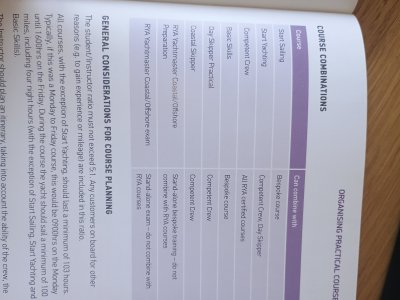
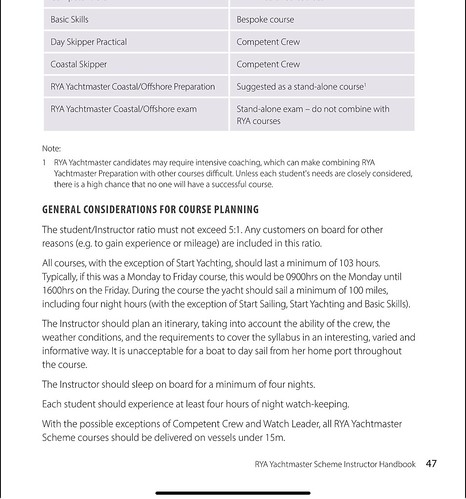
This is from the RYAs Instructor Handbook, there's no leeway I can see.17579347642642160850518923082858.jpg

Running a combined DS and CC, or CS and CC works well, as the skippers have some crew to manage.

I agree with your comment about min hrs, but the RYA also require as a minimum 2 days as skipper, before doing the CS course. Its difficult to express prior experience required, as everyone learns at different rates, and will experience different weather etc whilst sailing. I'm not sure how you would improve on current requirements.
 
I agree with your comment about min hrs, but the RYA also require as a minimum 2 days as skipper, before doing the CS course. Its difficult to express prior experience required, as everyone learns at different rates, and will experience different weather etc whilst sailing. I'm not sure how you would improve on current requirements.
They do also say "Candidates are expected to have prior boat handling expertise to the standard of the RYA Day Skipper practical qualification. This ensures you have a solid foundation of sailing skills before undertaking the Coastal Skipper course."

I think that's a fair description? If you can comfortably (perhaps not perfectly) demonstrate all the elements of the DS syllabus without instruction then I would think you'd get on fine with the CS course, and if you're below that level then I'd expect you'd struggle.
 
Always feels like Coastal Skipper is a kind of fill-in course for lubbers like me who don't have the experience or opportunity to prepare for the Yachtmaster qualifications, but who fancy something to tick off on their way past.

It fills a niche, I guess, but I'm not excited by the idea.
Useful if you want to charter a boat and sail at night.
 
This is from the RYAs Instructor Handbook, there's no leeway I can see.View attachment 199486

Running a combined DS and CC, or CS and CC works well, as the skippers have some crew to manage.
Interesting it seems to conflict with RAHs view - without seeing the text that explains the usage of the table it is a bit of a guess but I’ll take your word for it. The question then is what does the RYA overlook it?
I agree with your comment about min hrs, but the RYA also require as a minimum 2 days as skipper, before doing the CS course.
Yes I am aware, but of course 2 days (or even 6) skippering a flotilla yacht in the med with experienced other sailers are quite different from singlehanding which is different from sailing with relative beginners. You could actually complete the coastal skipper course and never have spent a night at anchor. I think it’s theoretically possible to do the whole thing only entering and leaving the same marina - perhaps the same one people have used for all their prior experience…
It’s difficult to express prior experience required, as everyone learns at different rates, and will experience different weather etc whilst sailing. I'm not sure how you would improve on current requirements.
Yes I 100% agree, you could have two candidates do exactly the same stuff 1 week apart and get very different experience based on the people and the weather. I don’t have any simple answers but it’s clear that for dinghy and powerboat instructors (possible others) we have pre-assessment to assess capability with core skills. In other qualification worlds you often need to build a “portfolio” - essentially a glorified log book, but if you actually needed to submit real details (logs, gps tracks, photos, passage plans) people might be (a) more honest about their experience (b) diverted to specific pre-course prep. Of course not trivial to implement - and it depends whether clueless people are the anomalies that make the interesting stories or a frequent problem.
 
This is from the RYAs Instructor Handbook, there's no leeway I can see.View attachment 199486

Running a combined DS and CC, or CS and CC works well, as the skippers have some crew to manage.

I agree with your comment about min hrs, but the RYA also require as a minimum 2 days as skipper, before doing the CS course. Its difficult to express prior experience required, as everyone learns at different rates, and will experience different weather etc whilst sailing. I'm not sure how you would improve on current requirements.

Okay I agree on the CS and DS not being run together, my mistake. I mixed up the YMCS Preparation combinations based on my edition. Your edition states that the YMCS Preparation is not to be combined, but my version, which I have just refreshed on line does not say that.

Back checking previous editions to 2000 they all say the same, so I wonder if you have the latest version and after I downloaded updates it is still not the latest version. What version do you have?

Untitled by Rival Sailor, on Flickr
 
I never had a problem running a course with a Coastal and a couple of Day Skipper students on board. In fact I enjoyed stretching them all a bit and the CS person actually got to be a skipper.

I obviously knew the people staffing the RYA admin and they had no problem either.

Do seem to get a lot of heresay with this topic.....
 
Okay I agree on the CS and DS not being run together, my mistake. I mixed up the YMCS Preparation combinations based on my edition. Your edition states that the YMCS Preparation is not to be combined, but my version, which I have just refreshed on line does not say that.

Back checking previous editions to 2000 they all say the same, so I wonder if you have the latest version and after I downloaded updates it is still not the latest version. What version do you have?

Mine is the 2015 edition, re-printed Oct 2016, so not that new.
 
Mine is the 2015 edition, re-printed Oct 2016, so not that new.

Okay. Mine is 2015 edition, updated to 2024 edition, eBook. I have a recollection at one of the conferences, this being discussed. Now I may be miss remembering, but I think that Cruising School RTCs kicked up a fuss about it.
 
I can't find the post again, but someone above suggested that a course with four Day Skipper (or was it Coastal Skipper?) candidates, rather than a mix of 'skippers' and Competent Crew candidates wouldn't give them enough time skippering.

That wasn't my experience at all. There were four of us, two Coastal Skipper candidates and two doing prep. before their immediately following Yachtmaster Offshore exam. We all learnt a huge amount from working with and watching each other - both what worked/went well and what didn't, and different habits and different techniques for tackling particular problems/tasks. The excellent instructor certainly gave us instruction and guidance as and when needed, but mainly fostered our cooperation and learning from one another's experience, triumphs and failures, provided great feedback and challenges, and emphasised that being skipper was about managing the crew (including using their knowledge, skills and experience) as much as the yacht (he generally discouraged the 'skipper' from taking the helm). So even when we weren't the nominated 'skipper', we were learning skippering by watching and listening to the one who was.

It was great that everyone was an experienced skipper, but with very different types of skippering experience. One had done a circumnavigation, another mainly on corporate yachts cruising and racing, another a modest sized boat with his family mainly in one location, and my skippering was much wider ranging geographically, but only in very small boats, and all single-handed or just two-up (usually with the same person, my partner), and I'd never then been on a modern large boat, such as we were using, with big winches and other gear that would be commonplace to most others. I am certain we all learnt a great deal.

It was an action packed week, and being in the middle of winter meant we got lots of weather and night hours. The Solent turned out to be an excellent place to do the course, because there were numerous different types of harbours, marinas and rivers all in close proximity, so we didn't spend hours on passage between them, and were almost all the time docking, getting the sails up, down or different, or changing course and negotiating traffic, etc.

It was great fun, and I learnt so much (including the areas where I was weaker and would need to develop further, e.g. communicating with, looking after, and making the best use of the varied skills/experience attitudes of a larger crew). I can't imagine how it could have been better. Sad to hear some others didn't have a very positive experience.

It greatly increased my confidence, and gave me a solid foundation to continue learning, which I am still doing to this day, of course.

Examples of using whiteboard (or sheet of plain A4 laminated) for passage planning/entry.

View attachment 197870

View attachment 197871

@wonkywinch your examples are exactly what I was trying to suggest. Glad to say I knew those two routes intimately too 😊
Interesting to see you chart without the Beaulieu lights.

Below images not to same scale.

Navionics has the lights at all usable zooms.

View attachment 198037

They’re not shown on the smaller scale Admiralty charts, only the most zoomed in ones as far as I can see. This from Memory Map.

View attachment 198036

I had to smile on seeing the example of the Beaulieu River, and the comments about familiarity, and whether/when the lights are shown on the chart. We went in there during our week, just as was getting dark, tide ebbing to the lowest the largest range for many decades (and hence risk of getting seriously neaped if we went aground).

As we approached from the East, the instructor announced that an imaginary fog had descended, and sent the 'skipper' below, with curtains pulled closed and GPS off (as I think it was most of the week), to find our way into the river from the nav table using only the chart, depth sounder and compass, and calling up compass courses to steer to the person on the helm.

It was amusing and a little nerve wracking for those of us on deck, being able to see where we were, and how we sometimes wandered into or away from the buoyed channel, and other times were at risk of colliding with buoys. The 'skipper' did a great job of the navigation, but was clearly hugely stressed by the exercise, until he transposed a couple of digits in calling the next course change (which I think he'd actually calculated correctly) up to the cockpit, the person on the helm obeyed the order and we went aground, at which point the 'skipper' sort of fell apart. He'd previously been the most outwardly confident of us, which I suspect was another lesson for us all!

I'm please to say we managed to quickly extricate the boat from the mud, otherwise we might have been there to this day!
 
Last edited:
That wasn't my experience at all. There were four of us, two Coastal Skipper candidates and two doing prep. before their immediately following Yachtmaster Offshore exam. We all learnt a huge amount from working with and watching each other - both what worked/went well and what didn't, and different habits and different techniques for tackling particular problems/tasks.
For sure there's value in learning from other experienced people, but I do think it's essential somewhere along the way to practice directing novice crew. Experienced people might politely ignore small imprecisions and inaccuracies in your instructions if they already know what you "meant to say"; and working with novices is essentially informal teaching and a whole skillset in itself.

Given the choice, I'd far rather learn to work with novices under the "protection" of an instructor and then go sailing with other experienced skippers - than the other way around.
 
In my view taking a sailing boat out with 1-2 people completely new to it (and nobody else), when it's unknown how quickly they will grasp anything or whether they'll be worried or feeling unwell, is much harder than singlehanding. I appreciate it's difficult for schools to arrange, but someone who gets qualified only from courses with salty veterans who instinctively know how to do everything might be missing something important.

One thing I really wonder about with Day vs Coastal Skipper is "familiar waters". If I do Coastal Skipper in the Solent how do I go beyond "familiar waters"? Should I, on the honour system, go somewhere I've never been for it? On the other hand, literally everywhere I've been in my own boat was "unfamiliar waters" the first time... so I already did some...
 
Top