YAPP idea - MOB alert system

Angus - well done. Count me in for 1 base (SeaTalk input) plus 4 crews.
Three questions:
1) With an aluminium boat I guess I'll need to locate the base where it can "see" crew boxes on deck and below (otherwise it will go off each time one ducks below) - is the antenna in/on the base box or can it be separated?.
2) How hard would it be to have both SeaTalk and NMEA 0183 on the board with either a switch or jumper to select or only plug one in? (my boat is ST my mate's is NMEA).
3) How hard would it be to issue a SeaTalk MoB command (6E . . .) so that the chartplotter swings into action - I'm not sure if the s/w is as easy as that so I'll play with it to see if I can do it on the bench and get back to you.

Thanks, Andrew
 
I've never used an LM2931, and I'm looking for a compact 5V supply. Presumably C9 is low ESR, but is 10µF really enough? Most of the supplies I build have at least 470µF, probably overkill as I don't have a reference for the required values.

Thank you for the feedback. I "borrowed" the power supply design from somewhere or other, can't remember where now. :) The LM2931 is a good small power 5V regulator to use as it's as close to being designed specifically for marine applications as it's possible to get. It's a load dump regulator which means it can handle spikes of up to 60V which may come down the 12V line when the starter motor is used. It's main application is automotive. It can also cope with reverse polarity, shorts, wrong insertion and pretty much any other abuse YAPPists can throw at it.

Checking the datasheet again the output capacitor it needs is 10 to 100uF low ESR, like this one...

http://uk.farnell.com/jsp/search/productdetail.jsp?sku=2079293
 
Angus - well done. Count me in for 1 base (SeaTalk input) plus 4 crews.
Three questions:
1) With an aluminium boat I guess I'll need to locate the base where it can "see" crew boxes on deck and below (otherwise it will go off each time one ducks below) - is the antenna in/on the base box or can it be separated?.
2) How hard would it be to have both SeaTalk and NMEA 0183 on the board with either a switch or jumper to select or only plug one in? (my boat is ST my mate's is NMEA).
3) How hard would it be to issue a SeaTalk MoB command (6E . . .) so that the chartplotter swings into action - I'm not sure if the s/w is as easy as that so I'll play with it to see if I can do it on the bench and get back to you.

1) I don't have a metal boat to test on, but given that I know that autopilot remotes don't work well on carbon boats, I suspect that my device will also not work well on a metal or carbon boat. The antenna would be difficult to separate as it's on the same board as the RF driver chip. That communicates with the processor by I2C and the range of that is short.

2) Both will work for reception at the same time. I will put space for both interfaces on the PCB but in general will supply it built with only one interface. Adding both will not be a problem but would be a couple of £ more. There will also be connectors added for both if this option is chosen.

3) Problems with this...

i) Lack of pins - they are all used. I could convert the LCD interface from 8 bit to 4 bit, but flash space is getting short. I could go to the next size processor, but that adds cost.

ii) It will take more flash space and probably need a more expensive processor, only another £1 but it all adds up.

iii) Lack of PCB space possibly. Not done the base layout yet so I don't know.

Probably nothing insurmountable there to add that feature, but it depends if there is much call for it. There would need to be a Seatalk MOB cancel message as well.
 
Excellent idea - me, I buy black boxes that do good stuff for me. What happens inside really out of my zone.

I'd fix them on the life jackets and that would be that. Make the base unit the same size and style as a NASA unit - then it would also fit in with the rest of the instrumentation. Also maybe with a 'red' back-light for the NASA look. Maybe the back-light flashes on the main unit to show an alert.

What happens if some to$$er goes off to the loo, pub and leaves the unit in his pocket whilst the unit is active?
Can the alarm be suspended, but need some sort of hard reset to clear an alarm message.

Like the idea of the message to the plotter MOB facility. Would make it much faster and reliable to return for the search, rather than transferring lat - long from one system to another at a time of high stress.
 
Excellent idea - me, I buy black boxes that do good stuff for me. What happens inside really out of my zone.

I'd fix them on the life jackets and that would be that. Make the base unit the same size and style as a NASA unit - then it would also fit in with the rest of the instrumentation. Also maybe with a 'red' back-light for the NASA look. Maybe the back-light flashes on the main unit to show an alert.

What happens if some to$$er goes off to the loo, pub and leaves the unit in his pocket whilst the unit is active?
Can the alarm be suspended, but need some sort of hard reset to clear an alarm message.

Like the idea of the message to the plotter MOB facility. Would make it much faster and reliable to return for the search, rather than transferring lat - long from one system to another at a time of high stress.

The crew boxes will need to be inside waterproofs, not outside in the rain. They will be splash-proof, not totally waterproof.

Red backlights unfortunately not available in cheap LCD displays, but the level can be turned down to very low for night use. The brightness could automatically go up a few levels on an alarm or even pulse.

The base station box will fit in with other items in the YAPP product range :) There won't be any imitating of commercial products.

If your careless crew goes to the loo and you get an alarm, just press the cancel button. You won't get another alarm on that channel for a while - re-alarm time to be determined or settable in settings. If he's gone to the pub for a few hours just switch the base off or disable the channel.

The GPS data shown on an alarm will be course and distance to last known location. There won't be any lat or long to transfer.
 
Angus

I am delighted with my prev purchases , please add me to your sales forecast for a pack of one central controller plus crew packs. Merry Christmas

Ian

Angus I still have not fitted my first purchase of your yet.. Hope to have it fitted by the time you release these and I will be up for base plus 4...
 
So cool.

I would like to purchase a base unit and 4 crew transmitters, please.

Thank you.

edit: nmea input please
 
Last edited:
Checking the datasheet again the output capacitor it needs is 10 to 100uF low ESR, like this one...
http://uk.farnell.com/jsp/search/productdetail.jsp?sku=2079293

Sorry to go on about such a small point, but that would not be my ideal. I have always chosen electrolytic capacitors with a working voltage just above the required voltage (say 6.3V to 10V for a 5V supply) otherwise I believe they can lose capacity.

A TI datasheet I've found says 100µF minimum (I've checked datasheets from various manufacturers).
http://www.ti.com/general/docs/lit/getliterature.tsp?baseLiteratureNumber=snosbe5&fileType=pdf
From another datasheet, the ESR needs to be below 0.4Ω.

Assuming that a minimum of 100µF is the target, this would be my choice, but it isn't cheap:
http://uk.farnell.com/panasonic/10sep120m/cap-alu-elec-120uf-10v-rad/dp/2354564?Ntt=2354564
 
Last edited:
So cool.

I would like to purchase a base unit and 4 crew transmitters, please.

edit: nmea input please

It will be months away before they are ready; they are just a pigment of my imagination and a load of brown wires at the moment. I will need to do some proper on-board testing, and that needs my boat in the water and going again, so looking at Easter at the earliest.
 
Sorry to go on about such a small point, but that would not be my ideal. I have always chosen electrolytic capacitors with a working voltage just above the required voltage (say 6.3V to 10V for a 5V supply) otherwise I believe they can lose capacity.

A TI datasheet I've found says 100µF minimum (I've checked datasheets from various manufacturers).
http://www.ti.com/general/docs/lit/getliterature.tsp?baseLiteratureNumber=snosbe5&fileType=pdf
From another datasheet, the ESR needs to be below 0.4Ω.

Assuming that a minimum of 100µF is the target, this would be my choice, but it isn't cheap:
http://uk.farnell.com/panasonic/10sep120m/cap-alu-elec-120uf-10v-rad/dp/2354564?Ntt=2354564

[LATER] Now I'm confusing myself. My search for the above included 0.1Ω to 0.4Ω, but the datasheet says it is lower.

This is quite a complex subject and difficult to sum up in few sentences. But....

Al Elco capacitors have high inductance which makes them a poor choice when low ESR is required. This is worse for through hole (as opposed to surface mount). Al Elco's are good for smoothing out slow ripples and transients (they are cheap) but not good for higher frequencies.

One of the major downsides of Al Elcos is that they can dry out. In warm or hot conditions the dielectric drys out and as it does the capacitance reduces; occasionally that leads to spectacular exploding cans.

Amplifiers with capacitive loads (which is what voltage regulators are) are unstable. That is to say, they have a limited range of stability. The designers put a lot of effort into making them as stable as possible but there is always a trade off with other features such as transient response. This is why there is a range of ESR values in Fig 34 of the datasheet you referenced. It is also why some regulators specify a bulk capacitor in parallel with a low value, low ESR.

Alternative dielectric types have advantages and disadvantages.

Tantalum devices can have low ESR but have a tendency to explode at turn on if the working voltage is close to the device limit and the source impedance is very low. This isn't normally an issue on the output of a voltage regulator but can on on the input side and in switch mode designs. They are also expensive in larger sizes and voltages.

Ceramic devices can be a good choice, they tend to be low cost, there are low ESR types. But the capacitance reduces as the working voltage gets closer to the device maximum.

In general the bulk capacitor on a regulator output only needs to be large enough to supply current during dips in the supply caused by transients. Each IC needs it's own dedicated decoupling to cope with local transients (caused by micro-controller switching for example) and spreading the bulk capacitance around a board is a good idea.

Surface mounted devices are much better than through hole when it comes to high speed circuits and there is a lot more choice. I fully understand the YAPP approach, it's good, I have one myself which I'm very pleased with. But it isn't difficult to hand solder surface mount devices of the 0805 size or bigger with a soldering iron so long as the PCB pads are created with hand soldering in mind.
 
It will be months away before they are ready; they are just a pigment of my imagination and a load of brown wires at the moment. I will need to do some proper on-board testing, and that needs my boat in the water and going again, so looking at Easter at the earliest.

I'm in no rush; just grateful clever people such as yourself are around.
cheers
 
Most excellent idea! Please put me down for 1 base and 4 victim units.
Would be even more outstandingly excellent if could be used in various modes:

1. night or meal mode: Plotter off, boat at anchor. Crew falls off boat while having a pee. Alarms in saloon. No position needed.
(some advantage in this situation if victim unit isn't very waterproof, so that it stops transmitting when the victim hits the water .. rather than when he's drifted far enough away to allow base unit to activate alarm)

2. sailing mode: Plotter on, helm alone on deck: Helm falls off boat. Alarms down below, loud. position marked.
If position is marked (i.e range and direction to Mob), this information will be available down below but not at the helm. Would be great if position could either be marked on plotter, or message sent to mimic MOB button press on plotter (same thing?) , or range and direction to MOB also available from helm position .. a position / direction repeater at helm (to avoid having to run up and down stairs to work out which way you need to sail to pick up your crew.

Of course these are just frills. Even just as a stand alone with no position data, it would be excellent to have a system to wake me up if my crew (wife) falls over the back while I'm having a nap down below.

Please count me in .. thank you very much.
All the best, Peter
 
There is a much cheaper type here: http://uk.mouser.com/Search/ProductD...67-EEU-FR1A221. I'm putting together an order from Mouser, would you like me to order some?

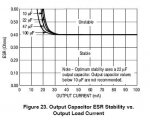
The capacitance at 220uF is above what the datasheet from the manufacturer (ON) of my LM2931 specifies. They recommend that 22uF is the best. Attached is their graph. Above 100uF stability decreases. It appears that if the ESR is less than 0.4 ohms then any capacitor in their suggested range of 10-100uF will provide stability at any power level. Thank you for the Mouser offer, but it is too early to be buying components at the moment.

lm2931.jpg
 
Last edited:
The capacitance at 220uF is above what the datasheet from the manufacturer (ON) of my LM2931 specifies. They recommend that 22uF is the best. Attached is their graph. Above 100uF stability decreases. It appears that if the ESR is less than 0.4 ohms then any capacitor in their suggested range of 10-100uF will provide stability at any power level. Thank you for the Mouser offer, but it is too early to be buying components at the moment.

View attachment 38186

A good example of semiconductors from different manufactures with the same part number not being identical. It's often difficult to get the buyers to understand that they can't just switch between manufacturers just because the part numbers are the same.
 
On the "nice features to have" note. If possible, a relay output or facility to drive one would be useful for us Billy Nomates sailors: To trigger an engine shut-off device and/or put the helm over on those occasions when prancing about the boat when not hooked on goes wrong.
Also, can the trigger range be shortened? 25m is fine if the remaining crew will come back to get you, however it's a bit of a swim in the above situation.

Cheers
Rum Run
 
On the "nice features to have" note. If possible, a relay output or facility to drive one would be useful for us Billy Nomates sailors: To trigger an engine shut-off device and/or put the helm over on those occasions when prancing about the boat when not hooked on goes wrong.
Also, can the trigger range be shortened? 25m is fine if the remaining crew will come back to get you, however it's a bit of a swim in the above situation.

I am planning on a 12V 5A output on alarm trigger. This can be used as is or to drive a relay. The power output and receiver sensitivity of the RF module are both configurable although I have done no testing. There are 4 levels to transmit power and 2 levels of receive sensitivity. I will have to go up to the next size processor to add more features to the base which will push up the cost by £1. I could put some jumpers on the board of the the victim box - users would have to experiment with their setup and choose the appropriate level. This will add less than 50p to the cost.
 
Last edited:
Top