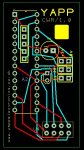
YAPP idea - MOB alert system

Can this not be done with off-the-shelf bluetooth beacons?

Possibly. Tell us more. What do they cost? Are they available? What's their range? Is the range controllable or detectable? What do they communicate with? What power would the receiver need (computing and electrical). Is building a system using them within the range of YAPP possibilities?
 
Last edited:
Possibly. Tell us more. What do they cost? Are they available? What's their range? Is the range controllable or detectable? What do they communicate with? What power would the receiver need (computing and electrical). Is building a system using them within the range of YAPP possibilities?

some basic information here http://apps.jamgo.co/lighthouse/ (ignoring the 'cloud' bit)

it would be a software rather than hardware, though, which is probably not in keeping with the spirit of a YAPP
 
1) I don't have a metal boat to test on, but given that I know that autopilot remotes don't work well on carbon boats, I suspect that my device will also not work well on a metal or carbon boat. The antenna would be difficult to separate as it's on the same board as the RF driver chip. That communicates with the processor by I2C and the range of that is short.

2) Both will work for reception at the same time. I will put space for both interfaces on the PCB but in general will supply it built with only one interface. Adding both will not be a problem but would be a couple of £ more. There will also be connectors added for both if this option is chosen.

3) Problems with this...

i) Lack of pins - they are all used. I could convert the LCD interface from 8 bit to 4 bit, but flash space is getting short. I could go to the next size processor, but that adds cost.

ii) It will take more flash space and probably need a more expensive processor, only another £1 but it all adds up.

iii) Lack of PCB space possibly. Not done the base layout yet so I don't know.

Probably nothing insurmountable there to add that feature, but it depends if there is much call for it. There would need to be a Seatalk MOB cancel message as well.

Re:
1) If it can transmit say 10m through 5mm "Perspex" and 12mm ply I can find a dry spot within my instrument pod - I'll attach the crew units to velcro where we take off our wet weather gear - should reduce false alarms;
2) If had had to choose I would opt for the SeaTalk option - but would be happy to pay a little to retain an NMEA option;
3) One way of tackling this is to have a contact closure to drive a relay for a powerful alarm (as you propose) PLUS a low power NC switch to act as one of the switches for a module based on your AP_Remote YAPP:
  • one would then have upto 3 inputs to trigger 3 ST messages (or 6 if you can mimic a "long press"). That way users could have their own messages to suit their own gear.
  • Not sure if the base unit will send ST messages - with this approach it need not as the AP module does it for you.
  • Would require an extra AP_Remote board etc - not a big deal, especially if it can sit in the same box???
  • I'm not sure about the need for an onboard MOB cancel capability - wouldn't that be done via the chartplotter?
  • It will still be a day or two before I can play with sending MOB messages to my Chartplotter - this needs to be confirmed before getting too excited about an MoB option (we have Tiger snakes at the bottom of the garden - need to clear the back paddock).
I reckon this is one of your better YAPPS and deserves the time to collect User Requirements (as you are doing) - I'm happy to go with the concensus. Cheers, Andrew
 
Last edited:
... the manufacturer (ON) of my LM2931 ... recommend that 22uF is the best...
So they do, I missed that when I was looking, sorry. A good reason to use them rather than TI. I would still aim for a lower working voltage though, providing the ESR is still low enough.

Regarding Bluetooth: Elton produced an Android app that used BT transmitters, that's why I bought a few for testing. They were dirt cheap, possibly cheaper than your transceivers, but no point in going down another route if they work.
 
Last edited:
This evening I have converted the LCD display driver from 8 bit data mode to 4 bit data mode thereby freeing up 4 output lines. That means now there is a pin available for transmitting a Seatalk MOB command. I see that there is also a Seatalk cancel MOB alarm message as well, so cancelling an alarm on a chartplotter would cancel my alarm as well, or cancelling on my box would cancel the alarm on the chartplotter. These features would of course be available only for the Seatalk variant.

However, I have only 204 bytes of flash space left without going to the next size up processor.
 
Last edited:
The Seatalk MOB function is extremely cool, a big upgrade in functionality. Just the time from hearing the alarm, running through the whole WTF panic and looking round - to the time you press the MOB button could easily be 100 metres travelled, which equates to massive difference in the search area size.
 
The Seatalk MOB function is extremely cool, a big upgrade in functionality. Just the time from hearing the alarm, running through the whole WTF panic and looking round - to the time you press the MOB button could easily be 100 metres travelled, which equates to massive difference in the search area size.

There's no promise that will work, it's something to try. Don't forget my base will give course and distance to the position of the last received message, although located inside this would not be as useful as a chartplotter at the helm with a graphical display.
 
Here's an update of what's been done today...

1) LCD driver changed from 8 bit data to 4 bit data freeing up 4 processor pins for other uses like sending a MOB message to Seatalk. Schematic updated.

2) I have added the ability on the schematic for the victim box to set the transmission power to 1 of 4 levels using 2 jumpers that will be on the the PCB inside the box. No done any software change or testing yet.

3) When the an alarm is active the backlight level on the LCD display will pulse up and down 1 level to give a visual indication.

4) Added handling of Seatalk alarm cancel message.

5) Done the victim box PCB layout...

cwr.jpg
 
Angus, I've set my chartplotter up on my bench and am sending commands via SeaSigma (I'll change to my own s/w shortly but have other commitments).
According to Thomas Knauf (my intepretation) to start MoB one should send:

82 A5 40 BF 92 6D 24 DB
6E 07 00 00 00 00 00 00 00

I had to send it more than once for it to work. Sending the 6E line alone didn't work.
On my setup, sending the 82 line alone, several times, works too.
May I suggest that when you send the MoB line that you send several times??

Cheers, Andrew
 
Angus,

By coincidence I've been working on exactly the same thing, though mine is not using a PIC controller.....that was going to be model number two. But I may as well now put yours on my shopping list!

Some thoughts on the spec, by way of discussion, certainly not by way of criticism!

1. I have included a "comfort" light on the receiver. Very easy to do but the simple addition a green LED gives those down below the instant reassurance that everything is working and all are on board. I know the lack of an alarm should give the same message but a positive indicator is effectively the night watchman calling out "All's well"

2. I opted to not go for automatically returning the boat to the MoB location. Partly because it's probably beyond my abilities at the moment (it's been a very steep, but interesting learning curve so far) but equally well because I didn't want to run the risk of mowing down the victim. Also, on my boat at least, when under sail I don't think it could be relied on to return to the MoB location without setting the sails again. (I'm assuming you meant that the return would be automatic, rather than simply giving the Mob position for the crew to steer to).
I have opted to go for switching off the engine or, preferably, simply dissengaging the gearbox (meaning that crew can come on deck, put her in gear, and return to the victim). I also plan to be able to dissengae the tiller pilot. If the boat is under sail and tiller pilot then it would simply be disengaged and would head up into the wind.

I think that those options are probably also best for when I am single handing.

3. I have included some water sensors to trigger the victim unit. This is because of the possibility of crew being tethered to the boat and still falling over board. I wouldn't want to be dragged along with the boat whilst everyone else thinks everything is all OK!

4. FWIW I have set the trigger time at less than one second and have, as much as possible, set the transmission distance to just a few metres. That way the alarm is given as soon as possible and the boat would hopefully be stopped in the shortest possible time...probably important when single handing.

5. I'm also working on a system to automatically dump the danbuoy/life ring into the water when the alarm goes. But that's a mechanical gizmo; it just needs a relay output from the receiver to trigger it.

Just some thoughts. I'm going to have a look at your circuits now!:D


Edit. Some further thoughts.
Simply for comfort I've been trying to make my "victim box" less than 2cm thick. 4cm does seem a bit cumbersome.

FWIW unless I've missed it, I'm a bit surprised that nobody has yet asked for a doggie version.
 
Last edited:
The victim box measurements were approximate. I have measured the dimensions and they are 74mm x 56mm x 24mm. This just what I have in my bits box. I may be able to find a smaller one as long as it can get the PCB and a pair of AAA batteries in.

The receiver has a backlit LCD display. The level can be set from very low to full on. When everything is OK the light level is constant. When an alarm goes off, the light level pulses. The LCD display in monitoring mode also shows how many seconds since the last message was received. It also shows lat/long reception status with a small icon. I think a video is needed. I shall do one and add it to this thread.

The device does not return the boat to the MOB position. However, when an alarm goes off it automatically switches to the bearing/distance display to the last known position. There is no intention of controlling an autopilot for the reasons you say. There will also be a link to send a MOB message to a Seatalk enabled chartplotter if this can be made to work.

Water sensor is not in the scope this time - maybe in the future. It would add considerably to the cost and would probably need custom victim box plastic.

There will be a 12V/few Amp (not decided yet) output which can be used directly or drive a relay.

I think the standard victim unit would work equally well for dogs with a paw print or bone decal stuck on the box :)
 
The relay seems problematic: there are going to be some false alarms, someone going to the loo and the unit getting so covered in oilskins and in a sealed room that the signal is lost - every false alarm would trigger the release of a Danbuoy or suchlike. Very occasional false alarms are good, last thing you want is five years going by and then it alarms because someone's gone in the water but everyone looks around to see which smoke detector is going off because they don't know what the alarm noise is!
 
The relay seems problematic: there are going to be some false alarms, someone going to the loo and the unit getting so covered in oilskins and in a sealed room that the signal is lost - every false alarm would trigger the release of a Danbuoy or suchlike. Very occasional false alarms are good, last thing you want is five years going by and then it alarms because someone's gone in the water but everyone looks around to see which smoke detector is going off because they don't know what the alarm noise is!

My intention for the 12V switch output was to sound a horn or switch on some lights or send a text message to your mum or something, not start releasing things into the sea, but it will be up to the user what to use it for.
 
I've got a NMEA only device that does the same thing. And on thinking about it, I don't know how: one talker and all that.

There will also be a link to send a MOB message to a Seatalk enabled chartplotter if this can be made to work...

Could you consider doing the same for NMEA, if I can figure out how it does it? I happen to have a spare one at home.

Is the AAA battery and "no switch" set in stone? Have you considered a CR2032? These have about 1/3 the capacity of an AAA, but would allow the unit to be considerably smaller. Perhaps it could incorporate a flashing LED to indicate transmit, then a magnetic switch could be used to make the PIC go into sleep mode, and power the whole thing down.
 
Top