Yacht Time Correction YTC rule

Indeed, we did a regatta using Byron (which became YTC).

Byron didn’t become YTC. YTC was created at Mylor Yacht Club as an alternative to Byron from some rather complex maths from a club in Chichester I think that sought to reverse engineer a formula from PY numbers that were already in existence. The idea was to come up with a simpler and more accessible way of rating boats that had no PY but that wasn’t based on race to race performance like NHC or at up front cost like IRC.

It’s rather grown since then!
 
Our Byron rating and our YTC rating are the same, and requested the same information.
Good! Byron was a really useful resource in an area that the RYA had neglected but the problem was it relied on one person and donations to expedite

Which wasn’t great for people entering regattas. Also over time, different clubs’ PY numbers had diverged

If you google SWYTC you can see how it all came about… and spread beyond Falmouth

The chap who led on it did an amazing job to encourage casual racers back into the fold
 
Byron didn’t become YTC. YTC was created at Mylor Yacht Club as an alternative to Byron from some rather complex maths from a club in Chichester I think that sought to reverse engineer a formula from PY numbers that were already in existence. The idea was to come up with a simpler and more accessible way of rating boats that had no PY but that wasn’t based on race to race performance like NHC or at up front cost like IRC.

It’s rather grown since then!

Err no, YTC is based on the work of Professor Linda Wolstenholme of Emsworth Slipper sailing club.
I've pages of spreadsheets to develop a handicap for my one off boat from her formula.
20240603_154419489.jpeg
 
The chap who led on it did an amazing job to encourage casual racers back into the fold
Well he's failed with my club - not touching a regatta that uses that again. Any rating that puts a sailing school boat and a stripped out racer with carbon rig and dyneema sails at the same level is useless.
 
Err no, YTC is based on the work of Professor Linda Wolstenholme of Emsworth Slipper sailing club.
I've pages of spreadsheets to develop a handicap for my one off boat from her formula.
View attachment 177940
I wrote something similar in Python. Worked, but there's a random number generator in there called keel curve or similar with no method given for evaluating it.
 
Good! Byron was a really useful resource in an area that the RYA had neglected but the problem was it relied on one person and donations to expedite

Which wasn’t great for people entering regattas. Also over time, different clubs’ PY numbers had diverged

If you google SWYTC you can see how it all came about… and spread beyond Falmouth

The chap who led on it did an amazing job to encourage casual racers back into the fold

Well he's failed with my club - not touching a regatta that uses that again. Any rating that puts a sailing school boat and a stripped out racer with carbon rig and dyneema sails at the same level is useless.
Professor LINDA Wolstenholme.
1718005703300.png
 
Byron didn’t become YTC. YTC was created at Mylor Yacht Club as an alternative to Byron from some rather complex maths from a club in Chichester I think that sought to reverse engineer a formula from PY numbers that were already in existence. The idea was to come up with a simpler and more accessible way of rating boats that had no PY but that wasn’t based on race to race performance like NHC or at up front cost like IRC.

It’s rather grown since then!
It appears that Byron PNs were the base for the simplification work by Professor Linda Wolstenholme of Emsworth Slipper sailing club (ESSC); some time later MylorYC along with some other clubs in the Falmouth to Dartmouth area created SWYTC which was based on her formulae; the RYA handicap system (RYAYTC) replaced SWYTC in 2022 and has been "further developed by the RORC Rating Office using Machine Learning models" according to RYAYTC Policy 2025.

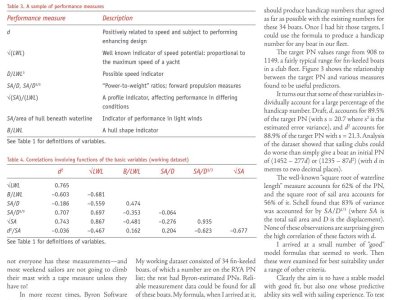
To quote LW in her article 'Sailing Close to the Statistics' dated June 2009 (attached Page55 middle col. ):
"My working dataset consisted of 34 fin-keeled boats, of which a number are on the RYA PN list; the rest had Byron-estimated PNs."
I recollect there were only four RYA PY boats listed around 2007. I also recollect that Dartmouth and Falmouth Regattas used Byron predicted handicaps for a number of years about a decade ago (alongside IRC and OD fleet races) until RYA 'politics' became an issue. It would therefore be reasonable to assume that SWYTC had a larger Target PN dataset than LW's 34 boats.

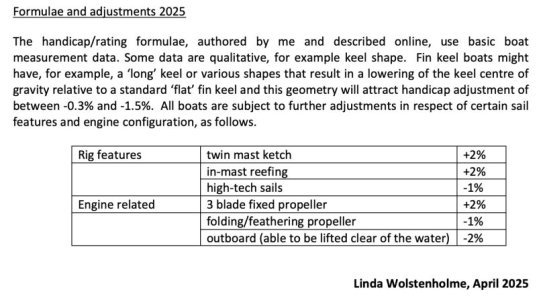
To get an idea of the size of boats/types sailing at Emsworth, I looked at the RYA YTC Listings (RYA YTC Listings - Royal Ocean Racing Club | Rating Office we see 1540 records of BoatNames but NONE for an Emsworth Club? Being rather surprised that ESSC and ESC don't appear to use the RYA/RORC YTC system, I found their Cruiser Handicap Update (CRUISER HANDICAP UPDATE 2025 : Emsworth Slipper Sailing Club) issued by Linda Wolstenholme April 2025 which states:
"Formulae and adjustments 2025 - The handicap/rating formulae, authored by me..." (re attached).
Should we now assume that LW and the Emsworth Clubs are still using SWYTC and NOT the RYAYTC system?

The above confirms the comment by 'weaver_fish' that they "sought to reverse engineer a formula from PN numbers that were already in existence...the idea was to come up with a simpler and more accessible way of rating boats".
"Simpler?" YTC formulae uses a much reduced number of variables when compared to Byron, ref: (www.byronsoftware.org/boats/calcrequest.htm ) eg Beam, Keel weight, sail material and roller reefing are included with Byron; Some skippers saying 'why does YTC differ so much from my PN', of course, if fewer variables included then rating errors inevitably occur, ie if we compare boats with same SA/D, a 'fat cruiser' with larger Beam/Len ratio and larger Disp/Len ratio can muster far less boat speed than a 'skinny hull' which slices through the water with less resistance. I suspect we can conclude that YTC is simpler but probably less accurate across the range of club sailboats.
"More accessible?" YTC requires the completion of a webform which is submitted to RORC for processing; Byron has been supporting PNs for over two decades and the freely available web list has more than twelve hundred sailboat Classes (ByCN ByBoat) which many clubs have been using with the old RYA YR2 system plus fleet adjustments to suit local conditions such as tidal influences.
Byron also produces a boat specific handicap/rating via a webform to ensure less equipped and modified Class boats are rated correctly, hence if a boat has Carbon sails or lead added to the keel then the Byron PN will change accordingly. YTC does not publish a Class list so I think we can say with confidence that YTC is less accessible.
 

Attachments

  • CloseToStats.jpg
    CloseToStats.jpg
    129.7 KB · Views: 4
  • 2025 ESSC-ESC Handicap Update.jpg
    2025 ESSC-ESC Handicap Update.jpg
    65.4 KB · Views: 4
I wrote something similar in Python. Worked, but there's a random number generator in there called keel curve or similar with no method given for evaluating it.
Comparing SWYTC and RYAYTC powered by RORC formulas:
LW formula used by Emsworth/near clubs:
FNfin = kf (2091 -407d+86d^2 -30.5Lwl -59.6(SA/Lwl^2) -810(SA^0.333/D^0.25))
where, for flat single keels kf = 1, and for long keels kf = 0.98;
FNbilge = kf (2211 -1389d +431d^2 - 137*B/LWL - 54.9*LWL^0.5 + 455*SA/D^0.666)
where for twin bilge keels, kf = 1; and for triple bilge keels, kf = 1.01
Inboth d=draft, Lwl=WaterLineLength, SA=SailArea to windward and D=Boat Weight. InBilge only B=beam.

From RYA YTC Policy 2025:
(https://rorcrating.com/wp-content/uploads/2025/01/RYA-YTC-Policy-and-Procedures-2025.pdf)
RYAYTCfin = kf*(2123 -386d+82.8d^2 -30.4L -49(D/100L^3) -1005(SA^0.333/D^0.25))
variable changes L=LH-0.5*(LH-LWL) replaces Lwl, and (D/100L^3) replaces (SA/Lwl^2)
Does the term -49(D/100L^3) include a typo? it's negative which suggests a 'heavier boat is faster',
however it appears to make a rather small contribution compared to other variable groups.
eg First 18 has D=630kg and L=5.27 so 49*(630/100*5.27cubed) equals 2.11 of YTC961 ie 0.22%
Sigma 33 has D=4173kg and L=8.95 so 49*(4173/100*8.95cubed) equals 2.85 of YTC935 ie 0.31%
Archambault A40 D=6200kg L=11.62 so49*(6200/100*11.61cubed equals 1.94 of YTC828 ie 0.23%
RYAYTCbilge = kf*(1817 -290d+62.2d^2 -22.8L -37(D/100L^3) -755(SA^0.333/D^0.25))
where kf is same as for LW's FNbilge(above), but now plus long keels kf = 1.03
Comparing RYAYTCbilge to LW formula FNbilge the historically rated terms including B/LWL and LWL^0.5 have been replaced by the insignificant contribution from the term -37(D/100L^3)
It is also noted that Long Keels are now relegated to this bilge formula, we ask ourselves is it due deadrise? or wetted area? or just that the difference to PN was too large?
Should we conclude that kf(keel type) and larger SA downwind(due spinnaker) are 'after thoughts' and not included in the regression analysis?
Also how does 'Spin % area allowance 1.75-(DSA/SA)' match the RYA/RORC stated +2.5% for No Spinnaker? as when No Spinnaker and DSA equals SA, their formula of 1.75-1 equals 0.75 ?
Perhaps these 'further developments' by RORC explains why Emsworth clubs and others do not appear on the RYAYTC weblist of BoatNames/Clubs.

All these formulae show (constant1*draft) and (constant2*draft_squared) in 'statistical tension', that is: 1st term being negative (so lower handicap indicating 'more boat speed') against 2nd term with d^2 being positive (so 'less boat speed'); the difference of 'draft in meters' to 'area in m^2' results in a number which is approx 40% of the YTC (in the few I've calculate too date);
To be fair, the standard fin yachts calculated (handicap approx 1000) do have comparable numbers, but struggling to get a match with lift keel boats and smaller lightweight cruisers/dayboats, perhaps RORC just quotes web sourced PNs for these boats?
Would it correct to say that RYA/RORC YTC formula does NOT allow clubs to easily accommodate a wide range of yachts in their racing events?

LW in her comment (Page55 right col) "sailing clubs could do worse than simply give a boat an initial PN of (1453-277d) or 1235-87d^2)".
Really? does Professor LW's expert advice mean that web sourced PNs would be worse than such a simple formulae?
The formulas inform us that all you need to transform a 'fat lift keel cruiser' into a 'low handicap race boat', with all else remaining the same, is to change to a deeper/extended GRP keel or centerboard. Was it Benjamin Disraeli or Mark Twain that wrote the well-known phrase about using statistics alone? "Lies, damned lies, and statistics".

It is understood that a computer Regression program aims to analyze the relationship between a dependent variable(PNs) and independent variables; the variables used in LW's and RYA/RORC's formulae are NOT independent in my opinion; doesn't a typical 'Longer boat' tend to be heavier? and also have a deeper fin keel? Surely it's best to rely on the 'Laws of Physics', particularly the 'Law of Moments' and 'Newton's laws of motion' to inform judgments and computer model inputs?
Is it correct to say that this 'simplicity focused', rather than an 'accuracy focused' exercise has produced more questions than answers?

On the few RYA/RORC pdf certs I've seen, next to an eye catching red IRC logo is the text "You are on your way to apply for an IRC Certificate... To apply for an IRC Certificate please go to the..." plus a link. Would it be wrong of us to suspect that RORC's motive is to pursuade more Club sailboat owners to pay £100 or so to get an IRC number? and if YTC replaces established PNs and then creates dissatisfaction, will more skippers be encouraged to pay for an IRC TCC?
Conversely, if RORC develop a 'good free YTC system' then won't more current IRC cert boats be tempted to save the annual sum paid to RORC?
It does appear that the RYA have created a 'conflict of interests' for RORC with 'powered by' and 'further development of YTC' by the RORC Rating Office?

To be fair, RORC do organise some excellent Ocean/Offshore high value races, the results of which we presume are fed back to keep their IRC TCC calculations in line with new yacht developments.
However, does the IRC single TCC translate well to Inshore/Estuary/River/Inland 'round the cans' Club racing? I suspect not, as other Rating authorities such as Offshore Racing Congress ( ORC Rating Systems ) issue different Rating numbers for different race types. Also I can't imagine sub 20ft or any PN1150+ boats being eligible and applying for an IRC TCC.

Has the RYA spent our subs money wisely in trying to replace the old PN system? firstly by NHC and currently by promoting and supporting/contracting RORC Rating to develop and administer the new YTC system? Can any experienced/expert forum member point out my errors? as I fear the RYA/RORC and their YTC formula/system is not looking like a workable solution for the range of boats/clubs that relied on PNs previously.
 
When we asked for a reassessment as it's a school boat that also races, we were told that the modifications required by the RYA couldn't be used in recalculation of YTC, only manufacturers data could be used.

Running the calculation with the most recent formula and published data about the boat, it still needs a kg of over 3. Unfortunately there's no data about how kg is measured to refute.
 
When we asked for a reassessment as it's a school boat that also races, we were told that the modifications required by the RYA couldn't be used in recalculation of YTC, only manufacturers data could be used.

Running the calculation with the most recent formula and published data about the boat, it still needs a kg of over 3. Unfortunately there's no data about how kg is measured to refute.
RYA/RORC YTC Policy penalises a boat for carrying MCA dictated SAFETY equipment!
Shouldn't carrying safety equipment/Liferaft in particular be encouraged in our sport?
 
I feel that a lot of the problem in sailing handicapping, in real life and in this thread, is from not explicitly agreeing on the objective. There are 2 incompatible aims. One is to rate the maximum potential of the boat. The other is to rate the boat,crew and circumstances as they are. They are both perfectly reasonable approaches, but you have to decide which is right for you and your circumstances.
 
I suspect we can conclude that YTC is simpler but probably less accurate across the range of club sailboats.

"More accessible?" YTC requires the completion of a webform which is submitted to RORC for processing; Byron has been supporting PNs for over two decades and the freely available web list has more than twelve hundred sailboat Classes (ByCN ByBoat) which many clubs have been using with the old RYA YR2 system plus fleet adjustments to suit local conditions such as tidal influences.

Thanks flatcap - it was a bit weird reading this thread and some other folks comments when we were literally sat around the table doing this thing!

My accessible comment relates to its origins and initial intention - it gave us the means the generate a number in house - in the club. There wasn’t any plan for it to be national! One of the problems we found with Byron was that sometimes there was a wait for numbers - not a criticism - but a natural thing with a system that wasn’t in house.

The other issue was that in the local area, clubs had different PY numbers for similar / same boats owing to individual club adjustments. Over time this caused friction e.g. with Falmouth Week or COGS.

As said above, no system is perfect…. YTC was a local solution which worked well for us and overcame some of our specific issues.

Of course issues with handicapping and ratings are as old as Noah
 
The criticism of PLW using Byron and PY as a starting point, is I think unfair. You have to start somewhere and be able to relate it to other systems otherwise there can be no comparison.

On my version of PLW's work, I needed to compare my boats with mini keelboats of which there are very few types, so from round the world. I also needed to compare my boat Norfolk Broads keelboats where I sail,
So in my spreadsheets are included.
RYA PN,
The old USA PN,
PHRF,
Broads Handicap ( note broads handicap values vary from club to club, and my club has different values for, on the river, on the Broad, and the 3 Rivers Race.)
 
I like to partake in a Regatta for only a few days of the year, and not really expect to win.

In order to do so, I managed to have the help of a friend to hold the tape and write down the simple measurements, it took 30mins and cost me nothing to get a handicap enabling me to participate.

Simple.
 
For The Q - out of interest how are the Three Rivers Handicaps worked out - as it always seems to give a wide range of different types of boats in the top 10
 
The 3RR handicap has 64 races of experience, over that time repeated entries of classes has changed handicaps for boats up and down to try and give everyone a chance.


If it's a new class of boat to the 3RR, they start with any existing handicap, normally if it's an outsider it'll be likely be RYA PN, there's a rough formula to convert that to Norfolk handicap.
Then the Handicapper ( a maths teacher) will then look at the type of boat and from some years of experience adjust that up or down a little.. if it's got a tall rig it's likely to be more heavily handicapped.
If that boat does exceptionally well then the following year it's handicap will be increased..

The big broads sailing cruisers have their own handicaps
Yacht Information (2024-5) - River Cruiser Class

If the boat has no previous handicap from anywhere, then it's up to the handicapper to guestimate one.

I only know of one big error in issuing handicaps which was under a previous handicapper some years ago, a boat entered which looked like a home build plywood sailing cruiser, which it was.. However it had the rig of a racing boat and a very good keel... It vastly out performed it's issued handicap that year.. it got a very revised handicap the following year.

Note that the maximum handicap issued is 25% this is to discourage really slow boats.. though I've completed the race several times in a boat whose true handicap is 35...

Some examples of Norfolk handicap (. Using well known classes ) as I don't have the 3RR ones to hand.
Laser pyn 1108, Norfolk 10,
Merlin Rocket 983, 7.
Mirror 1388, 32
Solo, 1139, 17,
Topper , 1363, 27,
Yeoman Keelboat, 1108, 13.
 
Last edited:
Top