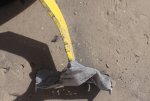
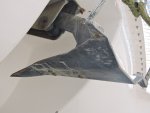
Would you still be using this anchor?

By no means trying to make a 'colourful' suggestion, but if the anchor's getting bent, isn't that an indication of its holding prowess?
Genuine question from a CQR owner.
It looks to me that the failures seen in the thread are due to collisions on the roller, nothing to do with their use on the seabed.
I also have a photo of a fractured CQR, one of the cast iron ones, also due to a collision.
 
Sadly you new anchor will cost a bit more than the new socks :( and be much more difficult to pack such that you cannot guess what it is :)

Jonathan
I once ordered an anchor by mail order. I missed the delivery so I had to pick it up from the carrier. The woman at the counter went and got the parcel, and heaved it onto the counter saying, "Good grief! What's in there, a bloody anchor?!"
 
By no means trying to make a 'colourful' suggestion, but if the anchor's getting bent, isn't that an indication of its holding prowess?
Genuine question from a CQR owner.

If you can check out this article Anchor Tests: Bending More Shanks - Practical Sailor look at the damage caused to the aluminium Excel.

IMG_9134.jpeg


The aluminium Excel is a direct copy of the steel Excel except that the aluminium version now has a more beefy shank, made from 7075 aluminium which has a lower tensile strength than the 800 MPa of the steel anchor.

But to cause the damage done to the fluke then when the snatch load was applied the fluke held tenaciously - if the hold had been low the anchor would simply have popped out and no damage would have been done.

Its a credit to the design - but not to the engineering. The level of destruction was a real eye opener, totally unexpected.

The aluminium Excel was completely rebuilt for the necessary strength, inclucing the upgrade to the shank. WE had one of the original alluminium versions, this is (or was) it. We were given a new replacement to the upgraded engineering (and have now been using it for years) but we were requested to bequeath the destroyed version to AnchorRight - but we took the pictures prior to releasing it.

I paint commonly the shank but sometimes also the fluke with whatever garish could paint I have. Garish paint shows up better underwater.

This test made my commitment to holding capacity and Proof Testing as data points for an anchor - an anchor needs to be able to hold and not to be damaged. All the anchors Super High Holding Power anchors approved by Classification Societies have been Proof Tested and their hold defined - includes Rocna, Spade, Excel, Fortress, Epsilon . In this bunch of anchors there is a model that suits everyone and all of therm are available in Europe, America and Asia - I simply would not choose an anchor whose hold has not been verified and has not been Proof Tested. An SHHP for a 15kg anchor has a hold, for a, of about 2,000kg in clean sand - more than enough (a decent safety margin) for a yacht for which a 15kg anchor is suggested. An HHP anchor has half the hold, at around 1,000kgs - and developing a tension in your rode of 500kg is not impossible - so not much safety margin. The fact that the old models have a lower hold, 1,000kgs - seems fine - but given the propensity of these anchors to drag - its obviously not enough.

You will be hard pushed to find many reports of SHHP anchors dragging - it does occur - but not with a high frequency.

This anchor has both a low hold and is poorly engineered but enjoys much support - good marketing (beware the hype) and excellent customer service wins. (I do have other pictures - its not an exception). Holding capacity (including magazine tests) and Proof Testing are good criteria.

image1.JPEG

BUT - you can bend any anchor if you try hard enough. I have pictures of bent anchors, including those classified as SHHP, - it is possible. You are simply hedging you bets if your anchor has been tested

also BUT - no anchor is perfect - most of the SHHP anchors are a complete waste of time in soupy mud - use a Fortress. BUT a Fortress is particularly useless in weed and pebbly seabeds. Concave anchors can collect a fluke full of mud etc etc. Some anchors will not fit on your bow roller. If you sail beyond your home waters you should really carry a spare (people do lose their anchor) - the spare can be a different design to the one that is best suited to your home waters. Aluminium anchors are ideal if you need to anchor in a 'V' and want to deploy the second anchor by dinghy - etc etc.

You know it makes sense.

Using a bigger anchor anchor than that recommended for your yacht - you are simply wasting your money. That 2,000kg hold is more than enough.

Take care, stay safe

Jonathan
 
Last edited:
No, that is an indication of getting caught under a rock.

Not entirely true - in the bendy shank saga I was given a an anchor whose anchor was tested (by a NATA certificated testing facility, that had bent in a sudden wind shift during a thunderstorm in the Caribbean. The owners were most unlucky - they must have had one of the early suspect anchors sourced in Europe, which bent, it was replaced in America with another suspect anchor - which also bent. Of the few reports of bent anchors - it was the shank that bent, commonly during retrieval. In fact of the bendy shank episode - there were only reports of bent shanks. There are images of bent flukes - some have bent, like the one I posted, Post No 23, where the fluke has bent because the fluke lacks robustness and/or has bent at a poorly located and executed weld.

Jonathan
 
Haha, it's not mine and it's not my boat. We use a 30kg Spade anchor. I was just wandering around the marina we are in spotting stuff. I can't believe anybody would have this anchor on their bow roller
Why not ask the owner if they bought it from a bent anchor salesman?
 
The question surely is which anchor would you buy to replace it -is a Rocna any better in stainless BTW?

'Quality' manufacturers of stainless anchors will declare that the shank is made from duplex 2205 stainless and if you check the shank is commonly made from a thicker piece of steel to compensate for the lower strength of the duplex compared to the gal version where access to higher quality steel is available. I believe Anchor Right have been using a much stronger steel than their gal anchors than the 800 MPa used originally, maybe 1,100MPa or even 1,300MPa.

The stainless anchors you see on Superyachts are individually Proof Tested, normally (if the anchor passes muster) its a non destructive test. Crewed yachts will need to have Classification Society (CS) certificate for their ground tackle. Most small stainless anchors are simply not tested - the owner will not pay the cost and there is no legal requirement. But the fact the galvanised anchor is CS Certificated certainly does not mean the stainless anchor has been subject to any tests, at all. It is assumed the hold is similar (no reason why hold should not be similar) but they may never have been Proof Tested. It is left ambiguous with the hope that the buyer will assume the stainless model is as good as the gal model.

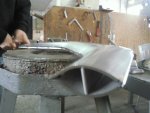
The exception is Ultra they have been Proof Tested (their hollow shank has a rib of stainless inside the hollow to impart there necessary strength). This a picture of the 'inside' of an Ultra shank.

Image 14.jpg

Note - I generalise - maybe some stainless anchors have been Proof Tested. do have Duplex shanks - but if so I would expect it to be a prominent part of marketing and not left 'unsaid'.

Tests for oil rig anchors do confirm that a smooth steel developed better hold than a rough steel, sand casting is not as good as fabricated anchors - whether this makes a noticeable difference at our scale - I don't know - but I doubt you can tell the difference.

At our sizes and say upto 50kg stainless anchors appear to be chosen for their bling factor - performance is secondary. At our scale an anchor is Proof tested and it is then assumed that all the other anchors of a similar size will be to the same quality. The bendy shank saga does illustrate some of the certification is based on trust.

If you demand a stainless anchor - make direct contact with the anchor maker - he (or she) will be more than happy to confirm what quality was used in the shank and whether the anchor is CS certificated.

Jonathan

Why not ask the owner if they bought it from a bent anchor salesman?

I do like a bit of light relief in anchor threads even better when it is a clever play on words - hopefully it reduces the fear factors normally engendered.

J
 
Last edited:
Top