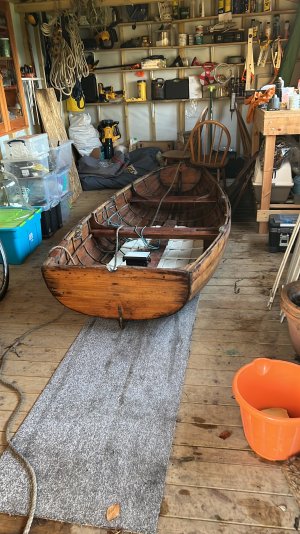
Workshop cradle for 8’ dinghy

DoubleEnder

Well-Known Member
Joined
27 Apr 2002
Messages
1,584
Location
N Hemisphere
Visit site
I’ve acquired a nice little pram dinghy, very lightly built in 5/16” clinker larch. It is in pretty good condition but there are a few repairs I’d like to do. I would like to build a sort of cradle, basically two vertical pieces of heavy plywood on a horizontal frame. The ply uprights need to have curves cut out to support the curved bottom of the boat. I don’t think it needs to be super accurate, but the closer the better. It will be padded with carpet.
The question: what’s the best way of transferring the actual curve of the boat to the ply? I need a massive profile gauge…..I plan to use cardboard templates but is there a better way?
 
Use 3mm ply cut into strips and a hot glue gun. You could make a rough sort of triangular shape the use pointed bits of the same ply that touch the hull and glued to the frame. Put it onto a large sheet of something and mark the points, then use a flexible batten to get a fair shape. You can then use this to create whatever frame you want. If you are lucky the each side will be a mirror of each other. This is a standard pattern making technique that use use for any boat restoration.
 
I would just get a piece of cardboard. Cut it to eye by your imagination. Such that it can be offered up to the up turned hull. Cut as needed or mark where you have cut too much. Successive approximation will get you to the accuracy you want. Then copy to ply wood for the support frame. ol'will
 
These maybe overkill, but. The weight of the boat should be on the hog and the rest is just to stabilise. Edge on plywood is too narrow, you need something wider to spread the load.
So cut your template sl too large then either fix a thin piece of plywood across the top to give a broader surface , or don't bother. Then plenty of padding, ensuring as above the the hog is taking the weight. If you don't bother with the second bit of plywood then a couple of layers of pipe lagging will help spread the load
 
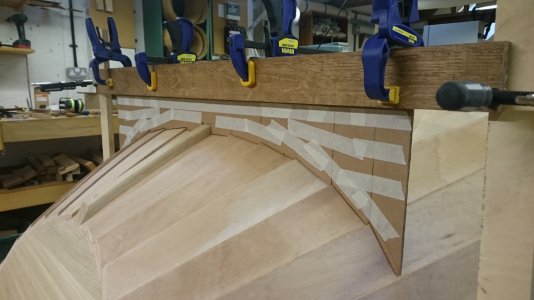
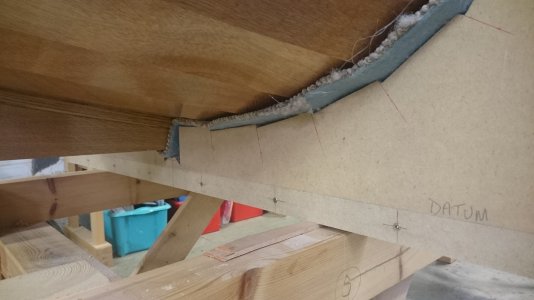
Cardboard templates.

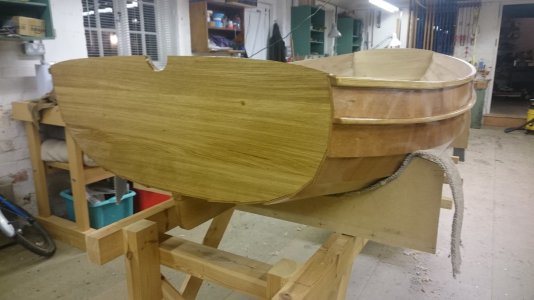
With the tender upside-down (still on all its building moulds in my case) I set up horizontal beams (at stations 1 and 5) then offered up and scribed vertical cardboard strips from the centre-line outwards. The cradles (repurposed MDF moulds) were then positioned back at their original stations.

I needed exact accuracy as, without any thwarts or knees or other stiffening internal parts yet, the hull was still very floppy and twisty. Your's should already be stiff, so you might be able to concoct simpler cradles at each end?

DSC_0270.JPG

DSC_0344.JPG

DSC_0347.JPG

DSC_0352.JPG
 
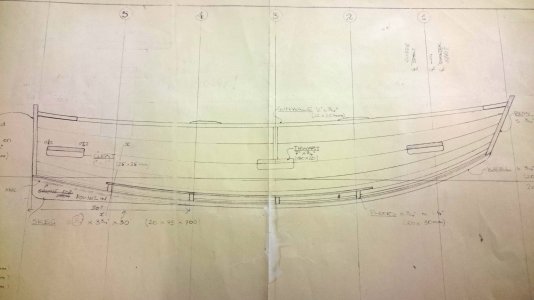
Great. Thank you. Good point about the keel/hog taking the weight. The boat is all framed out and has thwarts etc fitted. She is complete, so the shape is stable. But some hood ends have sprung a little, and a couple of the lodging knees need beefing up.

I’m thinking to use bronze gripfast nails to deal with the hood ends but maybe that’s a bit brutal. I should probably use screws. Original fastenings seem to be blind copper boat nails.

A lovely little boat about 75 years old, but a long time in storage
 

Attachments

  • 466DAC83-B0AF-43B9-AD3F-26E3DCCBCA99.jpeg
    466DAC83-B0AF-43B9-AD3F-26E3DCCBCA99.jpeg
    1.5 MB · Views: 15
A bit like Babylon's template device with cardboard or Hackers with thin ply and a glue gun. When I wanted to make a 'similar' template I used a fairly thick plank, slightly longer than the beam, drilled 10mm holes through it in a straight line and stuck 10mm dowel through the holes and then manipulated the dowels until they followed the curvature.

There is probably a name for my dowel device (you have called it a profile gauge), its used in cutting tiles (slightly different scale :) ).

'My' advantage is that you can use my device as often as you want, moving from bow to stern, scribing the results onto paper and then moving a further 15cm along the dinghy. The downside is that you need a lot of dowel.

An 'Office stationer' should have rolls of cheap paper for sale, used to print large plans, like those for a full sized dinghy :). You can scribe onto such and then convert to ply or MDF - use a thin sail batten as a French curve.


Lovely looking dinghy

Jonathan
 
...An 'Office stationer' should have rolls of cheap paper for sale, used to print large plans, like those for a full sized dinghy :). You can scribe onto such and then convert to ply or MDF - use a thin sail batten as a French curve.

Decorator's Lining Paper is cheap and easy to find.
 
Top