Wiring for Lifepo4

mattonthesea

Well-Known Member
Joined
28 Nov 2009
Messages
1,519
Location
Bristol
ayearatsea.co.uk
I know that good practice is to have each battery with an isolation switch to a bus bar with equal length leads. However, I was pondering the other day whether a parallel wiring set up needed to be the same as lead acid batteries. That is, taking me negative load from the opposite end of bank to the positive end. Would the different chemistry mean that this hypothetical situation would be irrelevant?
 
Each LifePO4 battery should have its own BMS, fuse and isolator. The positive should be the same length, as should the negatives, so the same current is drawn from each battery, keeping them in balance.
 
The concept of taking output from parallel batteries from opposite ends is in theory very good. It ensures that due to resistance in the cables loads on the batteries are equal. However with heavy cables even with say 500 amps of starter current the voltage drop in paralleling cables to the more remote battery must be extremely tiny.
I don't see any difference with lithium except as Paul says they need separate BMS but even then you will have wiring which can parallel the 2 battery systems. So the same theory applies to equalising cable lengths / current path from both batteries/BMS but again does it matter? ol'will
 
I've never heard of needing an isolator per battery. If you need to take an individual battery offline, just do it on the app. In all emergency, pull the fuse, although I'm not sure what kind of situation would require that.

It's not unusual to run lithium batteries of different capacities in parallel, so I really don't think it's a big deal to have slight differences in cable length. Unlike the crude lead acid installations of yesteryear, lithium batteries with their own individual BMSs are already somewhat isolated from many of the things that could harm them.
 
I've never heard of needing an isolator per battery. If you need to take an individual battery offline, just do it on the app. In all emergency, pull the fuse, although I'm not sure what kind of situation would require that.

It's not unusual to run lithium batteries of different capacities in parallel, so I really don't think it's a big deal to have slight differences in cable length. Unlike the crude lead acid installations of yesteryear, lithium batteries with their own individual BMSs are already somewhat isolated from many of the things that could harm them.
With different length cables the one with the shortest cable will supply more power. Due to the low resistance of Lithium that's likely to be worse than LA and the BMS cannot do anything about it. If fitting more than one battery it doesn't make any sense whatsoever to use different length cables, when it's just as easy to fit them the same length.

Same with isolator switches, for the sake of a few quid, why not have one for each battery. Who wants to be scrambling around amidst the batteries pulling fuses if something goes wrong ? As for relying on the app' what if it's the BMS that's the problem ?
 
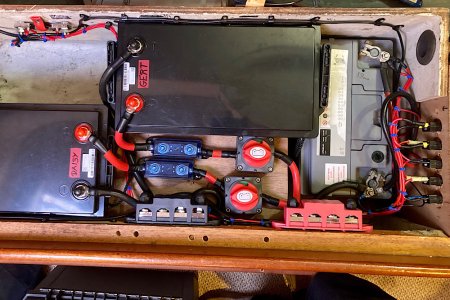
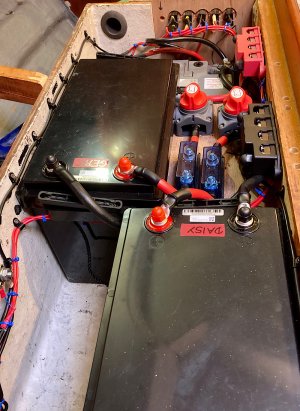
After much research and seeking advice here (thanks all, especially to Paul) I raised my knowledge and understanding of this subject from an extremely low point (I’m a woodworker) to a degree where I felt able to complete a “drop-in” lithium installation myself.
All I can say is, that by following that advice I now not only have a system that works beautifully (no comparison to the old LA) but one that I feel safe enough to allow me to sleep soundly on top of!
I’m also proud enough of my efforts to post a couple of pictures…
Btw, they are now firmly secured.
 

Attachments

  • IMG_4423.jpeg
    IMG_4423.jpeg
    314.7 KB · Views: 67
  • IMG_4420.jpeg
    IMG_4420.jpeg
    522.6 KB · Views: 66
With different length cables the one with the shortest cable will supply more power. Due to the low resistance of Lithium that's likely to be worse than LA and the BMS cannot do anything about it. If fitting more than one battery it doesn't make any sense whatsoever to use different length cables, when it's just as easy to fit them the same length.

Same with isolator switches, for the sake of a few quid, why not have one for each battery. Who wants to be scrambling around amidst the batteries pulling fuses if something goes wrong ? As for relying on the app' what if it's the BMS that's the problem ?
I'm struggling to think of under what circumstances you would want to isolate an individual battery, where the fuse wouldn't be sufficient to deal with whatever was going on? And the isolator would presumably be in very close proximity to the battery so if it was something truly catastrophe happening (dead short?) you're not going to want to be there.

Maybe it doesn't do any harm but it is adding extra components and connections, and a high quality, high amperage isolator is certainly not cheap.

It's entirely possible I've not thought this through and there are some scenarios I've not accounted for.

As for battery cable lengths... what are your thoughts on mixing different capacities of LFP battery? From the research I did it seemed that you could pair up batteries of wildly different sizes without any real problems. I'm using one 271Ah and one 280Ah pack, but I've heard of things like 100+300Ah systems which worked, apparently, just fine.
 
I'm struggling to think of under what circumstances you would want to isolate an individual battery, where the fuse wouldn't be sufficient to deal with whatever was going on? And the isolator would presumably be in very close proximity to the battery so if it was something truly catastrophe happening (dead short?) you're not going to want to be there.

Maybe it doesn't do any harm but it is adding extra components and connections, and a high quality, high amperage isolator is certainly not cheap.

It's entirely possible I've not thought this through and there are some scenarios I've not accounted for.

As for battery cable lengths... what are your thoughts on mixing different capacities of LFP battery? From the research I did it seemed that you could pair up batteries of wildly different sizes without any real problems. I'm using one 271Ah and one 280Ah pack, but I've heard of things like 100+300Ah systems which worked, apparently, just fine.
Wouldn't the fuse have already dealt with that? So no need to go near it at all. :unsure: Surely an isolator is for isolating when you want the battery "Off line" in a controlled fashion i.e. general maintenance or fault finding, No?
 
I'm struggling to think of under what circumstances you would want to isolate an individual battery, where the fuse wouldn't be sufficient to deal with whatever was going on? And the isolator would presumably be in very close proximity to the battery so if it was something truly catastrophe happening (dead short?) you're not going to want to be there.

Maybe it doesn't do any harm but it is adding extra components and connections, and a high quality, high amperage isolator is certainly not cheap.

It's entirely possible I've not thought this through and there are some scenarios I've not accounted for.

As for battery cable lengths... what are your thoughts on mixing different capacities of LFP battery? From the research I did it seemed that you could pair up batteries of wildly different sizes without any real problems. I'm using one 271Ah and one 280Ah pack, but I've heard of things like 100+300Ah systems which worked, apparently, just fine.
Following the above logic, why have any isolators ?

The isolators might not be far from the batteries, but it's rare to actually have them in the actual battery box.

The things you didn't think of are usually the ones that cause issues. Doesn't have to be a dead short, or something catastrophic, you may just want to take a pack out because a cell has an issue or the BMS has a fault. Turn the isolator off and everything related to that pack id dead. A single isolator means you have to turn everything off and when you turn it back on the wiring that went to that pack is still live. If you're out there in a rough sea, that's not what you want to deal with when you could just turn a switch off.

The switch doesn't need to be a particularly high amperage one (most BMS are only rated at 200A or less), with a few newer JK ones being 300A. A 250A Durite isolator, for instance, is only £21. If you parallel 2 batteries you double the potential current trough the isolator switch, so you need an even higher amperage isolator, a 400A Durite is over £50 so the cost argument is backwards.

** Just using Durite as an example, other makes are available, just don't fit cheap crap.
 
Last edited:
I cannot why it woild be necessary to include a battery isolator for each battery in a bank but one of these could be used

OIP.EkYaG5DQmNJ_CeCJb7o04wHaHa


If you wish to have a switch with removable key one of these could be used as I used on my outboard speed boat

OIP.uX9NicNZj0Aadx67LAaM5QHaHa


Or simply a battery terminal with a screw post and wing nut
 
I cannot why it woild be necessary to include a battery isolator for each battery in a bank but one of these could be used

OIP.EkYaG5DQmNJ_CeCJb7o04wHaHa


If you wish to have a switch with removable key one of these could be used as I used on my outboard speed boat

OIP.uX9NicNZj0Aadx67LAaM5QHaHa


Or simply a battery terminal with a screw post and wing nut
You can't see why an isolator would be fitted, but you show some options to disconnect a battery
where you need to be in contact with the battery, apart from the switch you show, despite not seeing the point of a switch.

How bizarre !
 
After much research and seeking advice here (thanks all, especially to Paul) I raised my knowledge and understanding of this subject from an extremely low point (I’m a woodworker) to a degree where I felt able to complete a “drop-in” lithium installation myself.
All I can say is, that by following that advice I now not only have a system that works beautifully (no comparison to the old LA) but one that I feel safe enough to allow me to sleep soundly on top of!
I’m also proud enough of my efforts to post a couple of pictures…
Btw, they are now firmly secured.
Unless i'm mistaken, those are ANL or Mega fuses, which should not be used with LifePO4
 
I've never heard of needing an isolator per battery. If you need to take an individual battery offline, just do it on the app.
just remember not ALL BMSes feature transistors! mine doesn't, needs a BlueSea 500A relay to disconnect the lifepo4 bank...
 
Last edited:
I'm struggling to think of under what circumstances you would want to isolate an individual battery, where the fuse wouldn't be sufficient to deal with whatever was going on? And the isolator would presumably be in very close proximity to the battery so if it was something truly catastrophe happening (dead short?) you're not going to want to be there.

Maybe it doesn't do any harm but it is adding extra components and connections, and a high quality, high amperage isolator is certainly not cheap.

It's entirely possible I've not thought this through and there are some scenarios I've not accounted for.

As for battery cable lengths... what are your thoughts on mixing different capacities of LFP battery? From the research I did it seemed that you could pair up batteries of wildly different sizes without any real problems. I'm using one 271Ah and one 280Ah pack, but I've heard of things like 100+300Ah systems which worked, apparently, just fine.
I install isolators on each battery. If you want to do maintenance on a battery, isolation is essential. The cost of an isolator is tiny in the scale of boat ownership.
 
Top