Wiring colours

lustyd

Well-Known Member
Joined
27 Jul 2010
Messages
14,922
Visit site
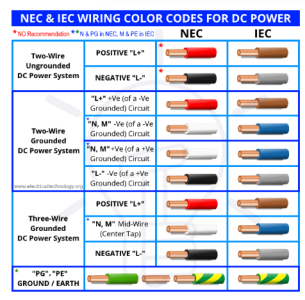
Just saw a post on Facebook suggesting brown/grey/blue are correct wire colours for DC. I assumed it was some US nonsense or AI but a bit of Google later and apparently those are the proper colours. I’ve never seen them used other than blue for the lights on our boat.
Can any wise electrical soul add some context or clarification? As far as the Internet is concerned red and black isn’t a thing and I feel like I’ve slipped into another dimension
 
That's the nice thing about "standards" - they all vary 😂

1770986413805.png


NEC and EIC use different interpretations, automotive (and vessels) pretty much follow NEC. ABYC has some different colours because of the American AC system coulours, so there's another variant for you.


As someone else said, equipment manufacturers have different variations again, I know of one engine manufacturer who uses different colours in the extension harness than the panel and engine harness.

I like the idea of the 3 wire NEC colour code, where red is direct live (fused or direct to battery), and white is switched live. But i'm too cheap to buy different colour individual cable so all mine is red and black for twin wire DC and red, yellow & black for 3-wire DC. I label my wires at each end and have catalogued and created a wiring diagram showing the cable routing for each wire on board.
 
I've been in and around electronics for more than 50 years. Almost universally red is DC + and black DC 0v or negative. All other colours to your taste.

Cable FAQs - 12 Volt Planet Knowledge Centre
Indeed, however on an ROV where a single connector might have 3 separate DC voltages, the colour of the conductor will be 'bespoke' to its function to avoid confusion. Helpfully though, on almost all of the ROV's there will be numbers at each end of the conductor to help. (y)
 
Indeed, however on an ROV where a single connector might have 3 separate DC voltages, the colour of the conductor will be 'bespoke' to its function to avoid confusion. Helpfully though, on almost all of the ROV's there will be numbers at each end of the conductor to help. (y)
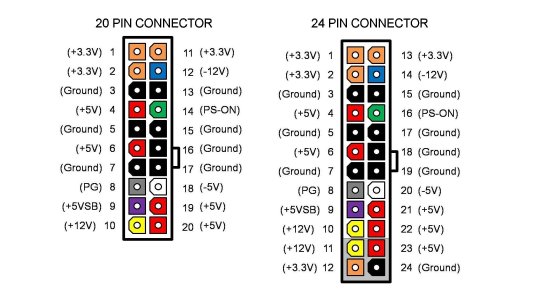
Yep, like computer PSUs ..

cpu_power_supply_color_coding-621UHo.jpeg
 
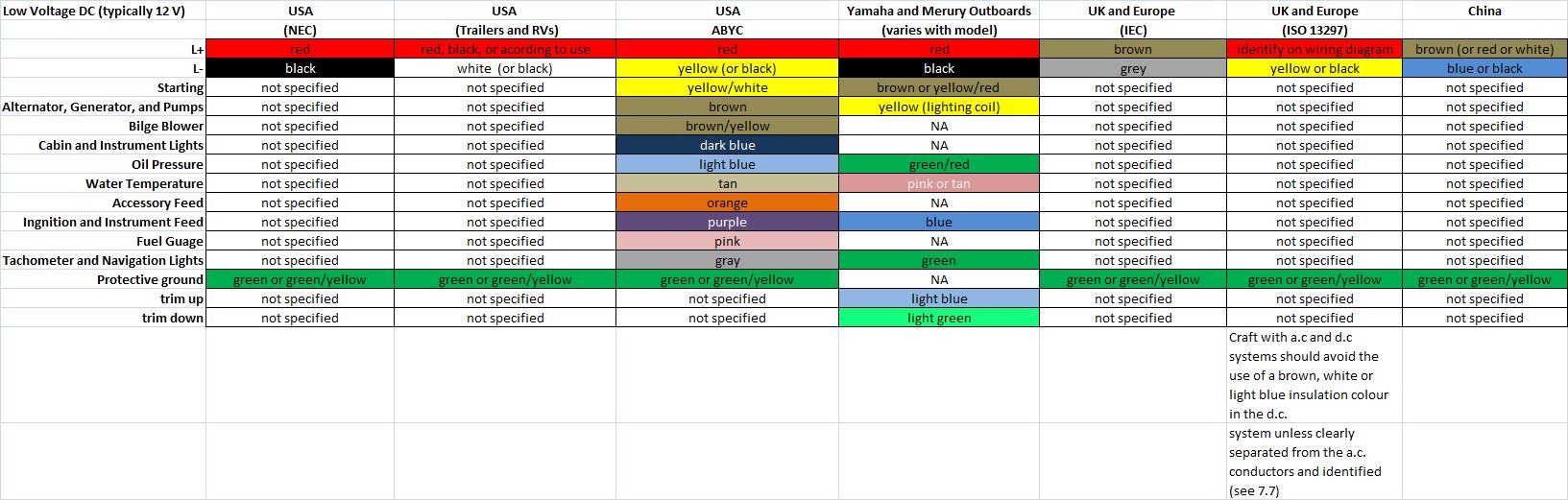
This is what I have found. It's crazy when components are mixed from many countries, and also that stuff from china can carry any mix, depending on the intended market. Don't expect the device to come with an explanation!

I think the funniest is that the US code for automobiles and trailers (caravans) is different, even when both are 12V and connected! Accessories can use either code. (The reason is to avoid confusion with the US 120V AC, where black is hot. Same reason ABYC does not recommend black for the 12V negative, though it is allowed.)

Yup, I was confused the first time I bought a bilge pump from China (no instructions, 3 wires, brown, blue, and yellowish).

(I'm sure there are variations.)
4b.%20master%20DC.jpg
 
At the risk of drifting the thread a little, a now-deceased family member of my wife used to do 230 volt electrical wiring alterations and additions. He had no certification or training (which maybe wouldn't bother some people) but he was completely colour blind too. So all these standards would have been a piece of cake for him to understand.
 
The ISO, which has to be complied with for the RCD (new boats) states the following:

All DC negative conductors shall be identified by black or yellow insulation. If the craft is equipped
with an AC electrical system which use black insulation for live conductors, yellow insulation shall be
used for DC negative conductors of the DC system. Black or yellow insulation shall not be used for DC
positive conductors.

Craft with AC and DC systems shall avoid the use of brown, white or light blue insulation colour in the
DC system, unless clearly separated from the AC conductors and identified as DC.
 
At the risk of drifting the thread a little, a now-deceased family member of my wife used to do 230 volt electrical wiring alterations and additions. He had no certification or training (which maybe wouldn't bother some people) but he was completely colour blind too. So all these standards would have been a piece of cake for him to understand.
Without being too morbid, did he die in a house fire by any chance?
 
I expect we all follow the wiring diagrams religiously in the instructions.

I have to admit that sometimes I don’t always know the "why" and try and find the reason for a particular wire's function. Particularly wires that are unsheathed like drain wires.
 
Top