Winterizing with summer didsel in tank

In the UK we don’t have summer and winter diesel, just diesel. We used to have diesel with a percentage of paraffin to thin the diesel to stop it waxing in very cold conditions, but these days additives have need. What is sensible is to brim with diesel, and use a decent biocide. I use Marine 16. This will work to reduce the chance of diesel bug.
As others have said, have a word with other diesel boat owners to see what they recommend?
Wrong, diesel suppliers provide summer and winter diesel often without you knowing and around October (or September if it is unseasonally cold) and they supply it to forecourts with the winter coagulating additives already blended, for many other uses such as farming where they stock on fuel for the end of summer August/September harvesting suppliers often come with a simple test kit to test the remaining diesel amd manually add the additives before adding the winter diesel. Local farm just had a delivery Friday and they had a surplus of diesel and the remaining diesel was tested and additives added.
 
So you are saying , should summer diesel clogg during winter storage its a non issue firing the boat up at spring at pleasant temps ? Every system on my boat is carefully freeze protected but i do not heat the boat in winter storage .
The issue is winter temperatures as a mild UK winter may not drop to -5 while a harsh winter may drop to -20 and at =5 summer diesel will be fine but at -20 it won't but there are other factors such as tank material as older steel tanks are often colder than ambient with cold winds blowing on them and at -20 they can be as cold as -25 while plastic fuel tanks have an insulating property and at -20 inside the tank may only me -15. In automotive applications the engines are oversupplied with diesel and smme bleeds off back to the fuel filter and as it passes through the pump and to the injector it collects engine heat, surplus from the fuel filter goes to a return line and back to tank so the tank receives warmer diesel which helps warm the tank fuel
 
Wrong, diesel suppliers provide summer and winter diesel often without you knowing and around October (or September if it is unseasonally cold) and they supply it to forecourts with the winter coagulating additives already blended, for many other uses such as farming where they stock on fuel for the end of summer August/September harvesting suppliers often come with a simple test kit to test the remaining diesel amd manually add the additives before adding the winter diesel. Local farm just had a delivery Friday and they had a surplus of diesel and the remaining diesel was tested and additives added.
Are you sure? With dieselgate and the consequent increase in testing, I have never come across any research on the impact of summer or winter fuels?
 
Are you sure? With dieselgate and the consequent increase in testing, I have never come across any research on the impact of summer or winter fuels?

Are you seriously asking ??

Are you aware that huge research / evolution and production of CFPP + Cloud Pt additives to counter this very matter ?

You are consumer will only be aware of it - IF you read the label on the fuel delivery pump casing in the Petrol Station. It is usual for the pump casing to have a small paper label fixed on it somewhere when the change from Summer to Winter grade occurs .. this label will say what the fuel is designed for .. it will state the TESTED CFPP value.

Standard Test Method for Cold Filter Plugging Point of Diesel and Heating Fuels

is the test method used when ASTM ..

IP 309: Diesel and domestic heating fuels - Determination of cold filter plugging point copy

is the IP test method

GOST R 54269 - Techno lab.

is the Russian GOST test method ...

Still think its not worth it ? That no research ?

For my own part .. I have conducted via my own companies injection of CFPP and Cloud Pt additives for over 30years ....
 
Are you seriously asking ??

Are you aware that huge research / evolution and production of CFPP + Cloud Pt additives to counter this very matter ?

You are consumer will only be aware of it - IF you read the label on the fuel delivery pump casing in the Petrol Station. It is usual for the pump casing to have a small paper label fixed on it somewhere when the change from Summer to Winter grade occurs .. this label will say what the fuel is designed for .. it will state the TESTED CFPP value.

Standard Test Method for Cold Filter Plugging Point of Diesel and Heating Fuels

is the test method used when ASTM ..

IP 309: Diesel and domestic heating fuels - Determination of cold filter plugging point copy

is the IP test method

GOST R 54269 - Techno lab.

is the Russian GOST test method ...

Still think its not worth it ? That no research ?

For my own part .. I have conducted via my own companies injection of CFPP and Cloud Pt additives for over 30years ....
I work on the other end of the process, vehicle engineering, verification and homologation. Plenty of research, development and money spent on optimising efficiency and real world performance. Nowhere have I come across different specs of fuel, other than reference fuel for the Approved performance.
 
I work on the other end of the process, vehicle engineering, verification and homologation. Plenty of research, development and money spent on optimising efficiency and real world performance. Nowhere have I come across different specs of fuel, other than reference fuel for the Approved performance.

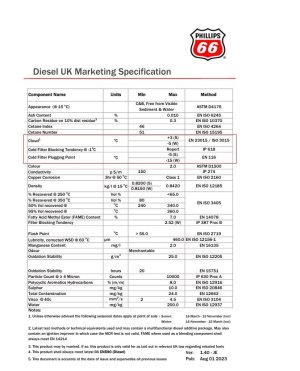
Check out BS-EN 590 .... here's an example from P66 .... see the red box in particular .. where it says S and next line W ... that's Summer and Winter.

Example UK Diesel EN590.jpg

OK now ??

You can search for Shell ... Esso .... BP .... whatever brand you like and find same specs.
 
steel tanks are often colder than ambient with cold winds blowing on them and at -20 they can be as cold as -25
Are you sure, I'm sure wind chill only affects things with their own internal temperature control, a steel tank would just get the fuel to -20 quicker than a plastic tank.
They would both still get to -20.
 
Are you sure, I'm sure wind chill only affects things with their own internal temperature control, a steel tank would just get the fuel to -20 quicker than a plastic tank.
They would both still get to -20.
Exactly this, it's why we blow on hot food to cool it down but cold things to warm them up. A cold wind can make something cold, but it can't make it colder than the air actually is.
 
And sticking with the topic, I thought the big problem with winterising with diesel in the tanks these days was the bio content 'going off' and causing problems with blockages. Seem to recall an MBY article about it.

I recall it saying that modern diesel has a shelf life of less than six months, which, when you include how long it may have sat in the suppliers tank (especially if non commercial like a marina, where they probably turn over very little in winter) plus how long it sits in your tank through the winter, is now an issue.

I have always brimmed my tank before winterising as the advice was always to have as little air in the tank as possible, but with bio content in the diesel, that may now be poor practice.
 
I have always brimmed my tank before winterising as the advice was always to have as little air in the tank as possible, but with bio content in the diesel, that may now be poor practice.
Bear in mind the biodiesel has been in the diesel in the UK since as early as 2004 but was not really common until 2008 (according to the internet).
I don't think you do any harm at all by brimming your tanks but I haven't done so and had no fuel issues.
You do have the advantage of having forgotten about the cost of the still full fuel tanks by the time spring arrives.
 
And sticking with the topic, I thought the big problem with winterising with diesel in the tanks these days was the bio content 'going off' and causing problems with blockages. Seem to recall an MBY article about it.

I recall it saying that modern diesel has a shelf life of less than six months, which, when you include how long it may have sat in the suppliers tank (especially if non commercial like a marina, where they probably turn over very little in winter) plus how long it sits in your tank through the winter, is now an issue.

I have always brimmed my tank before winterising as the advice was always to have as little air in the tank as possible, but with bio content in the diesel, that may now be poor practice.

To put it simply and I do not mean to be rude to you sir .... but Hogwash.

Life of diesel is longer than most any of you need worry about ....

I am fully aware of various such as BP info etc ... they are all WORST CASE scenarios.

Fill tank of not ... makes little difference overall.
 
Bear in mind the biodiesel has been in the diesel in the UK since as early as 2004 but was not really common until 2008 (according to the internet).
I don't think you do any harm at all by brimming your tanks but I haven't done so and had no fuel issues.
You do have the advantage of having forgotten about the cost of the still full fuel tanks by the time spring arrives.

Publicly ..... it actually goes back earlier than that ...

In the early days small % was added .. up to 5% and was not required to be declared.
 
To put it simply and I do not mean to be rude to you sir .... but Hogwash.

Life of diesel is longer than most any of you need worry about ....

I am fully aware of various such as BP info etc ... they are all WORST CASE scenarios.

Fill tank of not ... makes little difference overall.
When i bought my current boat it came with full tanks, 1500 litres. The boat had been sitting there unused for 2 years, i guess some of that fuel had been in the tanks for longer. I spent half of the first season of ownership happily burning the free diesel :)
 
To put it simply and I do not mean to be rude to you sir .... but Hogwash.

Life of diesel is longer than most any of you need worry about ....

I am fully aware of various such as BP info etc ... they are all WORST CASE scenarios.

Fill tank of not ... makes little difference overall.
But rather than simply offering some polite and informed information, you thought you would be anyway. Oh well, welcome to the Internet I guess...
 
I have always brimmed my tank before winterising as the advice was always to have as little air in the tank as possible, but with bio content in the diesel, that may now be poor practice.

Fill tank of not ... makes little difference overall

At the refineries I used to work at - The storage tanks every morning - the condensation water was bled off as some of the tanks weren't full - This is why some folk fill the tanks up - more fuel = less condensation building up on the inside of the tank running down into the fuel.
 
At the refineries I used to work at - The storage tanks every morning - the condensation water was bled off as some of the tanks weren't full - This is why some folk fill the tanks up - more fuel = less condensation building up on the inside of the tank running down into the fuel.
OK ... having been there in many refineries / transit terminals doing exactly that - draining off water .. I can say honestly - that most of the water is actually dropping out of the product.

Crude and other similar - water is often used to assist in getting higher pipeline flow rates. Example : Syrian Pipeline Co. would then spend at least 4 - 5 days draining off frre and suspended water before loading out to ships. (Yes I know Syria is a bit different now - but its a good example).
Middle distilates such as Diesel - come of the crackers at elevated temps ... which causes them in the run-down tanks to take up moisture ... as the run-down tanks fill - product is transferred to transit holding tanks ... this in itself creates further moisture related issues ...
In the transit holding tanks - the sheer volume of product and the suspended water content can be significant and I suggest is what you refer to.

Condensation is a problem in some locations where daytime vs nightime temps vary significantly and of course variable humidity ... but the amount of condensation is far less than the suspended water caused in the processing of the product.

I do not say you are wrong ... just attirbuting too much to it.

I have personally supervised tankage in Brazil ... Singapore .. Saudi Arabia .... India .... EU ... UK .... USA .... East and West Africa and many other locations as eaxmple in my company business.
 
I can say honestly - that most of the water is actually dropping out of the product.
Yes you are correct - as it is measured in the sea bed how much water is in the oil and how much oil is in the water especially when trying to extract the last remaining crude in that particular area.
Having the joys of entering Cargo oil tanks and fpso's the corrosion levels are generally a lot less on the walls as to what I have seen in the storage tanks on refineries including the product ready for distribution to the petrol stations
 
Top