Winterising engines - basically cooling systems

Toilets and other - get either Winter Screen wash (we have -30C screen wash here) or Anti Freeze thrown in and pumped through.

The water tank is going to be pumped out .... Superanne - I rarely bother to empty as its never full and a stainless steel job. Pipes despite lack of attention have never had problem with this .. its a bit difficult now anyway as GRP guy has had to have sink and surrounding furniture dismantled - so not possible to use the sink faucet ... only way would be to suck out via deck filler ....

Anisette - thats via faucet or deck filler ....
 
I had a raw water cooled engine for 25 years. All I did was drain it. If you are based in sea water then it won’t freeze unless temperature gets ridiculous.
It looks like a good engine so it may be worth flushing with redlyme and then antifreeze if you want.
Doesn’t need to be ridiculously cold to freeze sea water. Around -1.8C for typical salt water.
 
OK ... I have the manual for this Yanmar 2GM ......

Nowhere in it does it mention a Thermostat... nothing in diagram and parts names .... nothing in the Winterisation advice .... nowhere ...
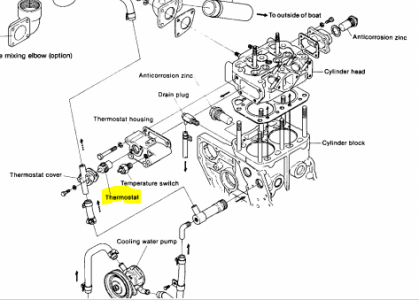
I think you will find it in the fitting halfway up the hose run from the pump to the exhaust. When the engine is cold all the seawater goes to the exhaust injection point and when the water in the engine reaches operating temperature the thermostat opens and water flows through the engine first.

As I suggested take all the pipework off and the housing the 2 pipes are connected to and clean them. As you don't know when this was last done worth checking. My experience of seawater cooled Yanmars is that deposits build up although in our warmer more saline environment plus longer sailing season it is probably worse than where you are.

BTW that installation looks really neat. Good have a space to take a 35hp engine and only fitting an 18! Good thing the boat sails so well as it must be a bit tedious motoring with so little power.
 
OK ... I have the manual for this Yanmar 2GM ......

Nowhere in it does it mention a Thermostat... nothing in diagram and parts names .... nothing in the Winterisation advice .... nowhere ...

I am pretty sure it has one of the double acting type, opens engine side and closes off bypass.

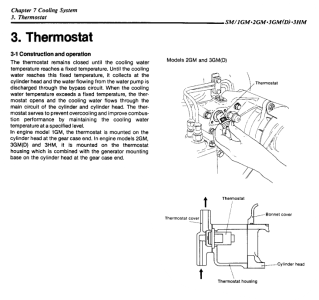
You need the service manual. That shows the thermostat and also tells you that it should start to open at 42 ± 2C and be fully open at 52 ± 2 C

Vyv is correct about it being a double acting type. Leaving it out could lead to overheating because the bypass will not be closed off.

Note which way the thermostat cover is fitted. I believe it is marked with an arrow.

1696596049093.png
 
The Perkins is easy - as there is no thermostat .... its out to make sure engine does not run higher temp where salts are deposited in system. Perkins actually make a strong statement about this in the Workshop Manual.

With the Yanmar being raw cooled - I may do the same .... that's if one is in there ...
Deleted
 
I think you will find it in the fitting halfway up the hose run from the pump to the exhaust. When the engine is cold all the seawater goes to the exhaust injection point and when the water in the engine reaches operating temperature the thermostat opens and water flows through the engine first.

As I suggested take all the pipework off and the housing the 2 pipes are connected to and clean them. As you don't know when this was last done worth checking. My experience of seawater cooled Yanmars is that deposits build up although in our warmer more saline environment plus longer sailing season it is probably worse than where you are.

BTW that installation looks really neat. Good have a space to take a 35hp engine and only fitting an 18! Good thing the boat sails so well as it must be a bit tedious motoring with so little power.

The engine was rebuilt just over a year ago - so I expect its pretty 'c;lean inside' pipes.
 
Thanks guys ... all that came with the boat - was the Owners Manual ...

Seems a bit strange to have a manual describing installation and how to align shaft etc. - with parts diagrams as well etc ... but no thermostat mentioned at all !!
 

Attachments

Interesting ... thanks to above - searched and found the Service Manual ....

It also lists the lay up as drain via cocks ... with no mention of thermostat ....

But then p65 - it talks about filling engine via thermostat opening with Anti-freeze.... not running engine to do it - but physically filling the engine ...
 
Interesting ... thanks to above - searched and found the Service Manual ....

It also lists the lay up as drain via cocks ... with no mention of thermostat ....

But then p65 - it talks about filling engine via thermostat opening with Anti-freeze.... not running engine to do it - but physically filling the engine ...
You would have to remove the housing to do that as when it is cold the thermostat blocks the outlet. The worst point for sediment build up is the inlet spigot shown at bottom right of the diagram in post#27 as this is the lowest point of the water jacket - lower than the drain on the other side of the block. Thought the engine looked nice for its age.
 
You would have to remove the housing to do that as when it is cold the thermostat blocks the outlet. The worst point for sediment build up is the inlet spigot shown at bottom right of the diagram in post#27 as this is the lowest point of the water jacket - lower than the drain on the other side of the block. Thought the engine looked nice for its age.

Yes - thermostat to be removed in the info.
 
OK ... further reading .... unlike my Perkins 4 series - Yanmar specifically warn against running without thermostat .... mmmm interesting.

Perkins 4 series being older - were at one time using the seacock as a temperature control .... saying to close it in to reduce seawater flow ... but to take care not to run engine at temperature liable to start depositing salts ....
Use of 'temp sticks' was discussed .... wax based sticks that melt at set temps.

Anyway - thats digressing ....

Looks like my Yanmar will keep its thermostat .. after winterising.
 
When I had a direct-cooled engine I flushed it with fresh water by putting a hose-filled bucket in the cockpit and drawing from that. Run it long enough to attain full temperature, thermostat open, then drain down. Remove impeller. Engine is hot so any remaining water evaporates off. You could put antifreeze in the bucket but I never did.
I did this but finished up with antifreeze to lay in the exhaust pipe silencer. I preferred to make sure engine was hot first using water drained from the shower etc into a tub then pour in antifreeze for the last gasp . I do not like salt deposits sitting in any part over winter esp the silencer box which cannot be drained unless dismantled
 
Many years ago I acquired a second hand raw water cooled 2gm20 and fitted it to my last boat. After using it for a year I thought the engine was running cool, so I removed the thermostat cover and found no thermostat was fitted. Not surprised as there were other parts robbed from the engine. So the engine can run without the thermostat without overheating. I did buy a good used one as the price of a new one was scary. Once fitted the engine ran noticeably warmer.
 
Many years ago I acquired a second hand raw water cooled 2gm20 and fitted it to my last boat. After using it for a year I thought the engine was running cool, so I removed the thermostat cover and found no thermostat was fitted. Not surprised as there were other parts robbed from the engine. So the engine can run without the thermostat without overheating. I did buy a good used one as the price of a new one was scary. Once fitted the engine ran noticeably warmer.

Tls for that ...

The Service manual says DAMAGE can occur running without thermostat ...... How ??
Surely the engine just runs cooler for longer ???

I appreciate that combustion may not be optimised being cooler ..... but I am willing to accept that for reduction of salts deposit ...
 
Top