Winterisation questions

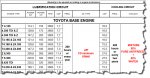
Changing at least every year is specified in the manual for your TAMD61s

View attachment 143950
Being fair…I think it states every 2 years these days…but definitely not required, I’d argue. But I’ll take that hit on the chin there. Fair play. Nice money maker for the OEM doing so, I’d suspect. At nearly £400 a go for such a thing ! I’ve been doing it every 5 years (or sooner with the need for a turbo or two !)
 
I last had my impellor out about 15yrs ago ....... in fact that was the last time I even had the face plate off ....
Oh.

You must have saved a fortune compared to me!

I feel like I am just being let into a secret everyone else knows and I have been left out!
 
I'm using a refractometer too - for this and other checks. Works great but says nothing about anti-corrosion and other properties - just the temperature aspect. At the end of the season, it still reads the boat coolant to -36C

The nominal capacity is 16 litres per engine but I'm draining & filling a total of some 20 litres 50:50 diluted so 10 litres of concentrate, every year. My local pusher offers a 12-liter can of long-life (5 yr) anti-freeze that exceeds the requirements at £30 (normal life version is £33!). Price as of today ?

I see no reason to buy engine-name rebranded anti-freeze or lube when the manual simply states
nannicool.jpg
 
Last edited:
Oh.

You must have saved a fortune compared to me!

I feel like I am just being let into a secret everyone else knows and I have been left out!

My Perkins 4-99 ..... never changed impeller in that in the 6 years I had it.
Replacement 4-107 with raw water cooling ... like I say ... over 15yrs and still pumping like a good un ...

icNPBnlm.jpg
 
For those tempted to leave that impeller for another season...
Impeller £50 ? every 2 years.
Serious possibly terminal damage to engine along with lift out and loss of boating time.
Saving grand total of 48p a week, slightly less on leap years.
Suspected there was something strange about people who go sailing, this surely confirms it ?
 
Changing the coolant every year is verging on ridiculous surely. Simply not required, nor called for by the manual.
Better than leaving it too long and then finding lots of crud that is reluctant to clean up.

For those tempted to leave that impeller for another season...
Impeller £50 ? every 2 years.
Also avoid the cheap impellers which I have tried and found them to be to be short lived . Therefore the more nsive impellers better value overall. I have known people say Volvo Penta genuine impellers last several years , for example . But even if an impeller is found to be long lived I would have thought annual removal of any impeller for inspection a good idea .
 
For those tempted to leave that impeller for another season...
Impeller £50 ? every 2 years.
Serious possibly terminal damage to engine along with lift out and loss of boating time.
Saving grand total of 48p a week, slightly less on leap years.
Suspected there was something strange about people who go sailing, this surely confirms it ?
As with most equipment, inspection is the key. I remove my impeller each winter and examine it carefully before replacing it, deflecting each vane to show up any cracks. I know it is good when it goes back, unlike new ones that may fail in the first few hours.
 
All of the above BUT keep your anti freeze containers and drain into them next Spring - the first year that I did it, I just poured perfectly good anti-freeze down the drain!!!

I now keep it, check that it’s still viable and then use it the following year…
How does one check if anti-freeze is still viable?
 
I use a thing that I bought from Lidls sometime ago - I always knew that it would be useful one day…
Thanks. I think you've jogged my memory...
I have vague recollections of a pipette with four small coloured balls, and if a certain number of them floated in the water/anti-freeze mix you had protection down to "x degrees". Jolly clever...
Here's a bigger version:
 
The most common problem with re-using last year's AF is that it has been diluted with the water left in the lines (even after draining). if it is less than 23% glycol or alcohol it will ferment and get foul. In potable systems this means bad tastes. In other systems it means low pH and corrosion. If it is still fresh smelling, I would boast it up to about 25% with concentrate before storing.

Engine coolant is more complex (corrosion inhibitors and salt contamination) and is beyond simple testing.
 
Thanks. I think you've jogged my memory...R
I have vague recollections of a pipette with four small coloured balls, and if a certain number of them floated in the water/anti-freeze mix you had protection down to "x degrees". Jolly clever...
Here's a bigger version:

It will only read EG or PG or battery acid or alcohol (windshied deicer and cheap AF). A refractometer reads all four. It is not interfered with by oil or dirt. Easier to clean. That's clever. Refractometer $20.

This became the preferred method in about 1980. Floating balls are 40 years out of date. Let the past go.
61fnA+JSp8L._SL1001_.jpg


61n+298fkOL._SL1001_.jpg
 
I take out the impeller for winter, which drains the lines. I put it back in spring. I have been using the same impeller for years
i have a yanmar 3ym30. it has a raw water drain plug between the raw water pump and the heat exchanger.
are you saying that disconnecting the hose leading from the impeller up to the heat exchanger will drain all the water from the heat exchanger ?
of course it would be much better to have no sea water residue in it but this is your method to avoid ice damage?
 
i have a yanmar 3ym30. it has a raw water drain plug between the raw water pump and the heat exchanger.
are you saying that disconnecting the hose leading from the impeller up to the heat exchanger will drain all the water from the heat exchanger ?
of course it would be much better to have no sea water residue in it but this is your method to avoid ice damage?
With the 3GM the heat exchanger is the high point in the raw water system. The impeller is effectively a non return valve, so there will be a column of water from it up into the heat exchanger. Removing the impeller empties this water and allows any remaining to fall into the trap. Ice is not a problem for me in Greece but I would far prefer to leave the whole system empty.
 
Top