Winter anchor chain care

I have some new chain in storage and put a quarter pint of well thinned Waxoil in with it, moving the chain well to spread it around. It dries and when you get around to using it is ok to handle, just a bit tacky.
Does galvanised chain stored dry not usually last indefinitiely anyway?
 
Does galvanised chain stored dry not usually last indefinitiely anyway?

Dunno, probably and I have doubts about it's usefulness anyway. However my garden shed is not the best and suspect much modern chain to be so poor it needs all the help it can get.

Speaking of which, if the OP end for ends his chain every few years he will certainly get more life out of it.

.
 
He's an idea. You know those little plastic chain markers? Couldn't somebody make those from zinc, so you add anodes to your chain?
I realise that they'd fall out once they began to wear, but if they were cheap enough it might be worth it.
I'd be interested to see how this would work in protecting adjacent links.
 
He's an idea. You know those little plastic chain markers? Couldn't somebody make those from zinc, so you add anodes to your chain?
I realise that they'd fall out once they began to wear, but if they were cheap enough it might be worth it.
I'd be interested to see how this would work in protecting adjacent links.
Current does not pass efficiently through chain due to poor contact link to link. Protection by a remote anode is never going to be very effective.

Also, there would need to be larger numbers of them than would be used as length markers. Anodes do not 'throw' very effectively. The rule of thumb for pipelines is an anode every 5 diameters.
 
Current does not pass efficiently through chain due to poor contact link to link. Protection by a remote anode is never going to be very effective.

Also, there would need to be larger numbers of them than would be used as length markers. Anodes do not 'throw' very effectively. The rule of thumb for pipelines is an anode every 5 diameters.
So you'd need one every link, more or less?
And most of the zinc would go to waste because the thing would fall out before much of it had been eaten away.
 
OCD much?

Rinse off the salt and ventilate the chain locker so that it dries. A galvanized fence can last ... longer than I've been alive and certainly longer than the 3-8 life expectancy of a chain in use. The real beasts are salt and rubbing on sand.

I doubt any of this fancy dancing equates to meaningful life extension, compared to the value of time at minimum wage. Feel-good maybe.
 
I've read somewhere that good quality galvanising can last 80 years in normal conditions. Obviously salt spray or immersion in seawater are far worse.

A friend recently switched to stainless chain. He's on his second circumnavigation and is fed up replacing chain every few years. He wouldn't tell me how much it cost.
 
????? You serious ?

My chain is same as came with the boat near 25yrs ago ... and it was already many moons old then ..
It obviously depends on how much you use it.
Ours is in use almost continuously. We live in the boat, and we are always at anchor unless we're underway.
In our usage chains start to look very tired after three years. Five is likely an upper limit.
 
????? You serious ?

My chain is same as came with the boat near 25yrs ago ... and it was already many moons old then ..
Life expectancy depends strongly on the type of use. Sand and coral are very different from soft mud. See Sea Change--he's only getting a few years before he grinds the galv off. My expereince has been in the middle, with some sand and gravel an a life of 10 years or so. I would also offer that if the difference for occasional anchorers in soft mud, between very careful treatment in the winter and just a good rinse is 25 years vs. 30 years, then the savings over 30 years ($3-7 per year depending on the size and length) doesn't justify me pulling out the chain and fussing with it. I feel the same about people that remove halyards and such. I own the boat, the boat does not own me.

Stainless does not have a much longer safe life in regular use than galvanized. The problem is stress corrosion in salt. If the world cruiser is using is daily he is going to be looking at a considerable risk of cracking at 5 years. There are a lot of links in a chain and only one needs a crack. A known problem with stainless anchor shackles.
 
OCD much?

Rinse off the salt and ventilate the chain locker so that it dries. A galvanized fence can last ... longer than I've been alive and certainly longer than the 3-8 life expectancy of a chain in use. The real beasts are salt and rubbing on sand.

I doubt any of this fancy dancing equates to meaningful life extension, compared to the value of time at minimum wage. Feel-good maybe.
I have yet to see a chain locker that remains dry all winter, even with a tent over it the deck drains into it. Hanging my chain on the cradle takes me no more than 10 - 15 minutes, well worth the effort.

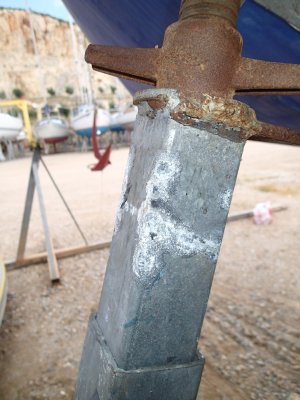
A few years ago I noticed this corrosion of the galvanised leg of my cradle where the rope holding my chain was tied all winter, The effect of almost permanent wetness on the zinc is very clear. This is exactly what happens to chain left in the locker.

1758894105331.jpeg
 
Every boat is different.

Rope is different from chain; it holds moisture. apples vs. hand grenades.

Also curious, the galvinized fence around my house is 55 years old. Some of the posts are bad, but the top pipe and wire are fine. I'm thinking you have salt spray or the rope was wet with salt. There is some manner of galvanic effect. Mooring shackles don't corroded that fast. Something else is going on. There is no way that should happen in one winter. Makes me wonder about the other cradles.

Also, when I mentioned chain life, I was talking about people like me that sail all year. I do rinse the chain locker out with some regularity, but it is damp and I don't lay up the boat for more than 1-2 weeks every other year.
 
Every boat is different.

Rope is different from chain; it holds moisture. apples vs. hand grenades.

Also curious, the galvinized fence around my house is 55 years old. Some of the posts are bad, but the top pipe and wire are fine. I'm thinking you have salt spray or the rope was wet with salt. There is some manner of galvanic effect. Mooring shackles don't corroded that fast. Something else is going on. There is no way that should happen in one winter. Makes me wonder about the other cradles.

Also, when I mentioned chain life, I was talking about people like me that sail all year. I do rinse the chain locker out with some regularity, but it is damp and I don't lay up the boat for more than 1-2 weeks every other year.
Obviously there is some salt around. We are 100 metres from.the sea. This is a very common corrosion event.
 
I used to put mine in a barrel of water with cooking oil upon the surface.

The idea being the water would eventually lose oxygen and therefore ability to cause oxidation (known as rust).

Not sure if it is scientific.

But on a pallet there is a lot of oxygen and rain replenished regularly.

I have been accused of overthinking things, but my chain was expensive and my pockets are only of a certain depth and I hate wasting things.

A LATER DAY :

I should say my chain had little to no galvanising left (but was very oversized and thick links, so worth keeping and inhibiting rust if I could try), hence the barrel idea.

Post 6 for good chain looks an excellent idea.
Seems to make sense. I might do that if I dont use it to hold down a tarp

You could enhance it by using boiled water (boiling drives off the oxygen)

It might be possible to further enhance it microbially, say with yeast, perhaps adding a carbon source such as molasses, which is claimed as a chelating anti-rust treatment, but I have no experience with any of that, and it seems to have potential to be messy, so preliminary small-scale experiment would be indicated.

I have experience with using the dry powder from a dead fire extinguisher on cast iron. This turned it black (phosphating?) but I was also using it as an electrolyte for DC de-rusting, (with beercan anodes) and I dunno if it would have done this without the current (probably would) or what the effect on galvanizing would have been.

Your procedure probably would also effortlessly "paint" the chain with vegetable oil as you either pull it out through the overlying film, or drain down the barrel if it has a tap. (Tilting to decant would be less effective).

The oil will then set by atmospheric oxidation (assuming the chain isnt used for a month or so) to form a plastic-like layer, Much later (think a year or more) this goes brown and becomes hard to distinguish from rust, so I'm unsure how effective it is long term if unsupplemented. On an anchor chain it wont last in use anyway.

If OTOH you abrade the oil-wetted rust with aluminium (this would be rather labour intensive on a chain) you get a slow-setting grey-brown "paint" that seems stable long term.

I used this (and veg/mineral mix oil spray) on my very old car in Taiwan, where AFAIK commercial rust inhibitors like Waxoyl (which from one UK use I didnt think much of anyway) are not available.

img_4413.jpg


https://bobistheoilguy.com/forums/threads/coke-can-for-brake-drums.242350/
 
Last edited:
If your chain is worn in parts and the galvanising is starting to fail, there is some merit in using a modest amount of the oil of your choice. If the galvanising is still in good condition, there's little point. A thorough wash to remove all trace of salt, and flaked out on a pallet, is good enough.
 
Top