Windlass manual override?

dgadee

Well-Known Member
Joined
13 Oct 2010
Messages
4,872
Visit site
Lofrans has manual override on only some vertical low profile windlasses in case of power failure. Is this needed? I haven't had to use it in the past. Do I buy with override or be stingy and buy without?

 
Lofrans has manual override on only some vertical low profile windlasses in case of power failure. Is this needed? I haven't had to use it in the past. Do I buy with override or be stingy and buy without?
The first obvious question is with the weight of anchor and chain you typically deploy, and the manpower you usually have on board could you lift the anchor if the windlass was dead? If not, then I think you want/need some sort of manual option. If you can, but it will be a major pain/effort then it becomes a how often will you need it equation; e.g. I can probably do it on my boat (but my wife couldn't at least without resorting to block and tackle and halyard winches etc, and if there was any significant wind blowing keeping the boat positioned so all the effort is going into lifting chain and anchor rather than hauling the boat forward would be half the battle. If it's a major electrical issue, you may have other headaches, so a manual windlass might be nice at that point.
 
I have had a Lofrans X2 without manual for 10 years on another boat. When I bought it I presumed it had manual override. Now, looking to fit one to the project boat I discovered it doesn't. So just wondered if manual override actually makes things any easier in actuality.

We are talking about 50m of 8mm chain and a 13kg knox anchor.

I am trying to do some age proofing.
 
I have had a Lofrans X2 without manual for 10 years on another boat. When I bought it I presumed it had manual override. Now, looking to fit one to the project boat I discovered it doesn't. So just wondered if manual override actually makes things any easier in actuality.

We are talking about 50m of 8mm chain and a 13kg knox anchor.

I am trying to do some age proofing.
Ok so I think that's about 80-90kg in total. Similar to mine. Obviously you aren't lifting all of that at once, and the bit that's in the water has some displacement. I could manage mine in reasonable weather, pretty sure my wife could not. I'm sure i could improvise something with a chain hook a spare halyard and winch or a handy billy to deal with a crisis. I'm sure after that faff I'd regret not having bought a version with a manual option. If I was age-proofing I'd definitely add a manual override - they are slow and tedious but much better than hanging over the side trying to get a grip on muddy chain to haul it in.

Perhaps your question is really how much physical effort does a manual override take? They may all be different but mine needs less effort than blowing up a paddle board: enough that you think electic is a good idea, but not so bad you contemplate cutting the bitter end and leaving the anchor behind!
 
I wouldn't dream of not having manual backup, but then again I've only had a reliable electric windlass for a very small proportion of the time I've been sailing.
8mm chain and a 13kg anchor sounds pretty easy to lift hand over hand.
I've got 12mm and 25kg and when my windlass stripper arm broke I spent several b weeks lifting that the hard way. My wife is very good at positioning the boat so that we never ever drag ourselves forward with the windlass. A technique honed through necessity...
 
Yes, no pockets in a shroud. Will get the manual override one. My wife is not so good at positioning ...
 
I tend to drop the anchor manually as it’s much quicker (3s per m in electric mode). Our Lewmar won’t allow you to pull chain in manually unless it’s switched off at the panel.
 
I think a manual drop option is a necessary safety feature incase of electrical failure or breaker tripping.

I fitted a Lorfrans X2 few years ago and this years the clutch cone had stuck and would not manual release - followed a YouTube video to remove gypsy, lubricate, and works well now.

8mm chain with 15 kg anchor and inverter can manually wind in easily in calm weather and 10m depth. Would not like wind or any deeper!
 
The advantage of HT lightweight chain, alloy or HT steel anchors.

I recall some many years ago of a member here, whose name I have forgotten, had his clutch slip on leaving the UK for the Med, Spade anchor. He did not have the bitter end secured and the lot went overboard. But if he had had 100m of 8mm chan and a 15kg Spade (a not unusual combination), he would have been unable to lift the lot manually, hand over hand.

Its not unusual - we dropped 30m of 8mm chain and a CQR, forget the weight, when similarly the clutch slipped.

Clutches are simple devices tightened such that the chain will normally be held but will release under tension (or that's how we had it set up. Consequently the clutch is not tightened up and with constant vibration of the windlass in use clutches can slip.

I would not want a windlass without manual ability and I'm surprised windlass are sold dependent on power or hand over hand. Hand over hand is easy with 6mm chain - but soon getting near impossible with 8mm and larger with a sensibly long rode.

Jonathan
 
I’m not sure the clutch is relevant? On most (all?) windlasses does a slipping clutch not also mean the manual mechanism slips?
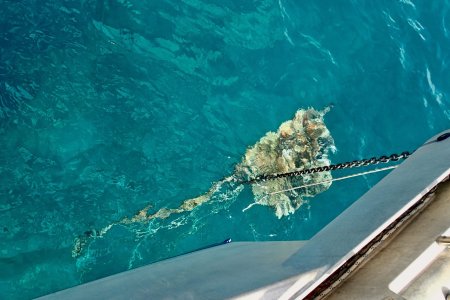
 
I think the ability to release the clutch and manually drop the anchor in a controlled way is a highly desirable feature for any cruising yacht. Personally, I would be reluctant to purchase a windlass without this feature.

The ability to manually retrieve the anchor using the electric anchor windlass is much less valuable on a sailing boat in my view.

These manual systems are usually an afterthought and often don’t work well. If the chain or anchor cannot be retrieved by hand, sailboats are equipped with powerful manual winches designed to control the sails. These are typically far more efficient than trying to use an electric anchor windlass in manual mode. You do need to think about the hardware needed for this backup solution, but typically, it is nothing more than a couple of lines with a chain hook or soft shackle.

A chain stopper which acts as a one-way clutch for the anchor chain is a significant help if the electric anchor windlass fails.
 
I’m not sure the clutch is relevant? On most (all?) windlasses does a slipping clutch not also mean the manual mechanism slips?
Yes

But if the clutch slips or the manual mechanism slips then possibly all the chain (and and anchor) deploys. You can tighten the clutch - but this does not mean the windlass can retrieve the full weight of 100m of chain and anchor, using the windlass electrical ability - it might be too heavy at approx 170kg. I do note that looking at specfications an 8mm windlass can lift 600kg - but personally I'd want to retrieve much of the weight manually- rather than rely n the specs . In most situations most of the rode, and anchor is on the seabed - but not if, under exceptional circumstance the full rode, accidentally, deploys - in deep water

Using the sheet winches, as Noelex suggests, with 2 ropes, chain hooks and some form of chan stopper, chain hook on a short strop would suffice - would be the way to go

Jonathan
 
Last edited:
The windlass for a long distance cruising boat should ideally be specified such that it has plenty of reserve power. On occasions, it will be called upon to retrieve not only the normal anchor and chain but debris such as the corral encrusted steel rudder and stock from a shipwreck pictured below that we picked up in Barbados.

More commonly, crossed anchors mean that you need to retrieve not only your own anchor and chain but that of your neighbour.


You_Doodle_2025-09-19T02_10_21Z.jpeg
 
The windlass for a long distance cruising boat should ideally be specified such that it has plenty of reserve power. On occasions, it will be called upon to retrieve not only the normal anchor and chain but debris such as the corral encrusted steel rudder and stock from a shipwreck pictured below that we picked up in Barbados.

More commonly, crossed anchors mean that you need to retrieve not only your own anchor and chain but that of your neighbour.


View attachment 199655
Agreed

When we downsized our chain from 8mm to HT 6mm we replaced the original windlass and the new windlass was rated for 8mm chain, but had a 6mm gypsy. We also opted for the standard 8mm motor of 1000w.

I have this nasty fear that most AWB have a minimalist windlass specification - quite the opposite to what you recommend - but I'm ready to be pleasantly surprised and shown to be wrong.

Jonathan
 
Years ago I fitted a manual, vertical axis windlass to a previous boat. It was remarkably difficult to use, requiring the user to kneel down, plus the slot for the winch handle was shallow. Consequently I rarely used it, continuing to haul 8 mm chain and 25 lb anchor by hand.

Much later, my Maxwell vertical windlass has a very similar shallow slot, which I have never used. Last year we were forced to anchor manually for a couple of days due to a corroded earth wire. It never entered my head to use the windlass manually, just hauled the chain as in days of yore.
 
I've got pretty limited experience of windlasses, but must say my Lofrans Tigres has a very useful manual function. It's slow but after seeing what other people put up with I'm not complaining.
Just as well really because I spent several months using it in manual mode until I was able to get it working.
 
Years ago I fitted a manual, vertical axis windlass to a previous boat. It was remarkably difficult to use, requiring the user to kneel down, plus the slot for the winch handle was shallow. Consequently I rarely used it, continuing to haul 8 mm chain and 25 lb anchor by hand.

Snap. I found bending over and winching very difficult and bad for my back. Far easier to stand and win against the chain by hand when it's slack, let the slack go into the locker and get it back on the gypsy before it goes tight, and repeat.
 
Snap. I found bending over and winching very difficult and bad for my back. Far easier to stand and win against the chain by hand when it's slack, let the slack go into the locker and get it back on the gypsy before it goes tight, and repeat.
Snap again - I extensively cruised on a chunky 36'er without a windlass but with a chain stopper. Easy peasy, just haul when the tension eases.
 
IME power failures is one of the more unlikely problems. You can always bodge around that. More likely is a problem with the bearings or pawls, or something jammed in the windlass, in which case a manual override won't help. I've had two failures in 40 years, and a both times it was just jammed tight. The first time required winching line. The second time I had a chain stopper with a pawl on the chain and all I did was grab the chain and walk down the side deck. The second trip and it was up in the roller, secure. Almost as fast as the windlass, just not as neat.

As Neeves said, lightweight, modern ground tackle reduces the problem.
 
Top