Windlass - Best way to connect cables?

Jokani

Well-Known Member
Joined
21 May 2014
Messages
849
Visit site
One of the last jobs before launching this year will be to fit a windlass.

For simplicity, I was going to use the leisure bank which is of ample size.

The battery bank is located over the keel, and a direct run to the windlass would not be more that 5 metres, but to the 1,2 both switch would be nearer 8 metres.

Would the better solution be to connect direct to the batteries, the existing switch, or a new switch by the batteries?
 
Which windlass are you fitting ?

You have to make sure that the cable is rated for the job, it should be fitted with an isolator switch and it must be fitted with a fuse or circuit breaker (fitted as close to the power source as possible. My choice would be a re settable breaker.

If you check the cable sizes you need, you will might find that it would be cheaper to go up a size for the additional cable length of wiring to the isolator. It might also be a neater job. But, there is nothing wrong with either method as long as you use the correct cable.

Also, i'd suggest that you wire it to the engine battery, assuming that it's a decent sized battery. You'll have the engine running and the trip back to the marina will most likely charge it back up anyway. Wiring it to the domestic bank could upset your electronics if the domestic bank is a bit low after a day at anchor.

Edit : It's worth noting that you can run the negative cable direct from the battery, whichever way you decide to go. Running the positive from the switch therefore only involves 3 more meters of cable.
 
Last edited:
I fitted an extra battery next to the chain locker, which short fat cables to the switchgear and motor, and normal cables back the length of the boat to the charging splitter. Works fine and means there is an extra battery for emergencies (usually other peoples boats!)
 
It could be that our inherited wiring is not correct but when I installed our windlass I did as Paul suggests above ie connect it to the engine battery. However when we select the engine on the 1/2 Off switch the electronics are also connected. The single engine battery does not have enough capacity to run everything so the plotter turns itself off often when using the windlass. Our bank of house batteries are of the dual use leisure type so I changed the windlass over to them and now with them connected we have 3k of CCA so now the plotter can happily run with the windlass operating. I was also dubious about using the engine battery to lay the anchor as if we have to lift it and re lay it (eg kelp etc) which can happen more than once then we are hammering the battery and then when successfully anchored we should in theory run the engine for some considerable time but that rarely happens. I am much happier now with an engine battery that I know is always topped up.
 
It could be that our inherited wiring is not correct but when I installed our windlass I did as Paul suggests above ie connect it to the engine battery. However when we select the engine on the 1/2 Off switch the electronics are also connected. The single engine battery does not have enough capacity to run everything so the plotter turns itself off often when using the windlass. Our bank of house batteries are of the dual use leisure type so I changed the windlass over to them and now with them connected we have 3k of CCA so now the plotter can happily run with the windlass operating. I was also dubious about using the engine battery to lay the anchor as if we have to lift it and re lay it (eg kelp etc) which can happen more than once then we are hammering the battery and then when successfully anchored we should in theory run the engine for some considerable time but that rarely happens. I am much happier now with an engine battery that I know is always topped up.

Ah yes, slight oversight on my part, i had overlooked the OP's statement that he had a 1/2/off switch. Nasty horrible things. My new boat has one and it's got to go. The plotter problem you describe is what i was referring to, but with the 1/2/both switch you most likely are better off using the domestic bank.

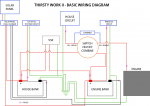
The problem with that switch is it doesn't give you two separate systems. All it does is determine whether you're using battery bank 1 or bank 2. Basically it just keeps a battery in reserve. A better way of doing things is to fit a Blue Sea Dual Circuit Plus (or similar) and a split charging system. This truly keeps the engine and domestic circuits totally separate. The engine only uses the engine battery and the domestics only use the domestic bank, with the added security of the "combine" setting that allows you to start the engine from the domestic bank. You could also fit separate switches for each bank, with a third for the emergency start function, but the Blue Sea switch is very neat.

This setup prevents the plotter issue you describe, because neither the engine or the windlass can drop the domestic voltage and cause your electronics to shut down. Of course, you do need a big enough engine battery and heavy enough cabling, as i mentioned earlier.
 
It has its own Lewmar breaker prior to the solenoid and cable run. Allthough now I come to think of it, the positive does have 2 outputs from the engine side of the isolating switch.. it might be already done.
 
:)
It has its own Lewmar breaker prior to the solenoid and cable run. <snip>

Don't understand this bit. Not trying to be pedantic, but do you mean "prior to the cable run and solenoid", because he solenoid is surely at the windlass end of the cable run.

There is nothing critically wring with not wiring it to the switch, as Nigel said, perhaps i should have said "i would prefer to wire it to the isolator switch"
 
:)

Don't understand this bit. Not trying to be pedantic, but do you mean "prior to the cable run and solenoid", because he solenoid is surely at the windlass end of the cable run.

There is nothing critically wring with not wiring it to the switch, as Nigel said, perhaps i should have said "i would prefer to wire it to the isolator switch"

Umm... it goes.
Engine Battery
Isolation Switch
Lewmar Breaker
Solenoid
Cable run to the:
Windlass

I put a solenoid in (replacing a very meaty switch) so that I could drop a remote control and manual backup toggle switch in the cockpit.
 
Top