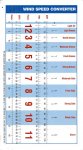
Wind speed at F4 etc

If you have a copy of "Reeds" you will find it there .
No criticism meant,( thread drift really) but questions are often asked about things which are readily available in Reeds. ( although it is more fun asking on the forum just to see the wide range of mad theories that come up)
It makes me wonder how many people actually use Reeds. I would never go to sea without the current copy.
There is so info much in there that one might have forgotten ,or needs to check. No need to buy a "Tom Cunliffe" or any other book for that matter.
For instance I can never remember when Thames or Dover are due to transmit weather info or the IPTS for ,call before entry ,& just, enter ,even though I have been "foreign" many times. So I have loads of little tabs attached to all the pages I may need for quick reference.

I have Reeds, of course (including several out of date ones).

However, whilst I am at home, I find there's almost as much information available on this worldwide web thing as there is in Reeds.
 
>But the Beaufort scale does not really deal with gusts eg a force 4 gusting 30 knots is quite different to a non gusting force 4!

NOAA forecasts point out that gusts can be up to 40% of wind speed, having been long distance sailing I know it's true. For example over Biscay we had 35 knots gusting 50, a ketch ran off towing drogues, a cat hove to using both engines and sadly a local fishing boat was lost with all hands. We had a heavy displacement long keel with cutaway forefoot steel ketch and kept sailing.

I was wondering about this the other day. The weather station at the marina was showing peak average wind speed for the day at 22 knots. Top gust speed 40 knots. It is nearly double quite often. I suppose it depends how the average is calculated but at least round here I suspect the wind is very variable over the space of a minute.

So what is the definition of a gust anyway? And how does one measure windspeed anyway if it is constantly going up and down. Obviously instruments are damped at say 3 seconds.
 
So what is the definition of a gust anyway? And how does one measure windspeed anyway if it is constantly going up and down. Obviously instruments are damped at say 3 seconds.

The World Meteorological Organisation defines a gust as a "sudden, brief increase of the wind speed over its mean value". Met Offices around the world may have their own, tighter definitions. In the US it's "the maxima that exceed the lowest wind speed measured during a ten-minute time interval by 10 knots. A squall is a doubling of the wind speed above a certain threshold, which lasts for a minute or more.".

Note that a squall, although often associated with rain, is defined purely as a wind phenomenon.

See also my post #8. By some authority's definitions if a gust endures for over 30 seconds, it's no longer a gust. The same is partially implicit in the NOAA definition above if it lasts over one minute, becoming a squall.
 
Last edited:
>Your wind speed instrument can predict future winds? Where can I buy one?

As I am sure you know carry a barometer, that forecasts wind speeds. We knew the gale over Biscay was coming as the barometer was dropping fast and reefed accordingly before it arrived. Since weather forecasts use the Beaufort scale I can't believe anyone doesn't use it.
 
As I am sure you know carry a barometer, that forecasts wind speeds. We knew the gale over Biscay was coming as the barometer was dropping fast and reefed accordingly before it arrived.

Barometers can forecast impending wind speeds, but not always. If, say, the course of an Atlantic low is such that the same isobar tracks across your position, then the barometer will show nothing...but that certainly doesn't mean it won't be windy. I once sat out a blow in Arisaig which brought peak winds of 65knots yet the pressure changed slowly and by only a few millibars (which were more in vogue back then than hPa). Luckily the gale was widely forecast and the only real harm befell a couple of boats on moorings which took unmanned trips to Skye. But the lesson certainly was that anyone who'd relied on barometer alone could have found himself in a desperate pickle.

Barometers also aren't much help with macro weather conditions. Still, they're very useful devices and of course were once the only thing most small boat owners could consult when well away from land (well, apart from consulting the sky, of course, which tells its own tales). I'm sure that sooner or later the glass on mine will succumb to my regular tapping.
 
Last edited:
So what is the definition of a gust anyway? And how does one measure windspeed anyway if it is constantly going up and down. Obviously instruments are damped at say 3 seconds.
Easiest way to measure average windspeed is to count the number of times an anemometer rotates. For stations with continuous recording, convention for average windspeed it to report the speed (i.e. revolutions) over the previous ten minutes.

Worth noting that speeds are usually at 10m height.

MASSES of detail here: http://www.metoffice.gov.uk/media/pdf/s/p/OH_Chapter51.pdf
 
I think the Beaufort scale is too simple and is now made redundant by the issue of more detailed forecasts including gust speed.
 
This was included in one of the Mags (PBO?) some years ago. It's good to keep handy.
 

Attachments

  • WindCard.jpg
    WindCard.jpg
    98.6 KB · Views: 0
>A squall is a doubling of the wind speed above a certain threshold, which lasts for a minute or more.".

I love that over the Atlantic a squall can last for two hours or more. We were sailing west off the Venezuelan coast at night and squalls and lightning began to appear, I turned the radar on to see what was going on. They were building all around us at the radar's range of 25 miles in every direction. They lasted for six hours and fortunately the lightning was cloud to cloud otherwise we would have been hit. The reason I say that was because I was on watch and I heard the biggest bang I've ever heard, the brightest flash and the smell of ozone, it was right overhead.
 
Last edited:
There are only three points on the Burnham Beaufort Scale.
1= not enough
2= Just right
3= too much

On a day sail that's all we need becuase you can tell from the deck almost immediately, but agree that weather forecasts are better for longer passages
 
Top