Salty John
Well-Known Member
Potted history of the Beaufort Scale here:
http://www.saltyjohntheblog.com/2013/09/the-beaufort-scale.html
http://www.saltyjohntheblog.com/2013/09/the-beaufort-scale.html

If you have a copy of "Reeds" you will find it there .
No criticism meant,( thread drift really) but questions are often asked about things which are readily available in Reeds. ( although it is more fun asking on the forum just to see the wide range of mad theories that come up)
It makes me wonder how many people actually use Reeds. I would never go to sea without the current copy.
There is so info much in there that one might have forgotten ,or needs to check. No need to buy a "Tom Cunliffe" or any other book for that matter.
For instance I can never remember when Thames or Dover are due to transmit weather info or the IPTS for ,call before entry ,& just, enter ,even though I have been "foreign" many times. So I have loads of little tabs attached to all the pages I may need for quick reference.
>But the Beaufort scale does not really deal with gusts eg a force 4 gusting 30 knots is quite different to a non gusting force 4!
NOAA forecasts point out that gusts can be up to 40% of wind speed, having been long distance sailing I know it's true. For example over Biscay we had 35 knots gusting 50, a ketch ran off towing drogues, a cat hove to using both engines and sadly a local fishing boat was lost with all hands. We had a heavy displacement long keel with cutaway forefoot steel ketch and kept sailing.
So what is the definition of a gust anyway? And how does one measure windspeed anyway if it is constantly going up and down. Obviously instruments are damped at say 3 seconds.
As I am sure you know carry a barometer, that forecasts wind speeds. We knew the gale over Biscay was coming as the barometer was dropping fast and reefed accordingly before it arrived.
Easiest way to measure average windspeed is to count the number of times an anemometer rotates. For stations with continuous recording, convention for average windspeed it to report the speed (i.e. revolutions) over the previous ten minutes.So what is the definition of a gust anyway? And how does one measure windspeed anyway if it is constantly going up and down. Obviously instruments are damped at say 3 seconds.


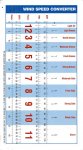
This was included in one of the Mags (PBO?) some years ago. It's good to keep handy.

All very well, Nigel, but the Met Office can't see your wind instrumentWhile I don't disagree with your post, I have never found any need to use the Beaufort Scale. Perhaps because I have a wind speed instrument that tells me the actual speed.