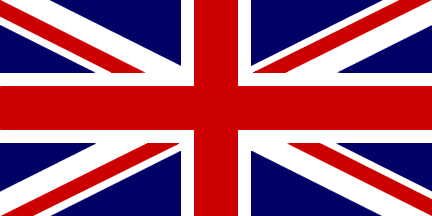
Why don't the red diagonal red lines on union flag line up?

CharlesSwallow

Well-Known Member
Joined
3 Dec 2009
Messages
2,545
Location
E Mids, London & Greece
Visit site
Surprised that this hasn't been raised before, perhaps it has?

Just got a call from a freind who has apparently gotten himself embroiled in an arguement on a US site but can't answer this question.

Googling it doesn't seem to give any satisfactory explaination. One says it's because it is "offset" but if you were to do that, the stripes would still be in alignment.

Surely SOMEONE knows the real answer?

Chas
 
The red diagonals are offset by their own width from the actual diagonal of the flag. It is that which gives the broad and narrow white stripes within the symetrical St Andrews cross

Full details of the evolution of the design and variants on it can be found HERE


Read THIS also. Then ask some silly/awkward questions about the design of the US flag


gb.gif
 
Last edited:
The red diagonals are offset by their own width from the actual diagonal of the flag. It is that which gives the broad and narrow white stripes within the symetrical St Andrews cross

Full details of the evolution of the design and variants on it can be found HERE


Read THIS also. Then ask some silly/awkward questions about the design of the US flag


gb.gif


Thanks

but

"In 1801, an Act of Union which made Ireland a co-equal member of the United Kingdom made it necessary to add a symbol for Ireland to the flag, but without obliterating any of the existing symbols. If the St. Patrick's cross had been centered on the diagonal stripes, then St. Andrew's cross would have been relegated to an inferior position, basically serving only as a border for St. Patrick's. But Scotland was the senior of the two kingdoms, so this was unsatisfactory. The solution was to divide the diagonal stripes diagonally, so that the red St. Patrick's cross would take up only half of each stripe, and so that half devoted to St. Andrew would take the place of honor. Thus, in the two hoist quarters, the white St. Andrew's cross occupies the upper position, and in the two fly quarters, the red St. Patrick's cross occupies the upper position.
"

would have done!

So actually, it ISN'T an "offset" at all but the halving of the width of the stripes in the Ulster flag to maintain the superiority of the St Andrew's cross. Ahh The English have been supressing the Irish all along, even the ones who claim to be loyalists!

Chas
 
Last edited:
I have a dim memory of the offsetting being responsible for the use of the name Union Jack too. My recollection of the story goes that an English ship was taken by the French and the crew captured. With the English fleet approaching, one of the boys (by the name of Jack) was ordered by his captors to raise the ensign to fool the English into thinking that the ship hadn't been taken. The quick thinking sailor raised it upside down, thus alerting the fleet to the danger.
 
I have a dim memory of the offsetting being responsible for the use of the name Union Jack too. My recollection of the story goes that an English ship was taken by the French and the crew captured. With the English fleet approaching, one of the boys (by the name of Jack) was ordered by his captors to raise the ensign to fool the English into thinking that the ship hadn't been taken. The quick thinking sailor raised it upside down, thus alerting the fleet to the danger.

No; a Jack is a flag flown on a Jackstaff, originally at the bow of a vessel. It is a nice story, but that's all.
 
No; a Jack is a flag flown on a Jackstaff, originally at the bow of a vessel. It is a nice story, but that's all.

Here's what the Flag Institute has to say:
In the 18th century the small mast on the bowsprit was replaced by staysails on the stays between the bowsprit and the foremast. By this time the Ensign had become the principal naval distinguishing flag, so it became the practice to fly the Union Jack only in harbour, on a specially rigged staff in the bows of the ships, the jackstaff. It should thus be noted that the jack flag had existed for over a hundred and fifty years before the jack staff came into being, and its name was related to its size rather than to the position in which it was flown.

It is often stated that the Union Flag should only be described as the Union Jack when flown in the bows of a warship, but this is a relatively recent idea. From early in its life the Admiralty itself frequently referred to the flag as the Union Jack, whatever its use, and in 1902 an Admiralty Circular announced that Their Lordships had decided that either name could be used officially. Such use was given Parliamentary approval in 1908 when it was stated that "the Union Jack should be regarded as the National flag".
 
Here's what the Flag Institute has to say:
In the 18th century the small mast on the bowsprit was replaced by staysails on the stays between the bowsprit and the foremast. By this time the Ensign had become the principal naval distinguishing flag, so it became the practice to fly the Union Jack only in harbour, on a specially rigged staff in the bows of the ships, the jackstaff. It should thus be noted that the jack flag had existed for over a hundred and fifty years before the jack staff came into being, and its name was related to its size rather than to the position in which it was flown.

It is often stated that the Union Flag should only be described as the Union Jack when flown in the bows of a warship, but this is a relatively recent idea. From early in its life the Admiralty itself frequently referred to the flag as the Union Jack, whatever its use, and in 1902 an Admiralty Circular announced that Their Lordships had decided that either name could be used officially. Such use was given Parliamentary approval in 1908 when it was stated that "the Union Jack should be regarded as the National flag".


STOP DRIFING THE THREAD!

Chas
 
Here's what the Flag Institute has to say:
In the 18th century the small mast on the bowsprit was replaced by staysails on the stays between the bowsprit and the foremast. By this time the Ensign had become the principal naval distinguishing flag, so it became the practice to fly the Union Jack only in harbour, on a specially rigged staff in the bows of the ships, the jackstaff. It should thus be noted that the jack flag had existed for over a hundred and fifty years before the jack staff came into being, and its name was related to its size rather than to the position in which it was flown.

It is often stated that the Union Flag should only be described as the Union Jack when flown in the bows of a warship, but this is a relatively recent idea. From early in its life the Admiralty itself frequently referred to the flag as the Union Jack, whatever its use, and in 1902 an Admiralty Circular announced that Their Lordships had decided that either name could be used officially. Such use was given Parliamentary approval in 1908 when it was stated that "the Union Jack should be regarded as the National flag".


That's quite interesting, I've quite often had people tell me that you shouldn't call it the union jack until it's flying, now I can tell them to bugger off! :D
 
Here's what the Flag Institute has to say:
In the 18th century the small mast on the bowsprit was replaced by staysails on the stays between the bowsprit and the foremast. By this time the Ensign had become the principal naval distinguishing flag, so it became the practice to fly the Union Jack only in harbour, on a specially rigged staff in the bows of the ships, the jackstaff. It should thus be noted that the jack flag had existed for over a hundred and fifty years before the jack staff came into being, and its name was related to its size rather than to the position in which it was flown.

It is often stated that the Union Flag should only be described as the Union Jack when flown in the bows of a warship, but this is a relatively recent idea. From early in its life the Admiralty itself frequently referred to the flag as the Union Jack, whatever its use, and in 1902 an Admiralty Circular announced that Their Lordships had decided that either name could be used officially. Such use was given Parliamentary approval in 1908 when it was stated that "the Union Jack should be regarded as the National flag".

Woo! People getting self righteous about not calling the flag the Union Jack really get on my goat. It's a name FFS, and would be just as acceptable if it was called the Union Bob.
 
Here's what the Flag Institute has to say:
In the 18th century the small mast on the bowsprit was replaced by staysails on the stays between the bowsprit and the foremast. By this time the Ensign had become the principal naval distinguishing flag, so it became the practice to fly the Union Jack only in harbour, on a specially rigged staff in the bows of the ships, the jackstaff. It should thus be noted that the jack flag had existed for over a hundred and fifty years before the jack staff came into being, and its name was related to its size rather than to the position in which it was flown.

It is often stated that the Union Flag should only be described as the Union Jack when flown in the bows of a warship, but this is a relatively recent idea. From early in its life the Admiralty itself frequently referred to the flag as the Union Jack, whatever its use, and in 1902 an Admiralty Circular announced that Their Lordships had decided that either name could be used officially. Such use was given Parliamentary approval in 1908 when it was stated that "the Union Jack should be regarded as the National flag".

Interesting thread. Does anyone know how the Jack/Flag/jackstaff (apparent) misunderstanding came into being?
 
Chas is going to go mad at you lot - I'm keeping my head down! ;)

Richard

Until he becomes a moderator, I'm not bothered! Plus, he has had an answer. :D

Thread drift is important, you normally learn more from the topics that surround the OP than just getting straight answers.
 
Yes. That's my point! They didn't start that way on the (so called) "St Patrick's Cross" the emblem of Ulster.

Chas

The Cross of St. Patrick represented all of Ireland, at least in English eyes, and the Union 'whatever you want to call it' of which it is a part substantially predates Irish independence. There was no thought of part of Ulster as a political entity prior to the 20th century. The 'Ulster' flag, which you will only find in six of the nine counties, is actually similar to the St. Georges cross used by England as their flag, though these days it usually has the addition of the O'Neills red hand in the centre to make sure it can not be mistaken for an English emblem. Most Irish people think of the red St. Patricks cross as an emblem dreamt up by the English to make their flag look interesting.
 
Interesting thread. Does anyone know how the Jack/Flag/jackstaff (apparent) misunderstanding came into being?

I cut a bit from that Flag Institute article. It seems, in summary, that a "jack" was always a small flag, so the thing it was flown on was called a "jack staff" and in turn people mistakenly thought that only things flying on jack staffs were jacks.

It's precisely the same error as saying "It's not the Union Flag unless it's flying from a flag pole."
 
Am I correct in recalling that one of the surviving flags from the battle of Trafalgar doesn't have the "offsets" (made up on board ship IIRC).
 
Top