Who thinks a vessel under sail always has right of way?

I think people spend far too much time fixated on Rule 18. Rule 9 also deserves consideration. A half century ago one US court wrote this, and whilst in a different country and under the prior set of rules, I think it's still relevant to the matter:
This Court, however, is not convinced that the meaning of Art. 20, as amended, is to make the sailing vessel the burdened vessel. The legislative history is not clear, and the one case discussing the change recites the rule in dicta in circumstances where the sailing vessel was clearly at fault. A careful reading of the legislative history and the wording of the statute indicates that the intent of Congress was not to change the status of the sailing vessel as privileged, but rather to limit her right as privileged vessel to set a course which endangered other shipping in narrow channels. The change is no more than a codification of the requirements of common sense and prudential seamanship previously enforced by the courts. No vessel, even before this change, had the right to insist on her status as a privileged vessel to the detriment of other shipping. Particularly is this so where the relationship is that of the heavily laden freighter in a narrow channel meeting the more maneuverable and shallow-drafted sailcraft. This Court, therefore, interprets Art. 20 as (1) placing the burden of avoidance upon the steam vessel, provided she may continue within the channel; and (2) limiting the sailing vessel to those courses which will not restrict the ability of the freighter to stay within the channel.
Or, in simpler terms, "play nice".
 
Shouldn’t be an issue with the North Channel - as minimum width about 10 miles (between NI and Kintyre).
Or did you mean a different north channel?
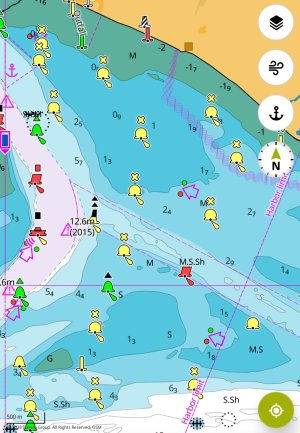
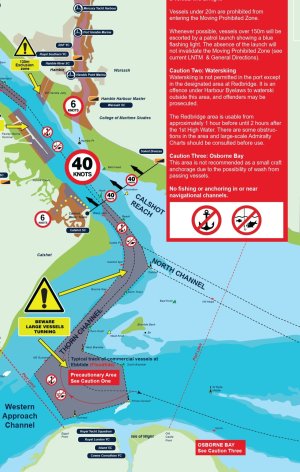
No, this North Channel in the Solent. Not much water either side when you draw 2.5m and it's LW springs.

The whole area peppered with yellow race marks.
Screenshot_20250912_155718_B&G.jpg
 
No, this North Channel in the Solent. Not much water either side when you draw 2.5m and it's LW springs.

The whole area peppered with yellow race marks.
View attachment 199336
Just ribbing you for being presumptuous in assuming everybody would know your were referring to the Solent.
But is that actually named North Channel on the charts or just a north channel?
 
Just curious. How many sailors on here think they have absolute right of way once they are under sail relative to all other vessels not under sail.
Slightly convoluted but find its becoming increasing common for someone under sail to be hollering 'Im sailing' which indicates that they think they have the right to proceed as they wish with total disregard for who or what vessels they interfere with.
Prize goes to idiot who tacked meters from me onto a collision course at Pinmill and kept shouting "Im sailing, Im sailing,' until putting the helm up a metre off long keeled 28 ton ketch.
Gey few, an they're a deid
 
Then we would be in breach of Colregs.

Colregs exist for a reason, you're tacking across the channel, i give way, you stand on, we both know who's going to do what because we are following the rules.
Not necessarily, a weaving motorboat in a river / channel, when there are many sailing boats, puts it's self in the way of many more standon boats than if it stuck to one side of the river.

During our annual regatta we put big signs each end of the course " Keep Right" major regatta Ahead. The rescue boats carry signs that can be shown such as racing ahead, keep right, please slow, and the ever popular " hug the bank" we prefer motorboats to slow, if not speed up slightly to give sailing boats clear space not weave.

As for speed, the max speed for motor boats for the majority of the course is 4 mph, you get the odd multistorey block of flats travelling through the course with massive twin Caterpillars rumbling away that are incapable of going that slow.
Some how they think an illegal vessel is ok..
 
Not necessarily, a weaving motorboat in a river / channel, when there are many sailing boats, puts it's self in the way of many more standon boats than if it stuck to one side of the river.

During our annual regatta we put big signs each end of the course " Keep Right" major regatta Ahead. The rescue boats carry signs that can be shown such as racing ahead, keep right, please slow, and the ever popular " hug the bank" we prefer motorboats to slow, if not speed up slightly to give sailing boats clear space not weave.
That's an entirely different situation to "Colregs exist for a reason, you're tacking across the channel, i give way, you stand on, we both know who's going to do what because we are following the rules."

It's a regatta and it's clearly signed, so everyone knows what to do and what to expect from others.
As for speed, the max speed for motor boats for the majority of the course is 4 mph, you get the odd multistorey block of flats travelling through the course with massive twin Caterpillars rumbling away that are incapable of going that slow.
Some how they think an illegal vessel is ok..
We are capable of travelling at the required speeds on the rivers we travel on. In the incident i mentioned earlier on the Deben, we were doing just over 4 knots, the idiot in the dinghy was proclaiming we shouldn't be doing any more than 5 knots, although the speed limit on that stretch of water is 8 knots. Some dinghy racers think Colregs don't apply to them and they just make things up.
 
Last edited:
. . . we prefer motorboats to slow, if not speed up slightly to give sailing boats clear space not weave.

It's remarkable that slowing or stopping (or even speeding up) is the last thing many boaters, especially motor-boaters but those under sail too, think of when trying to avoid other craft.

Long ago I used to race a dinghy in a narrow river with motorboats passing up and down (thankfully neither the size not frequency of those in the Broads), some of whom would be zig-zagging wildly down the river at a constant speed, aiming for the gap behind a sailing dinghy that still had two or three tacks across the river to do before they'd be in close proximity. Typically they still hadn't comprehended the regular pattern of the tacking dinghy's movements, nor the relative paths and speeds of the two boats, and would be making ever sharper turns, perhaps even ending up at almost right angles to the river.

I used to often give hand signals :D to indicate my intended turn as I approached the bank, or a motorboat on a previously predictable path! (Perhaps sailing boats should be fitted with indicators?)

Avoiding motorboats that were trundling up or down the river, or sometimes seemingly determined to run dinghies down, would often affect the relative positions of the dinghies racing, but fortunately for me it was a friendly family-orientated sort of club (serious racers would be deterred by that sort of hazard and the very restricted waters and go elsewhere) and most weren't too bothered by that. (There were inevitably a few who took it far too seriously - a couple of testosterone-fuelled teenagers, and an older chap who I suspected had some sort of mental issue about it - and get aerated about such setbacks. They were also the ones who would brazenly cheat to gain places, which seemed completely pointless to me.)
 
We are capable of travelling at the required speeds on the rivers we travel on. In the incident i mentioned earlier on the Deben, we were doing just over 4 knots, the idiot in the dinghy was proclaiming we shouldn't be doing any more than 5 knots, although the speed limit on that stretch of water is 8 knots. Some dinghy racers think Colregs don't apply to them and they just make things up.

Reminds me of my first visit to the Deben. We arrived in the evening. No other boats about. calm weather, and we dropped the anchor and enjoyed a peaceful night. Woken by speedboats thrashing about near us. We hadn't seen the signs indicating we were in the area designated for water-skiing! 😁
 
It's remarkable that slowing or stopping (or even speeding up) is the last thing many boaters, especially motor-boaters but those under sail too, think of when trying to avoid other craft.

Long ago I used to race a dinghy in a narrow river with motorboats passing up and down (thankfully neither the size not frequency of those in the Broads), some of whom would be zig-zagging wildly down the river at a constant speed, aiming for the gap behind a sailing dinghy that still had two or three tacks across the river to do before they'd be in close proximity. Typically they still hadn't comprehended the regular pattern of the tacking dinghy's movements, nor the relative paths and speeds of the two boats, and would be making ever sharper turns, perhaps even ending up at almost right angles to the river.

I used to often give hand signals :D to indicate my intended turn as I approached the bank, or a motorboat on a previously predictable path! (Perhaps sailing boats should be fitted with indicators?)

Avoiding motorboats that were trundling up or down the river, or sometimes seemingly determined to run dinghies down, would often affect the relative positions of the dinghies racing, but fortunately for me it was a friendly family-orientated sort of club (serious racers would be deterred by that sort of hazard and the very restricted waters and go elsewhere) and most weren't too bothered by that. (There were inevitably a few who took it far too seriously - a couple of testosterone-fuelled teenagers, and an older chap who I suspected had some sort of mental issue about it - and get aerated about such setbacks. They were also the ones who would brazenly cheat to gain places, which seemed completely pointless to me.)
Overtaking a tacking yacht is just a simple matter of geometry in most cases. As overtaking boat you merely aim to pass astern of the sailing boat just after it tacks, close to the side of the channel. You then have two of the yacht’s boards’ time to get well past, whereas if you use the centre of the channel you only have half the time. Not hard to understand.
 
Overtaking a tacking yacht is just a simple matter of geometry in most cases. As overtaking boat you merely aim to pass astern of the sailing boat just after it tacks, close to the side of the channel. You then have two of the yacht’s boards’ time to get well past, whereas if you use the centre of the channel you only have half the time. Not hard to understand.

Not hard for you and I to understand, but clearly is for a lot of inland motorboaters. (And the place I then sailed didn't have the high proportion of hire boats - and hence inexperienced skippers - found in e.g. the Broads.)
 
Overtaking a tacking yacht is just a simple matter of geometry in most cases. As overtaking boat you merely aim to pass astern of the sailing boat just after it tacks, close to the side of the channel. You then have two of the yacht’s boards’ time to get well past, whereas if you use the centre of the channel you only have half the time. Not hard to understand.
the challenge can be more complex when there are multiple sailing boats in a channel all beating, especially when it is not your specialism
 
And you are quite correct in that belief.

However when I am the stand on vessel I do believe in holding my course / speed until it is my belief that the give way vessel is not doing enough to resolve the situation. To the extent of calling merchant ships on VHF to make them aware of my presence.

Might is not right and professional mariners in my experience would prefer leisure sailors to obey the rules so they can predict what is going to happen. When some skippers in a stand on situation alter they may well just counteract the avoiding action made by the larger vessel! When I was driving HMs sleek grey warriors of death it wasn't unusual to have altered course up to 6 miles away to increase a CPA to an acceptable distance. Also larger vessels are looking further ahead and may have 2 or 3 vessels they are avoiding. The Dover Straits at 20+ knots were always fun!!
Former Merchant mariner here. Very well said sir, I did indeed do the same as our speeds are much higher compared to leisure boats and our manoeuvrability is a bit lower making time and distance your friend. So in open water I make sure to stick to the rules as a leisure sailor now. However when encountering professional traffic near Rotterdam, Flushing, IJmuiden I make sure to stay well out of their way outside the bouyed channels if water depth allows. Traffic Control is very helpful in guiding you through these traffic situations.
 
Any person who routinely puts their own boat on a collision course and expects others to alter course is failing to understand the basic principle that everyone should be jointly responsible for collision avoidance.
 
Sailing vessels never have "the right of way" perhaps your belief that you do is what causes you issues ?
Although perfectly true, I'll presume to answer for Little Sister; that many of us have the, perhaps ill-advised, habit of using 'right of way' as a shorthand for the more awkward 'stand-on vessel' which usually involves rearranging the sentence. I try to avoid it in the forum but I confess that I often use it mentally while knowing it to be inaccurate. I do the same thing with 'derestricted' on the roads in place of 'national speed limit' which doesn't come to mind as readily.
 
The trouble we have with mobos is that they often don’t understand how fast we are going. They’ll alter course, but to pass in front. Then alter again when they realise they’re not clearing us. Frequently a third time, before they give up and pass astern. We just have to let them do it, if we change it’ll only end up in more confusion.
 
The trouble we have with mobos is that they often don’t understand how fast we are going. They’ll alter course, but to pass in front. Then alter again when they realise they’re not clearing us. Frequently a third time, before they give up and pass astern. We just have to let them do it, if we change it’ll only end up in more confusion.
I think there is a moral if not legal responsibility for skippers of fast or unusually fast boats to keep out of the way. A slower boat may not have the ability to manoeuvre adequately, and assessment of a fast vessel without radar or AIS can be very hard, often in limited time.
 
Top