Whipping and sealing ends

Hot knives are expensive and require high AC power. Chef's blowtorch is cheap and does a good job of melting the end. Then I stitch-whip.

What else are you going to do on long passages?
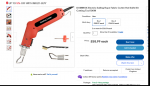
We have had our professional quality German hot knife for 8 years. It cost £85. It has cut loads of cloth, webbing and ropes. We just made a new stackpack for the main. All cut out with the hot knife so no fraying cloth. We seemed to have the thing out on a regular basis. We wouldn't be without it?
We also have a small chefs blowtorch. Not the same by any stretch of the imagination
 
I have a 230v hot knife that cost around £90.

Certainly not worth buying for the amount of rope work I do each year but invaluable for cutting and sealing cover fabric, which is why I bought it.

When I pack up sailing I expect to get a good price for it on eBay so it has been a worthwhile purchase.
 
I'm in the chef's blowtorch camp on this one, it works well outside without power and with a stiff breeze blowing. After sealing the ends I whip and smear superglue over the twine. I find superglue pretty useful for a lot of rope work including keeping the fibres untwining from the yarn and strands when splicing.
 
Old knife heated over the stove is a bit cheaper than a £90 hot knife - blimey some of you must have money to burn.
Me I like whipping so sailmakers whipping and hot sealed end every time.
 
Old knife heated over the stove is a bit cheaper than a £90 hot knife - blimey some of you must have money to burn.
Me I like whipping so sailmakers whipping and hot sealed end every time.
I don't think anyone has suggested buying a hot knife just for cutting and sealing rope.
As I pointed out above, mine was bought for another purpose and more than justified its cost.
And, I shall probably recoup most of its cost when I come to sell it.*
I can't see a flaw in that argument..

*Maybe not as much as I hope :cry:

1669725938873.png
 
Last edited:
If anyone buys or already uses an electric hot knife, be careful not to run it for long periods. The transformers in them are relatively small and will burn out if over used.
 
If anyone buys or already uses an electric hot knife, be careful not to run it for long periods. The transformers in them are relatively small and will burn out if over used.
A tip. I made my own rope cutter by replacing the soldering tip with a cutting blade on a cheapo car boot rapid heat soldering iron, total cost £15. I got the cutter tip off eBay. The curved blade I find better for cloth.
Some of those rapid irons have knife ends in the kit or as an extra. The lead diameters on the irons and tips on different makes and models are different sizes so be careful to match.
 
Another tip (from Sailrite) for cutting fabric with heat tools it to do it over a piece of tempered glass. I tried wood, formica, metal... but a glass surface really makes a difference, it does not stick, the two sides of cloth are better separated, the blade moves easily, etc.
I discovered when I went to a glass shop to ask for a piece, they explained it is made to measure piece by piece, tempered glass cannot be cut, it is a type of glass which is first cut to measure then put in the oven again. They had a nice scrap piece on site they gave away for 5e, I might use it as bathroom shelf in between cutting sessions :D
 
Another tip (from Sailrite) for cutting fabric with heat tools it to do it over a piece of tempered glass. I tried wood, formica, metal... but a glass surface really makes a difference, it does not stick, the two sides of cloth are better separated, the blade moves easily, etc.
I discovered when I went to a glass shop to ask for a piece, they explained it is made to measure piece by piece, tempered glass cannot be cut, it is a type of glass which is first cut to measure then put in the oven again. They had a nice scrap piece on site they gave away for 5e, I might use it as bathroom shelf in between cutting sessions :D

We use another form of Glass as a bed on 3D printers ....... Borosilicate ...... has to be stable to work with us heating it to 60 up to 80C and filament feeding onto it at about 200 - 220 C, up to about 275C in some cases.
 
Doesn’t it blunt the knife all the time?

For kitchen knives, yes, a stupid application.

A hot knife, of course, is not sharp.

Another advantage of glass over metal is that it does not draw heat away. Also, the melted fabric does not stick.

Note that solddering guns (150W with wire tip) can be made into a hot knife with an attachment or a flattened wire.
 
This reminds me of a JDS cartoon.
An old timer is working an elaborate fancy tapered rope end using a marline spike, and looking disdainfully at a new sailor sealing a rope with a lighted match.
 
Old knife heated over the stove is a bit cheaper than a £90 hot knife - blimey some of you must have money to burn.
Me I like whipping so sailmakers whipping and hot sealed end every time.
We have made both stackpacks, liferaft cover, rescue sling cover, petrol can covers, dinghy fuel tank cover, bean bags, reupholstered the 16 cushions in the saloon, windlass cover, cockpit cushion covers, hatch covers, boat full sun cover, etc. All with the cutting/sealing help of the hot knife. For the ninor cost it has saved thousands I suspect
 
Top