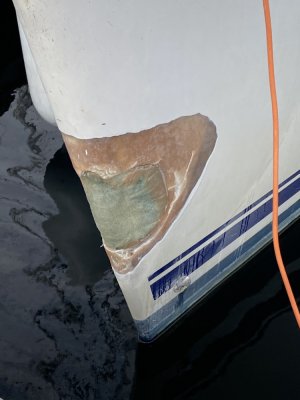
Whilst walking in the marina I saw these 2 horrors

I recall Cherbourg had those large curved bars forming the end of the finger. Usually single handed or with the OH on the bow, I can normally fling the midships bight over the entire finger which adequately holds things in place while I fetch the bow.

Another practitioner here, of feeding around cleats (or through) and secure on board, for 'all crew on board' departures next time (and of a lock turn). Also, the neighbour likes to create a cleat warmer for the shared bow cleat, leaving me little choice. And I get a bit irked when fingers/ pontoons are strewn with tails of lines. I don't know if they think creating immaculate spirals makes a mile of rope on a narrow finger ok, but it's no better than a spaghetti, and then I feel bad if I knock it slightly, and his artwork is undone!
 
The end on the short fingers have loops. There are cleats on the fingers and on the main floating pontoon.
There is a style of finger that has a large single loop around its end, generally covered in plastic as a token fender. I always find these awkward, especially as they are usually notably lacking in buoyancy as well.
 
My pet hate is the substitution of a ring rather than a proper cleat, on the pontoon, making a quick turn to hold the boat impossible when things are going pear-shaped. Do Titchmarsh and Cherbourg still have these abominations?
I loved sailing in the Orkney and Shetlands but most of the marinas have the scandinavian fingers. Welded loops only and very narrow fingers that almost submerge when stepped on. The first time I came across one of these whilst singlehanded, I found it simpler to hook a line over the winch on the fishing boat on the other side of the finger and then reeve the lines through the loops. Being a very small marina, I never saw another person there in 3 days, so chance to ask for help.
 
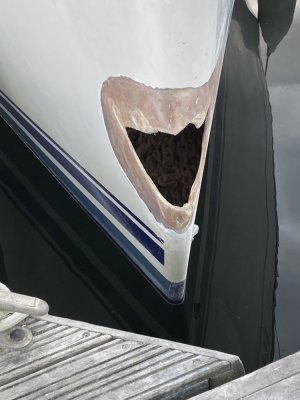
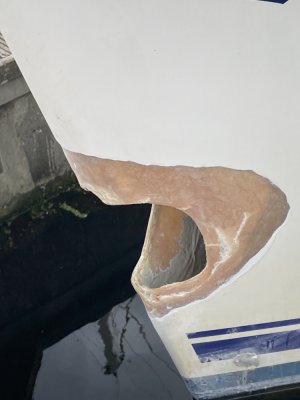
Further to the photo I posted in #1, I have been told the vessel hit the pontoon doing about 5 knots. It has been ground back ready for repairing, but the weather for the past few days has been too wet. Not sure if it will be repaired in the water or will be lifted.

IMG_1888 1000pix.jpg

IMG_1889 1000pix.jpg

I think this photo could be improved with some shark's teeth.
 
I saw something similar, fortunately without serious damage - the forward/reverse cable disconnected itself, so a dose of astern to stop the boat accelerated it, then thump. Not sure why anyone would be going anywhere near 5 knots approaching a pontoon, though.
 
Further to the photo I posted in #1, I have been told the vessel hit the pontoon doing about 5 knots. It has been ground back ready for repairing, but the weather for the past few days has been too wet. Not sure if it will be repaired in the water or will be lifted.

View attachment 194631

View attachment 194632

I think this photo could be improved with some shark's teeth.
Well, thats one way to wash the mud off the anchor chain.
 
I saw something similar, fortunately without serious damage - the forward/reverse cable disconnected itself, so a dose of astern to stop the boat accelerated it, then thump. Not sure why anyone would be going anywhere near 5 knots approaching a pontoon, though.
Yes, saw similar one. Skipper put in full “reverse” to try to stop but in fact full ahead. Nice sloping bow so 36 foot boat rose up onto main pontoon to very surprised looks of crew on the bow who also shot upwards, but were fortunately uninjured.
 
Further to the photo I posted in #1, I have been told the vessel hit the pontoon doing about 5 knots. It has been ground back ready for repairing, but the weather for the past few days has been too wet. Not sure if it will be repaired in the water or will be lifted.

View attachment 194631

View attachment 194632

I think this photo could be improved with some shark's teeth.
I was literally going to say something about shark teeth
 
I saw something similar in Cuxhaven. A British boat had gone head-first into a channel buoy. With about 4 kn of current that would have been around 10 knots. It looked much the same.
 
A further update.

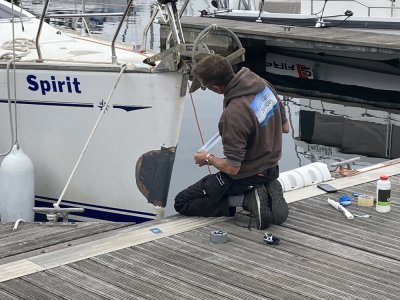
The repair is being done in the water. The hole was covered with duck tape on the outside and inside.

IMG_1912 1000pix.jpg

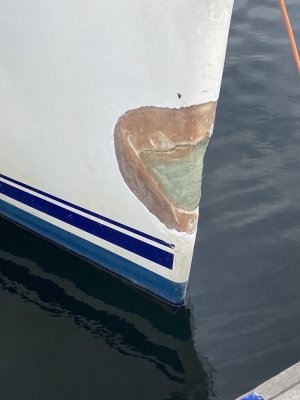
A few days later the laminate had been completed.

IMG_1920 1000pix.jpg

IMG_1921 1000pix.jpg

As i have now left the marina, I cannot do an update until I return to collect my car. Hopefully the job will be completed and the boat still in its berth.
 
Hopefully that's just a temporary repair until the end of the year. I saw a similar repair although to the side of a boat that had been T boned just above the waterline, it was done by a very skilled guy in Falmouth about 20 years ago the boat was returning from the Canaries where it had been damaged. The full repair would have involved the removal of internal cabinetry and was to be done later. It was a far better job than is shown in your photos including a gell coat skim and polish took 3 days in all iirc.
 
Amazing that level of damage can happen on a sailing school boat berthing in a marina.

I wonder what the circumstances were…
 
Amazing that level of damage can happen on a sailing school boat berthing in a marina.

I wonder what the circumstances were…
I once saw someone hit a fortunately well padded dock in a fortunately inflatable RIB at speed that could probably do that sort of damage if it had been fibreglass and unfendered steel: turned out the gear linkage was not connected properly so remained in forward when the helm tried reverse. What do you do when going too fast ahead? You give it a blast of reverse. If gearbox is stuck then you actually go faster. What if your automatic reaction? More reverse!
 
Allowing grinding dust and chemical drips into the water will contravene some regulation. Also, it would be difficult to control the quality of the repair doing this in the water.
 
Top