Whick Toolkit?

This is rapidly becoming a "who has got the BIGGEST toolkit" thread. Looking at Vyv_cox's collection, mine is pretty similar, but I've got a full-sized torque wrench, so Yah Boo Sucks!

The most-used tools in my kit are (1) the Mole Wrench; (2) the battered old electric screwdriver that doubles as a scraper and goo applier; (3) the Leatherman; (4) the Halfords mini-socket set, with sockets from 5mm - 13mm plus a range of screwdriver bits.
 
Last edited:
Range of screwdrivers, snipe nosed pliers, medium pliers, hefty pliers, footprint (adjustable wrench which will grip-and destroy-fuel filters but at least get them off), socket set, set of spanners.

If cheap enough not to mourn they will rust so you will slowly replace anyway.

On my boat the Yanmar engine is such that to get the impeller out you need a pair of long handled right angle snipe nosed pliers. Oh, and a piece of ordinary pine or similar softwood to act as a fulcrum for the pliers. Several bits of wood of assorted shapes are always useful as rests or temporary benches to protect the expensive bits of boat.

WIRE COAT HANGERS: absolutely vital. They can perform a myriad of tasks from unblocking, to hoinking out the piece of kit lost in the bilge or under the engine etc etc. Never leave port without one.
 
Depends on the age and type of boat and also how handy you are also, but I would suggest you start with:-

A basic tool set from somewhere like Toolstation (screwdrivers, spanners, pliers, hammer, knife, etc. in a toolbox).

Then add a 3/8" socket set and a set of electrical wire cutters/strippers.
 
I am coming to realise that the toolkit that served me well on wooden boats is not so useful on an MAB. There is little need for my roll of caulking irons, scrapers, planes, chisels, deck seam rakers, etc., but I have been able to repurpose the grease gun back into a grease gun from a white lead paste gun.
 
Here's a left of field recommendation. In addition to regular tools keep a couple of surface protection sheets like this:
https://www.wickes.co.uk/Proplex-Black-Surface-Protection-Sheet---2mm-x-1-2m-x-2-4m/p/118670

Also two big beach towels for grotty work and a big sheet of non-slip surface matting. Finally, a thick piece of wood for drill backing.

They're collectively great for protecting surfaces and for stopping screws and stuff from irritatingly rolling around.
 
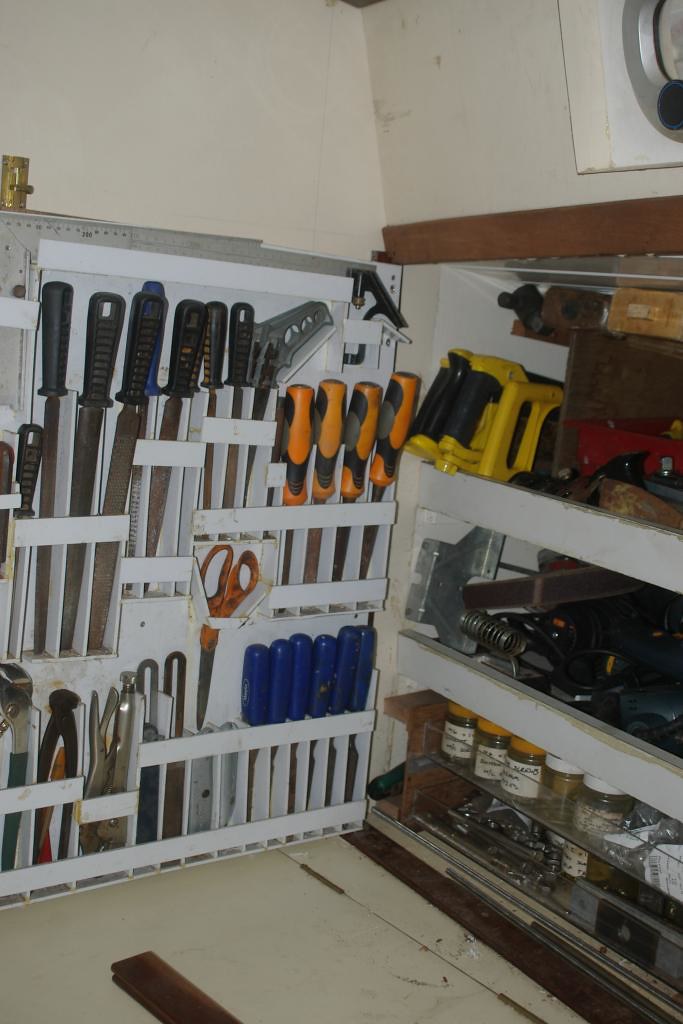
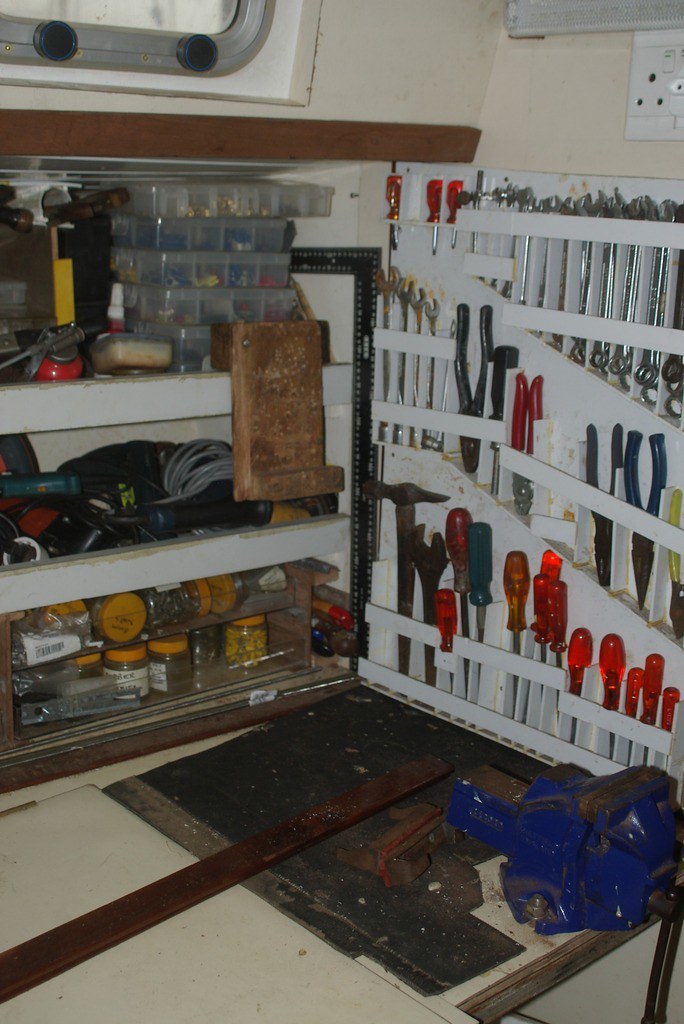
This is my on boat tool kit

35953366771_fca1eff4bd_b.jpg


35917694222_5842469ef1_b.jpg
 
I bought a Draper combined Metric, Imperial socket, spanner set, with an assortment of screw driver and allen key heads. It has worked well over the years. To keep the cost down I have supplemented the tools from car boot sales and auctions; good bargains to be had in second hand tools at such places, sometimes at a quality that is better than low cost stuff.
 
Pretty much as in the illustration with the addition of some mains power tools - we have a big genset.

I keep a small box of 'ready to use' tools handy for the times a spanner, screwdriver or whatever are needed quickly.

The larger tools are kept, in plastic toolboxes, in underseat lockers, along with the spare parts. If put away dry they dont go rusty.

I also think that portable vice is a great tool. Mine clips to a step or sticks to a smooth surface, but is smaller.

The tool I would really miss is the 5 inch Vise Grip. I have several genuine American Vise Grips, different sizes and jaw shapes, all but one set from 1970/71 when I was a Proto tool agent.

They are undoubtedly the best self locking plier available.

How many tools survive heavy workshop use fixing old motorbikes for over 40 years?

One 5 inch pair has hammer marks on its jaws from before it was fixed to my slide hammer. I would clip it to a shaft or spindle in a blind hole, warm up the crankcase or timing chest and gently tap the wide portion of the Vise Grip. This would always pull the shaft or spindle out of its tight interference fit. Welding a nut to the adjusting screw of the tool allowed it to be fixed to the slide hammer which made it even more effective - and quick and simple.

The local Bunnings here in wellington has a pair of genuine Vise Grips, 5 and 8 inch for 40 Dollars NZ. About 20 quid.

I'll pick some up next time I'm in.

However large and comprehensive your on board toolkit, sods law says the tool you need is elswhere at the time you urgently need it.........................................
 
Welcome to the forum and the wonderful world of boat ownership!

To answer this we need to know what boat you have & how handy you are. We'd also like to see a picture of your boat, we like looking at pictures of boats...
 
I thought I was light on tools, but I suddenly realise I have almost as many tools as everyone else, and sadly I've had to use most.

You absolutely need tools to:-
Change impellers.
Change belts (try it, you may find it's a substantial set).
Cut rigging.
A filter wrench.
Some sealant.
Electrical crimp kit.

I think everything else I could have winged it a bit.
 
Having collected all these lovely tools you might also want a box of disposable gloves and some nappies to collect all that split oil once you start to service the engine. A useful tool as mentioned above is a knife ,pliers and spike/shackle key set to strap near the helm plus a small gas powered scolding iron to melt ropes or heat bolts etc . Stubby spanner’s can a;so be helpful in confined spaces. Sadly you always end up buying extras but you might find a small battery pack drill and angle grinder handy . On basis these might be occasional use Lidl or Aldi products offer cheaper options for tools if to be left on board but do try for decent socket if budget permits . I rather suspect the kit needed might vary between those who potter around Chi harbour and those venturing around remoter parts of Med etc. A good source of info is to find a local mechanic to help with first engine service (on basis you have one)and seek his thoughts on what your engine might need . Even if you cannot fit a part yourself it’s always good to carry the key parts for engine if venturing away from local shores plus bulbs and suchlike if poss. Ask someone local to draw up a list maybe after viewing boat and discussing your plans and go from there .
 
I am in the process of steeling myself to buy a very expensive tool that I hope I shall never need - hydraulic bolt cutters.

At the more modest end of the scale, wire cutters, wire strippers and a crimping tool should be on the list. And a couple of extremely short screwdrivers.
 
Last edited:
A large roll of paper towelling is a useful addition. I seem to get through one every year.
I also carry a plastic tub of wipes, but I add a cup of Flash/water mix to keep them wet. Handy for cleaning ones hands & oily mess when finished jobs.
If into repairing engines, then a small tub of Swafega might be useful as well.
 
Last edited:
HI

Thanks for all the info.

Once purchase completed pictures to follow.

She will be leaving the warmth ?? of Chichester to the joys sailing in the Clyde.
I guess that you might not be setting off for the Clyde till next Spring and if so, I would recommend the Western route rather than the Irish Sea. There are lots of fine places to visit on the West of Ireland so you can spend the Summer in a gentle progress Northward.
 
I thought I was light on tools, but I suddenly realise I have almost as many tools as everyone else, and sadly I've had to use most.

You absolutely need tools to:-
Change impellers.
Change belts (try it, you may find it's a substantial set).
Cut rigging.
A filter wrench.
Some sealant.
Electrical crimp kit.

I think everything else I could have winged it a bit.

I think that is a good list!
 
I went the route of cheap toolkit moved to a tool roll, in a roll top waterproof bag. Only rust is from a pair of cheap pilers that got wet. The rest are nearly 10 years old and rust free. Having dropped and replaced a few tools cheap is a good way to go. I would go for decent sockets/spanners mind and eye up Bharco Or Halfords professional sets occasionally

I have added;
- Smaller and larger sockets / spanners. Check your engine or rig for large bolts/nuts (eg alternator pulley retaining nut) Ie 6mm to 24mm
- Pair of large adjustable spanners
- Good multimeter, wire stripper, crimper and adhesive lined heat shrink crimps
- Splice set comprising Selma fids, good scissors, needles (inc large/tough sailing ones), whipping twine and tape

The tools that get used the most are some screwdrivers, small adjustable spanner, multitool (has pliers) and the multimeter. These live in the chart table.

It helps that the boat is near an amazing old skhool hardware store that has the most amazing helpful staff and great selection called Hayling Hardware!
 
You absolutely need tools to:-
Change impellers.
Change belts (try it, you may find it's a substantial set).
Cut rigging.
A filter wrench.
Some sealant.
Electrical crimp kit.
.
Seeing that item makes me wonder how many forumites have actually lost their mast? I suppose it is a bit like the " why do I need a liferaft"? conundrum
But I admit to carrying both croppers & liferaft:encouragement:
 
I broke a mast (my own silly fault) on a sixteen foot open boat and the business of sorting out the bits and getting them on board was educational ...

The thought of losing a mast on a big boat horrifies me.

I am full of admiration for King Edward VII. I’ve seen a photo of Shamrock II or III on trials. The King was boating with his grocer, as his nephew put it, and the mast had just gone over the side in a mass of crumpled tubing, and doubtless a rain of blocks and wire, missing the helm by not very much. The King is standing next to the owner, calmly lighting a cigar...

Found a link, but not that exact picture. It was Shamrock II:

http://www.america-scoop.com/index....mrock-ii-s-story&catid=167&Itemid=423&lang=en
 
Last edited:
I am in the process of steeling myself to buy a very expensive tool that I hope I shall never need - hydraulic bolt cutters...

In a similar vein, I recently treated myself to a cordless angle grinder (blue Bosch one) and used it for the first time at the weekend for cutting 7mm rigging. Knife through butter in about 3 seconds!

Who doesn't love an angle grinder.
 
Top