
ltcom
Well-Known Member



Makes you wonder why base 10 (metric) is considered so smart compared to a system based on binary (2, 8, 16) or primes (6=2*3, 30=2*3*5).... because the Ancient Babylonians used a number system with a base of 60. Base 60 gave you a lot of "easy" relationships between numbers; 60 has a LOT of common factors.


If the one in the middle were drawn from the outside of the crooked thumb you would have 11.25 degrees.

The 112.5 degrees is half of 45 degrees plus 90 degrees, i.e. just aft of directly abeam. It's an arbitrarily selected but internationally agreed viewing angle for the coloured arc cut-off for navigation lights on ships and aircraft.


Blame the babylonians for the 360 deg circle. Napoleon would have made it 100degs, along with his ten day week, a 'decade'
Why don't they just use degrees and decimal degrees? I am struggling to see the advantages of mils, and there are rules-of-thumb for degrees as well. Mils must surely be in use because of a historical accident , traditionalism or somesuch..and now it would be hard to change perhaps.I'll throw Mils into the equation just to confuse everyone!
Mils
Mils are largely used by the military. The original system divides the face of the compass into 6283 divisions (Mils being short for mili-radians, derived from there being 2 Pi Radians in a circle, so 2 x 3.1416 or 6.283 mil-radians). Most Mils compasses however round this up into 6400 divisions for easier calculations. It is how bearings are described for artillery, mortar and tank fire and military handheld compasses use the same system. It can also be useful for determining range and scale – for example two objects that appear to be 100mils apart and are 1000m away from the observer are around 100m apart on the ground.

I read up on this a few years ago as part of exposing a 'Walt'. My recollection is that it's basically because a degree is way too big for shooters and the hexadecimal division not the simplest for everyone. Base 10 makes calculation far easier to teach.Why don't they just use degrees and decimal degrees? I am struggling to see the advantages of mils, and there are rules-of-thumb for degrees as well. Mils must surely be in use because of a historical accident , traditionalism or somesuch..and now it would be hard to change perhaps.
Aha thanks for the info.I read up on this a few years ago as part of exposing a 'Walt'. My recollection is that it's basically because a degree is way too big for shooters and the hexadecimal division not the simplest for everyone. Base 10 makes calculation far easier to teach.

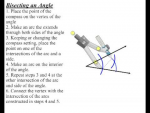
One of the first uses of a pair of compasses that one learned when starting geometry at school was how to bisect an angle.I get 6 segments with my compass. Maybe it's metric.
Why don't they just use degrees and decimal degrees? I am struggling to see the advantages of mils, and there are rules-of-thumb for degrees as well. Mils must surely be in use because of a historical accident , traditionalism or somesuch..and now it would be hard to change perhaps.


Revolutionary France tried 400 gradians, or gons, in a circle. They were never much used, although my ancient TI-33 calculator (1978?) does them.Blame the babylonians for the 360 deg circle. Napoleon would have made it 100degs, along with his ten day week, a 'decade'
Why don't they just use degrees and decimal degrees? I am struggling to see the advantages of mils, and there are rules-of-thumb for degrees as well. Mils must surely be in use because of a historical accident , traditionalism or somesuch..and now it would be hard to change perhaps.
Should be astrometry....ahem....astrology? #21