When things go wrong ... mast problems ....

Congratulations Nigel that is obviously a pretty heavy mast and you handled it well. I still reckon a higher crutch at the back but you will find that when you come to raise it again. (heavy at first) Make the crutch hieght based on bridge air draft and what you can reach from cockpit.
Re stopping mast swinging sideways. Macgreggor 26 trailer sailers have additional stay wires from chain plates on cabin side where pivot points are in line with mast hinge. The stays are light and only go to base of spreaders.
I have used bull dog clamps on stay wires set a bit above mast hinge line onto which I attach a line going forward to gunwhale then back to cockpit cleat. This is adjusted as the mast comes down to keep cap shroud tight in the traverse.
You could rope up a bridle on each gunwhale fore and aft of the mast pivot point the centre top of the bridle at the mast pivot line such that halyards could be arttached to remain tight through the traverse.
I use the armstrong method on my light weight mast but occasionally things get out of hand as yours did. My mast pivot is quite forgiving of swing sideways. I hope yours is OK. For peace I do the mast stabilising get helper to do the tackle which is always done from halyard winches on cabin top.
As said mine is a light mast but I reckon I have dropped and raised about 50 times over 40 years so we get into a habit. One thing that has gone wrong is getting halyards trapped under the mast base on raising. Really cuts the rope something aweful. Watch that one. good luck with the halyards ol'will
 
I think you realise how important it is to stop the mast swinging side ways ............ . It nearly went tits up when your helper let go !

I find with a smaller lighter mast I can manage without a helper by standing next to the mast as i lower it ( using the mainsheet tackle .) I always have a "helper" standing by , even if not actively helping, when raising the mast.

If you use the forestay instead of a halyard you will maintain adequate support for the furling spar. Connect a halyard as safety line if you feel it is necessary but let the forestay take the load .

I would love to use the forestay - but the windlass sits just behind it and I cannot get the a frame low enough to connect.

2rHiayk.jpg


The windlass in fact is hardly ever used ..... but to remove it would leave awful mess as it has a serious teak bed wedded to the deck etc.

I know - I asked him BEFORE the job - NOT to move from top of cabin ... to set himself a position and then stay there ...

Unfortunately - he's not a boater ... he just bought the MoBo next to my boat ... and he's only been out in it once !
 
I would love to use the forestay - but the windlass sits just behind it and I cannot get the a frame low enough to connect.

change your frame to an A shape frame by adding a cross member just in front of the cabin to bent the main members make them follow the curvature of the deck and clear the windlass maybe?
 
One of the considerations of the gear used ... I designed so able to carry it on the boat. I could have Wife drive car to Town Quay to collect the gear and take back to house ... but much easier if I can stow on cabin top or alongside sidedeck.
The wood crutch is such that I can lash to guardlines out of the way ...

Its another reason I am wondering about converting to a single gin pole.
 
change your frame to an A shape frame by adding a cross member just in front of the cabin to bent the main members make them follow the curvature of the deck and clear the windlass maybe?

See post #104 ...... one of the reasons for present design is it fits on top of cabin ...

Good idea - but would mean only suitable for use at home ... I need to also use at Town Quay ...
 
Top dog - well done Refueler - always a win when you can walk away with no wounded and the mast safely and undamaged in the crutch... :D Good lessons learned..

When you come to put it back up, as someone previously said, a higher crutch will help a lot to get you over the first 30 or 40 degrees of lift... some of the guys in my club use a ladder to lift the mast up as high as they can (just sit the mast in the top rung and then raise the ladder to vertical by man power) before resorting to the pulley/blocks to do the rest... on mine one of the guys stands in the cockpit, lifts the mast and then walks forward lifting as he goes, while I take the slack and load on the mainsheet, and the guy on the cabin roof checks for stays catching and lifts up.. once it goes past 45' all the forces start to drop off markedly..
 
All points well understood and taken ...

The job is to get to a situation that maximum 2 people with a system can raise and lower with gear that can stow on the boat

The Compass24 'Mast Lift' system was my original but I think I was lucky that C24 refsued to ship to me ... as the SWL of it is well below that of my mast.

The mast on Superanne was not from Searider Yachts as far as info given to me when I bought her. Its a mast from maybe a Centaur or Factory Colvic. Reason I tend to believe it - a) the weight of it is over 200kg's with gear, b) the spreaders are at a different level of mast than would be normal. This indicates that maybe a short piece was removed from the foot and base re-attached.
The boat was 'home completed' by her first owner back in the mid 70's.

The setup has its faults but nothing can really be done to fix them now ... main one is she carries a lot of weather helm, the mast is placed just forward of cabin bulkhead instead of directly above it... its only a few inches but makes a big difference.
It leads to a funny 'trick' I play on people who sail on her ... they find weather helm and I just say - ok ... How to reduce it ... feel free to do necessary ..

They ALL jump to the mainsail and want to reef that down ...

Because of the setup - its actually better to roll the genny in a bit first as that is the real driving sail of her ... then the centre of effort moves fwd nicely ... once a few turns of genny and the clew moves fwd of the mast - then if needed main can be reduced ..

If anyone wants to argue with that ... get out here - I will give you boat for a day and you prove me wrong !! (20 odd years of ownership may mean something ?)

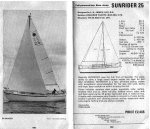
Bristows photo of the boat shows a massive Genoa - I would hate to even get near to that size on her without modifying mast position ...

Bristows SR25.jpg
 
Interesting comments on weather helm. It does seem to me that many people get true weather helm a bit confused. (compared to my thinking) To me weather helm is in most cases a result of heeling the boat hence as you found reducing genoa area reduces weather helm. The weather helm that is a result of sail area balance compared to keel/hull centre of lateral resistance can only be considered or demonstrated with the hull perfectly level. (no heel). So really gentle conditions. The effect can only really be seen when you try to make the boat self steer. ie tiller locked centre.
As soon as the hull heels you get effects like drag of the keel off centre to the forward drive of the sails so causing the boat to turn to windward. A kind of weather helm but not one fixed by sail balance. Often more pronounced on different shaped hulls. ol'will just waffling.
 
As we all know - a good idea is to have a boat set so it naturally wants to luff up if you let go the helm ... but there's a limit to how hard the boat wants to do it !

My boat if you have full sail and you get her going .. you are literally two hands on the tiller and leaning back ! The bow literally dips and tries hard to turn into wind. Reduce the genny and move its centre fwd and she literally pops up and sits nice with just that slight luff up.

I've tried different mast rake ... I have it set on the fwd setting of the base ... nothing much I can do now to correct .. But having learnt the hard way to roll in a bit of genny - I can live with it.

Steve (pal from Finland) we were sailing near close hauled ... about 50 deg of wind ... reasonable breeze ... genny about 70%, one reef in main and we were hitting 7kts without engine ... which is unheard of for her ... !!

Basically we decided to see what we could do with her after a 10 day cruise through Swedish and Finish Islands ...
 
Now its down ... start servicing it ...

First sort out the sheeves in the base ...

Retainers ... one sheered its captive plate ... another fitted before my ownership is unsuitable and sheered its screws ..

AIspRDA.jpg


Base needs a good clean up ...

LqSwqMg.jpg


9ibEhGO.jpg


TMURJRR.jpg


My pal's making new stainless retainers at about 5 euros each ... should have those early next week. I will have to drill and tap the base to make new screw fastening for them. After grinding away the old screw remains of course.

While all out - I can rearrange halyard order from the daft setup previous guy did ...

He had :

Genny halyard exiting rear of mast base - making it difficult to raise and lower genny cleanly.
Main halyard exiting front of mast base ...

This meant that halyards inside mast were crossing each other as well.

I will move Genny to the empty front slot and main to the rear.
It will also give me the front exit vacated by main for the spinnaker halyard.
 
Here's a question : Has anyone replaced the retaining plate / pins for the halyard sheeves with coach bolts ?

I measured my slot and where bolts are ... 45mm ... then the blade fitting on deck ... 40mm. It would appear that the required 10mm pin could pass one side to other without actually hitting the blade. Meaning a stainless 10mm coach bolt could if needed do the job instead of the original plate/pins.
 
Here's a question : Has anyone replaced the retaining plate / pins for the halyard sheeves with coach bolts ?

I measured my slot and where bolts are ... 45mm ... then the blade fitting on deck ... 40mm. It would appear that the required 10mm pin could pass one side to other without actually hitting the blade. Meaning a stainless 10mm coach bolt could if needed do the job instead of the original plate/pins.

I would not

I have similar retaining plated like yours but only one hole. I replaced the sheaves with some turned from Vesconite and fitted sealed stainless ball bearings to reduce friction. I also machined he sides to stop any grit getting between the sheave and the side plate. This prevented any grip jamming.

I have 2 scheves at front and aft side of the mast and a single pin. I replaced the set screw holding the retaining plate with a stud and nut to allow easer removal without snapping the retaining bolts as happened to both you and me.
 
I would not

I have similar retaining plated like yours but only one hole. I replaced the sheaves with some turned from Vesconite and fitted sealed stainless ball bearings to reduce friction. I also machined he sides to stop any grit getting between the sheave and the side plate. This prevented any grip jamming.

I have 2 scheves at front and aft side of the mast and a single pin. I replaced the set screw holding the retaining plate with a stud and nut to allow easer removal without snapping the retaining bolts as happened to both you and me.


Sorry bit confused there ....

You only have one hole for a pin that takes two sheeves ? As in the hole is only one side of the base and pin passes through to the other side but no exit ?

I was lucky that I have holes both sides exactly aligned ... that let me drive out the stubborn pins after I had removed the other.

Use of coach bolts would actually make the whole setup much easier - instead of those silly little retaining screws. It always amazes me the amount of dissimilar metalworks on boats ... no matter what metal those little screws are - they will seize.
 
Sorry bit confused there ....

You only have one hole for a pin that takes two sheeves ? As in the hole is only one side of the base and pin passes through to the other side but no exit ?

I was lucky that I have holes both sides exactly aligned ... that let me drive out the stubborn pins after I had removed the other.

Use of coach bolts would actually make the whole setup much easier - instead of those silly little retaining screws. It always amazes me the amount of dissimilar metalworks on boats ... no matter what metal those little screws are - they will seize.
I've got a couple like that. The pin goes in through one side, but instead of coming out of the opposite wall it stops inside. There's a small hole there to let you poke something through to push the pin out again - once you have the cover plate off. Saves having two plates. Anti corrosion goop works well enough on the small screws if you maintain regularly. (Mine's down every year).

I don't see why a stainless bolt shouldn't be used in your case.
 
I have 2 sheaves at the front of my mast with a single shaft passing through both. The same in the aft side of the mast. Giving me 4 halyards going down inside the mast.

Each shaft is held in place with a plate welded to one end of the shaft. (similar to yours) In my case I only have one hole in this keep plate offset from the center shaft to bolt into the mast same as yours. I had the same issue as you when I refitted the sheaves that the retaining bolt broke. I drilled and tapped a replacement hole but fitted a stud such that the hole in the keep plate fitted over the stud. A nut on the stud then retained the keep plate and thus the shaft.

The hole went right through the mast, the 3 sheave side plates and the sheave bearings then through the other side of the mast. As the keep plate was welded to the shaft, the shaft would not come out but once I removed the keep plate nut I could just push the shaft out from the side that did not have the keep plate.

The main reason to have a keep plate welded to the shaft is to prevent the shaft rotating and wearing the hole in the mast. If the sheaves jam there is no undetectable damage to the mast. It also stops the shaft falling out in one fitting.


Hope this make it clearer.

No close up pic I'm afraid.
 
OK ... I think I've got it.

Mine as you see are individual pins with retaining plate welded on ... so centre is clear of pin.

Measurements indicate that I could use a single pin right through for 2 sheaves ... and more I think about it ... the more I like the idea. The plate/pin idea is nice - but given the silly screws used ?? If I do use the plate/pins again (my mate is making new ones) - I will use hex headed screws - not screwdriver slot versions.

What is interesting ... I never took much notice 13yrs ago when all this lot was last dismantled - one sheave is Tufnol, while the other 3 are alloy. See earlier photo.
 
I've got a couple like that. The pin goes in through one side, but instead of coming out of the opposite wall it stops inside. There's a small hole there to let you poke something through to push the pin out again - once you have the cover plate off. Saves having two plates. Anti corrosion goop works well enough on the small screws if you maintain regularly. (Mine's down every year).

I don't see why a stainless bolt shouldn't be used in your case.

That makes better sense than mine. Each sheave has its own pin / plate as you see ... So if you cannot get one side out - you cannot tap anything through to push the other pin out.

I'm slowly starting to move towards the use of that coach bolt instead.

Now I've sorted the mast lowering system - I plan to be a better boy and look after my mast better now ...
 
Regarding spin halyard. A most successful system uses a halyard which comes out of a slot in the side of the mast. This exit is made quite high loike 2 metres above deck. The guy hoisting can use his weight to pull on the halyard to get it up quickly. A clutch is mounted below the exit slot . Forward hand pulls the spin up through clutch. Once things settle down the spin halyard is pulled tight via deck mounted turning block to cleat at cockpit cabin top. Clutch is opened. So spin can be hoisteda t the mast but dropped from cockpit.
Anyway Nigel have think about spin raising as I don't think a sheave at the front base of the mast will be most convenient. When replacing my mast I went away from sheves near the base to exit slots for all halyards with turning blocks attached to the deck. Less friction I think certainly I like it better. ol'will
 
Appreciate all comments ... but c'mon guys - this is an old plodder motor-sailer .... of 1974 vintage ..... how often I will hoist a spinny is maybe once a year !!

To run halyards back to cockpit would mean modifying the sprayhood as well as all the turn blocks and fittings to add. The Sprayhood is getting on and any modification will likely lead to its needing replacement !! When I had the 'windows' replaced - the guy said he was 50-50 whether the material would survive the work.
 
Top