When things go wrong ... mast problems ....

Look like a U bolt type chain plate.

Make up 2 big washers (don't need to be round) with a hole that a bolt will pass through the washers on each side of the U-bolt.

Your lowering arms and be drilled to fit over there bolts with a nut to keep thee lowering armes in place.

If the bolts are long with a spacer on the inside it would prevent the arms hitting the deck and molded toe rails.

My chain plated bolts run for aft so I have made some angle brackets ro get the hinge pin axis across the boat. Yours are easier
 
All suggestions / posts appreciated and all considered ...

I'm sure I am over-thinking this ....
I think you may be! You didn't mention that you had access to poles.. best ones are v v long carbon fishing rod blanks, but stainless just makes it harder work. Get a binos/camera up there, drone or strapped to tlift and hoisted and find out what the problem is. With a pole, bent steel rod/wire and patience you can lift the messenger back onto the sheave.
 
I think you may be! You didn't mention that you had access to poles.. best ones are v v long carbon fishing rod blanks, but stainless just makes it harder work. Get a binos/camera up there, drone or strapped to tlift and hoisted and find out what the problem is. With a pole, bent steel rod/wire and patience you can lift the messenger back onto the sheave.

I've used binos to see what's happened .... its a mast down job ...

Fishing rod blanks will not do this I'm afraid. I tried even a 'dolly' on another line to change the angle to free the trapped line ... didn't work.

I've lowered the mast before with poles etc. and they bent ... so I am cautious of what I use.
 
Hello Nigel. I assume you have a mast base fitting that will hinge. If not disregard all of the following. The A frame might also be called gin poles need to be long enough to give that decent angle of pull of the forestay when the mast is near horizontal. Something like the distance bow to mast or a bit more would be good. Seems like the ss ploes you have will be ok. The greatest load on the base of the A frame will be when the mast is near horizontal and this pressure will be down ward. So a plate of plywood or imilar would protect the deck. However the base of the A frame must be located positively so the bases don't skid backwards. Most people around here use a 4 purchase tackle on the forestay to lower or raise mast. Use a winch to get more power and control the tackle when the mast gets lower. No real load of course for the first 20 degrees.
Be wary of the mast swinging sideways this will wreck the base. This happens when boat heels with waves or people moving around on deck. Cap shrouds can be left on but must be tensioned as mast goes down because they get looser as it goes down.
Now I am a bit biased as around here almost every large keel boat is set up for mast lowering to traverse under bridges so it becomes a routine if tedious to do it while under way. (some are really huge masts). But I reckon you or any kb sailor should be able to lower his mast himself but with helpers for maintenance.
You will need a crutch to drop the mast into. make it as high as possible. I think if your mooring is as described you would put the boat in stern to the bank then lower the mast into a crutch to the point where you can access the mast top with a step ladder. The less you lower the mast the easier it is to raise it again and less stress on your A frame. It will be a much greater undertaking to remove the mast from it's base and take it ashore. Need helpers.
Perhaps not applicable in your case but for my little boat (f4ractional rig) at home for the winter with mast down and mast base on pulpit I pull all the rope halyards so that only the ends come out of the mast and the excess at the bottom goes in the anchor locker. All to reduce UV damage over winter. (yes it is a concern here) Anyway in a fit of madness or old age I pulled the spin halyard at the base only to find I had forgotten to put a stopper knot in the end. So spin halyard was lost inside the mast.
Now my trick to retrieve is to use the main halyard to take the spin halyard up again. I removed the sheave box for the spin pole topping lift and found the spin halyard and pulled it out that hole till I got the top end of the halyard. (if the halyard was right out I would use a stiff wire pushed from the bottom through the halyard exit holes in the mast near the base and use that to pull the halyard at least half way up to the topping lift exit box)
I fished out the main halyard enough that I could tape the spin halyard to the main halyard. I removed the exit sheave box for the spin halyard then pulled the main halyard up until the end of the spin halyard appeared at the exit hole. Fished it out. Refit the pop rivets for the exit sheave boxes and stupid mistake remedied.
I tell this tale as the idea might be useful to you or someone else. good luck ol'will
 
I have n 'A' frame which was sold through Compass Marine before they disappeared, it's built from aluminium tubing which permits it to be dismantled into sections short enough to fit(just) into a Ford Fiesta. It will handle mast weights up to SWL 120kg
and I have used it on my 10 M mast every season for the last 10 years.
It's a bit of a fiddle to erect at the start of the season when the mast is down, but at the end of the season when the mast is up it's simple, just haul it up with the spinnaker halyard.
I haven dropped and raised the mast with this single handed but a couple of crew around does make the job easier, the great advantage is that you can raise or lower the mast without a crane and we have in fact done it on the mooring a couple of times.
Several club members have borrowed it over the years for dropping their masts.
Will have a look around to see if I can find some pics of it in use, the original instruction sheet, or who manufactured it.
 
I have n 'A' frame which was sold through Compass Marine before they disappeared, it's built from aluminium tubing which permits it to be dismantled into sections short enough to fit(just) into a Ford Fiesta. It will handle mast weights up to SWL 120kg
and I have used it on my 10 M mast every season for the last 10 years.
It's a bit of a fiddle to erect at the start of the season when the mast is down, but at the end of the season when the mast is up it's simple, just haul it up with the spinnaker halyard.
I haven dropped and raised the mast with this single handed but a couple of crew around does make the job easier, the great advantage is that you can raise or lower the mast without a crane and we have in fact done it on the mooring a couple of times.
Several club members have borrowed it over the years for dropping their masts.
Will have a look around to see if I can find some pics of it in use, the original instruction sheet, or who manufactured it.

The Mast frame as you describe from Compass is still available .... I take it you mean this one :

Telescopic Mast Derrick

0112540_r2_FS06ix.jpg


I looked at it ... but they will not deliver to Latvia ... and price has soared over last year or so ...
 
Hi Refueler, yes that's it, I could take a couple of photo's of the relevant parts if it might help, it would be very easy for someone with even small metal working facilities to make something based upon this unit.
Basically it's purely a aluminium tubes drilled to accept drop pins to set the lengths required, a couple of rubber padded feet to rest on the deck, a 'U' section at the top to create the 'A' and a block and tackle (not supplied) to lift and lower the mast.
 
Hello Nigel. I assume you have a mast base fitting that will hinge. If not disregard all of the following. The A frame might also be called gin poles need to be long enough to give that decent angle of pull of the forestay when the mast is near horizontal. Something like the distance bow to mast or a bit more would be good. Seems like the ss ploes you have will be ok. The greatest load on the base of the A frame will be when the mast is near horizontal and this pressure will be down ward. So a plate of plywood or imilar would protect the deck. However the base of the A frame must be located positively so the bases don't skid backwards. Most people around here use a 4 purchase tackle on the forestay to lower or raise mast. Use a winch to get more power and control the tackle when the mast gets lower. No real load of course for the first 20 degrees.
Be wary of the mast swinging sideways this will wreck the base. This happens when boat heels with waves or people moving around on deck. Cap shrouds can be left on but must be tensioned as mast goes down because they get looser as it goes down.
Now I am a bit biased as around here almost every large keel boat is set up for mast lowering to traverse under bridges so it becomes a routine if tedious to do it while under way. (some are really huge masts). But I reckon you or any kb sailor should be able to lower his mast himself but with helpers for maintenance.
You will need a crutch to drop the mast into. make it as high as possible. I think if your mooring is as described you would put the boat in stern to the bank then lower the mast into a crutch to the point where you can access the mast top with a step ladder. The less you lower the mast the easier it is to raise it again and less stress on your A frame. It will be a much greater undertaking to remove the mast from it's base and take it ashore. Need helpers.
Perhaps not applicable in your case but for my little boat (f4ractional rig) at home for the winter with mast down and mast base on pulpit I pull all the rope halyards so that only the ends come out of the mast and the excess at the bottom goes in the anchor locker. All to reduce UV damage over winter. (yes it is a concern here) Anyway in a fit of madness or old age I pulled the spin halyard at the base only to find I had forgotten to put a stopper knot in the end. So spin halyard was lost inside the mast.
Now my trick to retrieve is to use the main halyard to take the spin halyard up again. I removed the sheave box for the spin pole topping lift and found the spin halyard and pulled it out that hole till I got the top end of the halyard. (if the halyard was right out I would use a stiff wire pushed from the bottom through the halyard exit holes in the mast near the base and use that to pull the halyard at least half way up to the topping lift exit box)
I fished out the main halyard enough that I could tape the spin halyard to the main halyard. I removed the exit sheave box for the spin halyard then pulled the main halyard up until the end of the spin halyard appeared at the exit hole. Fished it out. Refit the pop rivets for the exit sheave boxes and stupid mistake remedied.
I tell this tale as the idea might be useful to you or someone else. good luck ol'will

Thanks for the write-up ....

It's crazy that just 2ft more of boat and with the 'blade' mount - that the mast lowering takes on a different ball-game. My young son at around 12yrs with me - on our own could drop / raise my Snapdragon 23's mast without a-frames etc. But we had full tabernacle mount.
Present boat at 25ft has the blade mount (guy who fitted out the boat originally took gear from a Colvic. As you say - sideways movement has to be avoided as it could crack the casting easily. I have though in past to change to a Tabernacle - but would mean serious modification of mast lowest section due to cleats etc.
In the past 3 - 4 strapping lads along with blocks have done it ... but the last time - we actually bent the pulpit !


next photo - you can see it bent the metal pole at the bow !


Basically we used wood before - but I was 'pushed' to try the metal pole by the guys ... I was wary of it ... but they kept on and we tried. Luckily the bend in the pulpit itself was easily rectified by local metal master ...

When the mast was taken of in UK ready for transport to Latvia .. the guys there remarked that it was heavier than theyb usually saw on such a size boat .. which I had suspected anyway. The diameter and lack of taper to the mast always led me to believe it was a taller mast cut back.

The two SS poles will be 'anchored' at their foot to avoid any slip fwd / back ... originally I thought of getting metal U channel and fixing as a pivot to pole base and the U channel sitting over the Toe-rail ... fast to the U stanchion fixing. If I can find suitable - maybe that will still be done ...

I have a Royal Windlass on the foredeck - so no problem there.
 
Hi Refueler, yes that's it, I could take a couple of photo's of the relevant parts if it might help, it would be very easy for someone with even small metal working facilities to make something based upon this unit.
Basically it's purely a aluminium tubes drilled to accept drop pins to set the lengths required, a couple of rubber padded feet to rest on the deck, a 'U' section at the top to create the 'A' and a block and tackle (not supplied) to lift and lower the mast.

I contacted a company in Riga who make garden Flagpoles ... but they were not interested ...

I know the Compass system - I also know of a case where the guy stupidly tried to use and let the mast weight move from under the A and the tubes buckled ... as they are only designed for vertical lift.
When I talked to Compass some years ago - when I first saw this - I had their catalogue sent each year to me ... they reckoned a Centaur mast was no problem for it .. which is basically similar to mine. Price then was about 1/2 what it is now ...
But no delivery ... shame ..
 
I imagine one concern is the boat rocking as you lower the mast. Would there be any advantage in fitting some form of beaching legs to "fix" the hull to the bottom?
 
You are correct, the A frame is only safe for vertical lifts, but a small amount of deviation from vertical (side to side or fore and aft) does seem to be OK.
We have dropped a Centaur mast also, the mast on my previous boat an Invicta 26 and my current boat Sadler 25, all these masts were about the 10m length.
I guess I was lucky I bought this when it first came on the market and was only about the £100 Mark.
 
I would have bought the Mast Lifter from Compass if they'd delivered ... then it was pricey but acceptable. Now its a joke to ask so much when you don't even get gear to use with it !!

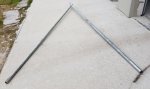
I've made my A frame based on the two poles - I made error earlier - they are not stainless - they are galvanized .... just have to wait for good weather and decide how to protect the deck while stopping poles from sliding ...

A Frame rig (1).jpg

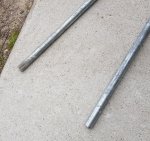
8mm stud bar is the pivot axle but because the poles are V'd this way - no weight comes on the stud bar.

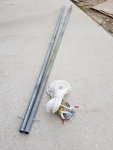
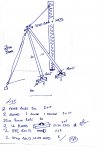
The rope is 30m of 8mm poly and 2x double blocks
A Frame rig (2).jpg

Those pole ends need some way to protect the deck ... thinking either 'wifes idea' of cut pieces from car tyres or a pair of old shoes !

A Frame rig (3).jpg

stowable :

A Frame rig (4).jpg
 
This is a pivoting A frame ... not static like the Compass lifter. The poles are only 2.8m long ....

The feet of the poles are in need of anchoring to prevent sliding on the deck.


If you make the poles just long enough to nearly reach the stem head fitting you can attach the forestay/ furling spar to its apex and the main sheet between the apex and the stem head

You can then lower it using the main-sheet tackle which has a more comfortable sized rope to handle than your 8mm poly-whatever. Assuming you have a jamming cleat on the mainsheet lower block you can utilize this if you need to pause midway

Arrange a support at the stern that will take the weight when the mast gets down to near horizontal ( bear in mind that the spreaders may well be near the point where you will arrange the support)

Be very sure about the integrity of the maststep/ tabernacle fixings to the deck because as yo get close to horizontal the shear loads on them become quite high.
 
Top