
what's missing from my mast?

jimmynoboat

Well-Known Member
Joined
13 Nov 2005
Messages
918
Visit site
We raised the main sail yesterday and found that we couldn't put a reef in because the reefing ring thing
couldn't reach the reefing hook thing because the plastic things that run in the track and attach the sail
have been stopped from dropping low enough by a make-shift pin through the track. (BTW please feel free to fill
me in ... regarding nomenclature that is).

The pin is just above the wider opening in the track which, I assume is there to insert the plastic things in the
first place. We removed the pin and managed to get a reef in although it was trickey stopping the plastic bits
from falling out. Not something I'd want to mess about with at sea.

So, the question is what's missing? is there supposed to be some kind of plate over the sides of that opening? There do not seem
to be any vacant fixing holes nearby. The previous owner must be responsible for the pin idea and must have had
their reasons.
 
I have exactly the same problem - on my mast there was a plate that covered the open slot so the sail sliders drop down enough. The screw thread that held the plate in position was stripped and as a temporary fix I fitted a spllit pinjust above the open slot which means that the pin ahs to be removed to allow the sail slides to drop down enough. I've marked the halliard so I only lower it just enough, cleat it off, remove the pin, hook the cringle eye over the reefing hook then tighten the halliard.
My 'temporary' fix has worked for three years to date.........
 
We raised the main sail yesterday and found that we couldn't put a reef in because the reefing ring thing
couldn't reach the reefing hook thing because the plastic things that run in the track and attach the sail
have been stopped from dropping low enough by a make-shift pin through the track. (BTW please feel free to fill
me in ... regarding nomenclature that is).

The pin is just above the wider opening in the track which, I assume is there to insert the plastic things in the
first place. We removed the pin and managed to get a reef in although it was trickey stopping the plastic bits
from falling out. Not something I'd want to mess about with at sea.

So, the question is what's missing? is there supposed to be some kind of plate over the sides of that opening? There do not seem
to be any vacant fixing holes nearby. The previous owner must be responsible for the pin idea and must have had
their reasons.
Sounds like original sail had rope luff. Pin added as you say. Normally with slides the gap or gate is assymetric and once sail is bent on a plate closes one side.stopping them coming out but allowing them to slide down below the gate. Havae alook at someone else's and copy it.
 
We raised the main sail yesterday and found that we couldn't put a reef in because the reefing ring thing
couldn't reach the reefing hook thing because the plastic things that run in the track and attach the sail
have been stopped from dropping low enough by a make-shift pin through the track. (BTW please feel free to fill
me in ... regarding nomenclature that is).

The pin is just above the wider opening in the track which, I assume is there to insert the plastic things in the
first place. We removed the pin and managed to get a reef in although it was trickey stopping the plastic bits
from falling out. Not something I'd want to mess about with at sea.

So, the question is what's missing? is there supposed to be some kind of plate over the sides of that opening? There do not seem
to be any vacant fixing holes nearby. The previous owner must be responsible for the pin idea and must have had
their reasons.

If it is a Selden mast there is an infill piece that you put in after the sail has been hoisted. It is held in by a fiddly self-tapping screw but allows the sail to slide back down.

Bit confused by the explanation but it sounds like the previous owner was missing this and put a makeshift pin in instead. I seem to recall this piece is in the Selden catalogue.

P.S. Just looked at their catalogue and it is there under sail entry stuff. Seems to be spring loaded now.
 
Can you add a pic at some stage please ?

I would not expect you to need the slides between full main and Reef point 1, as Reef 1 tack and clew will make the area of sail redundant, and all that area gets bundled/flaked up.

It does sound as if you need to have good control of the main halyard to stop the slides above the reef point falling out. Perhaps a mark made on the halyard just as it disappears into a mast sheave, or similar ?

The alternative is to add an extra length of track between the gooseneck and the current track to keep the slides under control.
 
I have exactly the same set up as the OP, and would like exactly the same fix!

I think Ludd has it in one my mast is obviously set up for a sail with a rope luff, and I now have sliders...

As per the original poster when I want to take a reef in because I no longer have a continuous luff, the slides drop out of the (non-asymetric) gate in a very irritating manner... :D

Does anyone have a picture of what these asymetric gates look like - can you retro fit to an old style gate??
 
We raised the main sail yesterday and found that we couldn't put a reef in because the reefing ring thing
Reefing Cringle
couldn't reach the reefing hook thing
Correct! (sometimes called a Cunningham Hook)
because the plastic things
Track Slides
that run in the track and attach the sail
have been stopped from dropping low enough by a make-shift pin through the track. (BTW please feel free to fill
me in ... regarding nomenclature that is).

I'll take my pedant's hat off now.

My son's yacht has a small section of track, hinged at the bottom and spring loaded at the top, that you press in to slide in the track slides. This section returns out and allows the sail slides to slide down lower, past this section, on the mast to facilitate reefing.

Tom
 
Last edited:
Spectacles?

(stainless steel rings on the end of a strong webbing strap which passes through the luff cringle)

MD
 
I had a similar problem on my Zspars mast. I cut out two plates from Aluminium sheet and drilled and tapped two holes either side of the track at the wide point where the slides go in. I have to unscrew one of the plates now to get the sliders in and out but it solved the problem.
 
Spectacles (stainless steel rings on the end of a strong webbing strap which passes through the luff cringle)

MD

That's how I do it, though a less sophisticated version.
Mine is a length of 8mm rope with an eye splice in one end, that goes over one side of the rams horn, through the luff cringle then a clove hitch onto the other side of the rams horn.
The rope is long enough to cope with the bulk of sail for any reefing point.
 
That's how I do it, though a less sophisticated version.
Mine is a length of 8mm rope with an eye splice in one end, that goes over one side of the rams horn, through the luff cringle then a clove hitch onto the other side of the rams horn.
The rope is long enough to cope with the bulk of sail for any reefing point.

I use toggles(like duffel coat). Pop through and they stay there,no slipping off horns when you start to hoist.
 
I had a similar problem on my Zspars mast. I cut out two plates from Aluminium sheet and drilled and tapped two holes either side of the track at the wide point where the slides go in. I have to unscrew one of the plates now to get the sliders in and out but it solved the problem.

Something like this? http://www.beneteau235.com/f235_mods-mast_gate.htm

This is one of my summer jobs (ran out of time over winter - too busy skiing:-)) I have also seen a design that uses threaded knobs instread of screws so you can undo and take the sail out without getting the toolkit out.

Have a search for 'mast gate' - you seem to be able to buy them for dinghies, but nothing big enough for a yacht :-(
 
I had the same problem, but came up with an alternative approach. On my boat there is a sliding gooseneck, so when the halyard is loosened, the boom slides down away from the mast gate. I threaded a hole in the slide and put a bolt through, making the gooseneck fixed and within reach of the cringle. Simples!
 
Something like this? http://www.beneteau235.com/f235_mods-mast_gate.htm

This is one of my summer jobs (ran out of time over winter - too busy skiing:-)) I have also seen a design that uses threaded knobs instread of screws so you can undo and take the sail out without getting the toolkit out.
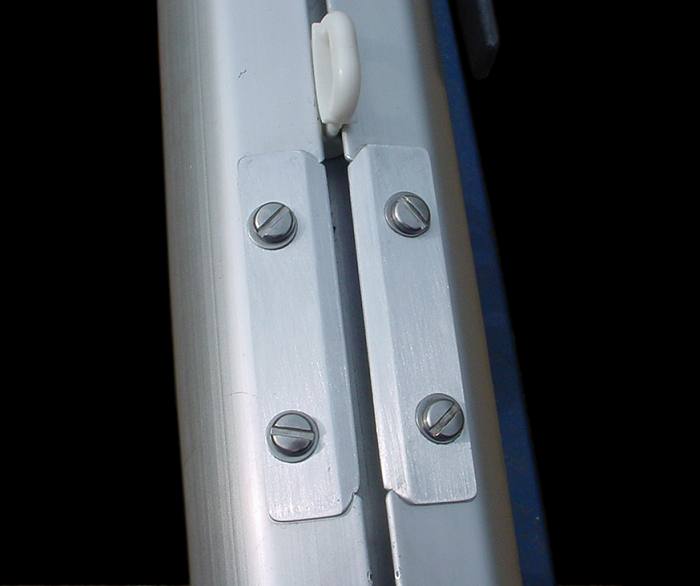
Have a search for 'mast gate' - you seem to be able to buy them for dinghies, but nothing big enough for a yacht :-(


Yes Exactly like that.
gate_with_plates_700.jpg
 
Thanks

Thanks everyone. Lots of good stuff again, I Thought of making up a couple of plates just like those in the photo. Though I am a bit confused about what must have been there before.
Thanks for the terminology corrections too.
 
I had a similar problem to you which I dealt with by getting a boatyard to make up 2 s/s plates which are set on either side of the mast track gate on knurled screws (which can be loosened but which cannot come out). One or both of the plates can be loosened by lossening the knurled screws and then be slid out of the way of the sail slides, which can then come out. However when the plates are in place and the screws tightened the sail slides pass down the gap between them and do not come out.
Dont know how to do photos on the website so if you would like to see some photos send me your email address and I will copy them to you.
Michael Minnitt
 
I have exactly the same problem - on my mast there was a plate that covered the open slot so the sail sliders drop down enough. The screw thread that held the plate in position was stripped and as a temporary fix I fitted a spllit pinjust above the open slot which means that the pin ahs to be removed to allow the sail slides to drop down enough. I've marked the halliard so I only lower it just enough, cleat it off, remove the pin, hook the cringle eye over the reefing hook then tighten the halliard.
My 'temporary' fix has worked for three years to date.........

We had the same issue, solved by the last owner who drilled a couple of extra holes in the plate for two self tapping screws to hold it in place. As its only removed once a year this works fine.
 
Top