What's inside a wired windlass remote?

Sea Change

Well-Known Member
Joined
13 Feb 2014
Messages
2,068
Visit site
My wired windlass remote was playing up, so I opened it up expecting to find two microswitches and not much else.
Well, there is a bit more to it than that. There's a few resistors etc in there.
The unit is basically kaput, with lots of cracks in the casing, and I'm not very enthusiastic about paying over £100 for what I thought was simply a box with two buttons on it.

What purpose do the resistors etc serve? What would happen if they weren't there?
 
I believe these components help distinguish which button is pressed, prevent electrical noise from causing false triggers, limit current to protect the system, and smooth out switch “bounce.”

Years ago I upgraded to a wireless remote, combined windlass and bow thruster, and am very happy.

Both branded and universal devices available.
Sleipner_RC_21E@72dpi.png.jpg
 
Last edited:
My wired remote didn't work when I got the boat 5 years ago. Stripped, cleaned, emery paper on the contacts and still intermittent. An electrician friend showed me I hadn't sanded the contacts enough and hey presto, back to working. 35 years old. No idea what the resistors do unless they are capacitors to stop the current surge when the solenoid engages?
 
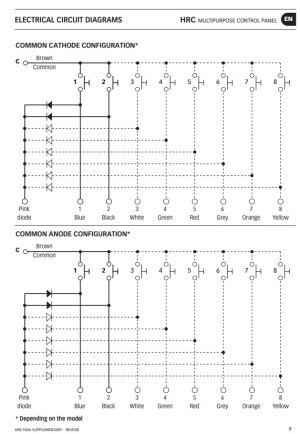
If it's a Quick one, it could be the diode version "intended for switching hydraulic motors" (according to the Quick booklet). I don't have experience of this but can only assume the diode is there to provide a feed to the pink wire whenever any button is pushed, ie to power another solenoid to start the hydraulic pump whilst the up/down 1/2 drives the motor in either direction?

The simple version has just switches so if you don't have hydraulic motors or the need for the diodes, then a simple switched handset will do. The pins can corrode in the plug/socket so it might be worth considering hard wiring it if you have no need to remove it from it's location, eg inside an anchor locker.

quickhrc.jpg

https://www.quickitaly.com/resources/downloads_qne-prod/1/HRC100x_Integrativo_Rev05B.pdf
 
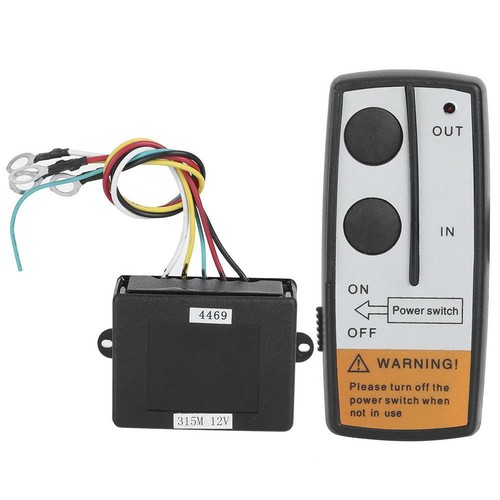
Paul Rainbow pointed me in the direction of this on ebay for about a tenner. It's in its third year on Jazzcat, and working well.

s-l500.jpg


How much faffing with an old remote would it be worth doing to save a tenner?
I had one of these on my previous boat and worked faultlessly for years. I installed one on my current boat for the windlass and one for the tender davitt and I'm very happy with them.
 
Paul Rainbow pointed me in the direction of this on ebay for about a tenner. It's in its third year on Jazzcat, and working well.

s-l500.jpg


How much faffing with an old remote would it be worth doing to save a tenner?
I've got that exact unit and it was dead out of the box. I was probably unlucky.

I'd rather stick with a wired control because I'd just lose a wireless one 😂. I could see how wireless could be useful if single handing.
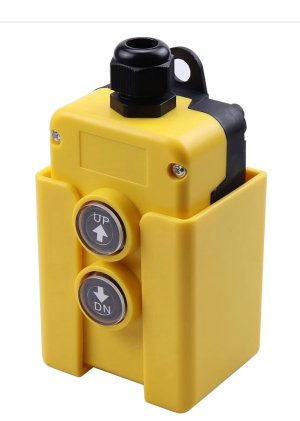
I think I'll just buy a cheap wired controller and reuse the cable from the Lewmar one.
 
If it is a conventional electric anchor winch with a solenoid, you just need two buttons as you assumed.

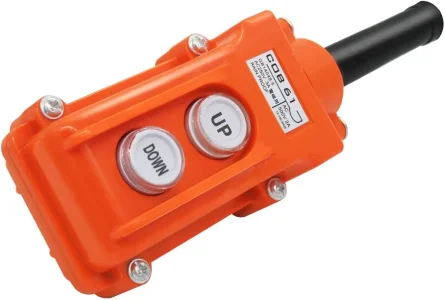
If you want a wired model, the industrial crane winch remote switches are much cheaper than the marine equivalents. They also use switches with a large contact area rather than the micro switches typically found in the marine units.

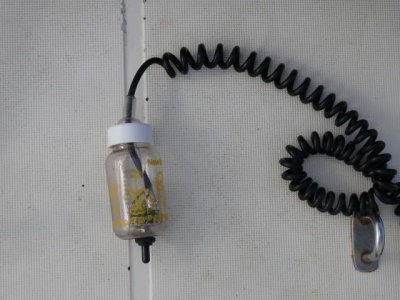
See the photo below for a typical example:
IMG_8417.jpeg


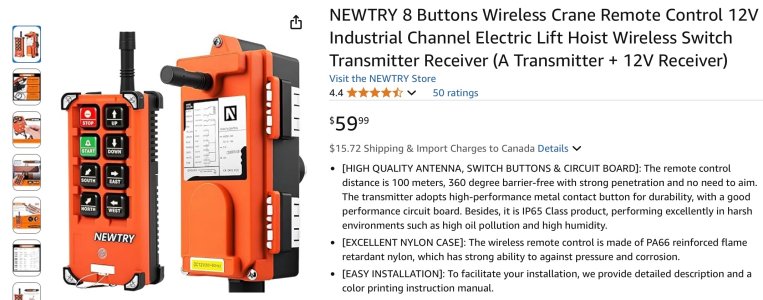
There are also industrial wireless models (see photo below) that are better than either the marine units or the very cheap 4x4 winch remotes. The ideal solution is to fit both a wired and wireless remote.


IMG_8416.jpeg
 
It's hard to see how something can be so much better than something which works flawlessly to justify spending more than is necessary. Anyway, each to their own.
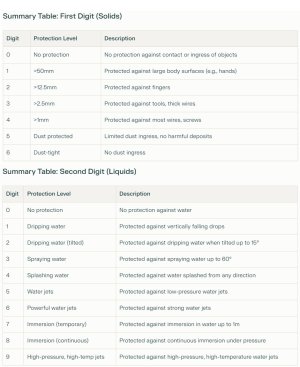
I'd expect the industrial ones to be better waterproofed. The wireless unit I bought (which didn't work) made no attempt at all to be waterproof.
 
It's hard to see how something can be so much better than something which works flawlessly to justify spending more than is necessary. Anyway, each to their own.

The biggest advantage I have noticed with the wireless industrial units over the 4x4 wireless units (such as those pictured post #4) is that the chain stops almost immediately as soon as the button is released. The 4x4 units have a lag where even the briefest button push winds in a reasonable length of chain, and this can be annoying at times. The industrial units also use conventional AA batteries in the handset.

The better reliability of the industrial units is the final advantage. Some users find the 4X4 units quite reliable, but they only lasted about six months in my use case. I am full-time cruising, anchoring over 300 days a year. A life of 150 nights at anchor, so this is perhaps not such a concern for most users, but as this and other threads on the subject show, the reliability of 4x4 units is variable at best.

As you point out, the industrial units are more expensive (around £40), but this is hardly exorbitant for boat equipment. It is another option to consider, that few boat owners seem to be aware of.
 
Last edited:
The biggest advantage I have noticed with the wireless industrial units over the 4x4 wireless units (such as those pictured post #4) is that the chain stops almost immediately as soon as the button is released. The 4x4 units have a lag where even the briefest button push winds in a reasonable length of chain, and this can be annoying at times
I know I've posted this before. I have a Quick wired remote at the Windlass and a Q chain counter at the flybridge, and I don't notice any more or less delay between these and the cheap remote.
The industrial units also use conventional AA batteries in the handset.
A definite advantage but I think I only changed the batteries once or twice on 6 years on my previous boat. I've been using the same remote on my current boat since April last year and I haven't had to change the battery. I too use my boat around 300 days per year and I anchor almost every day.
For most of the summer all I wear on the boat is a pair of swimming shorts and the cheapie remote fits snugly in my pocket.
 
I believe these components help distinguish which button is pressed, prevent electrical noise from causing false triggers, limit current to protect the system, and smooth out switch “bounce.”

Years ago I upgraded to a wireless remote, combined windlass and bow thruster, and am very happy.

Both branded and universal devices available.
Sleipner_RC_21E@72dpi.png.jpg
That looks expensive!

In my view a wired remote allows and encourages close encounters by less experienced operators with the trap point of chain on windlass.

I experienced the aftermath of an industrial accident where someone lost more than a finger in such a trap. It was life changing for the injured and shook management attitudes to safety.

Pneumatic Deck mounted foot buttons are fitted as standard on our boat well away from the windlass on the boat for good reason.
These can be used with far less risk to those less familiar with the trapping danger and are more reliable than electrical switches.

Plug in remotes are notorious for unreliable operation due to the problem of maintaining a dry waterproof connection without risk of corrosion especially in a permanently damp anchor locker.

I have installed a 4*4 winch wireless control but have added a two pole cut off relay onto the outputs. These are instantly isolated by an emergency stop push button at the helm.
In industrial control it would be normal for a wired or wireless remote to have one integral to the hand control.

Shit happens and there is a genuine risk of a serious injury with the open unguarded trapping point of a windlass. Risk is multiplied in dark and stormy conditions.
 
That looks expensive!

In my view a wired remote allows and encourages close encounters by less experienced operators with the trap point of chain on windlass.

I experienced the aftermath of an industrial accident where someone lost more than a finger in such a trap. It was life changing for the injured and shook management attitudes to safety.

Pneumatic Deck mounted foot buttons are fitted as standard on our boat well away from the windlass on the boat for good reason.
These can be used with far less risk to those less familiar with the trapping danger and are more reliable than electrical switches.

Plug in remotes are notorious for unreliable operation due to the problem of maintaining a dry waterproof connection without risk of corrosion especially in a permanently damp anchor locker.

I have installed a 4*4 winch wireless control but have added a two pole cut off relay onto the outputs. These are instantly isolated by an emergency stop push button at the helm.
In industrial control it would be normal for a wired or wireless remote to have one integral to the hand control.

Shit happens and there is a genuine risk of a serious injury with the open unguarded trapping point of a windlass. Risk is multiplied in dark and stormy conditions.
I worked on a fish farm for several years and day one of training was a slideshow of gruesome injuries caused by capstans.

Compared to that, an electric windlass with a properly set clutch is pretty safe. I suspect many people power up and down and have their clutch cranked up tight. I set mine so that it can lift the weight of the chain and anchor, and no more. It makes it impossible to overload the system. Probably wouldn't save a finger but you have to treat these things with a lot of respect.

Re waterproofing the connection, my wired remote is in the cabin and you have to open the hatch to pass it out. Seems like the simplest solution. If I needed to drop anchor in a hurry, I can just undo the clutch.
 
Nowt wrong with that. Proper PBO!
I was going to do something similar but when I started looking for switches on Amazon and stumbled upon an industrial unit for pennies so will try that.

View attachment 196209
This looks like the same unit we had on a previous yacht. It was recommended to us by a Greek charter manager who was frustrated by the frequent failures of the marine units on his fleet of vessels. From memory, the screws joining the two halves together were not stainless, so I replaced these when assembling the switch, but otherwise it was excellent despite the very low price.
 
In my view a wired remote allows and encourages close encounters by less experienced operators with the trap point of chain on windlass.
That is so, but on my catamaran I need to be in close proximity to deploy and recover the bridle. The wired remote is safest for this procedure since I need 2 hands to do it, and I don't have a 3rd to accidentally activate the remote. I generally don't allow anyone else near the windlass, apart from one son who is an experienced boater and a stickler for safety. Unfortunately our boating together is very limited as he lives in Ireland.
 
I've got that exact unit and it was dead out of the box. I was probably unlucky.

I'd rather stick with a wired control because I'd just lose a wireless one 😂. I could see how wireless could be useful if single handing.
I think I'll just buy a cheap wired controller and reuse the cable from the Lewmar one.
We've had a pair of these for years and worked perfectly. I'd have moaned and got a refund if they were DOA.

I opened our Quick wired remote when it failed. A meter immediately confirmed one switch had failed. The switch is tiny but we were in the middle of nowhere and I dismantled it. Fiddly but it wasn't difficult and nothing to lose. The miniscule contacts were dirty and easily cleaned. The switch was readily available from somewhere like RS so I bought some spares. Never used them as I almost always use a remote now. However, it does still work after many years.
 
Top