

alexincornwall
Well-Known Member
Brace yourselves for potentially daft questions, I’m an anode amateur.
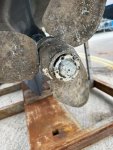
We’ve just been hauled out after 10 months in the water. All good but I was a little alarmed to see that the only remains of our brand new prop anode were its stainless fixing studs and the internal circular insert. The hull anode looks to be working as expected and as usual (maybe 25% eroded), as are the bower thruster anodes (50% eaten). The max-prop anode has always been the weak link on our boat as a design flaw (in my opinion), means that the fitting holes are positioned very close to the outer edges of the anode. Saying that, in previous years of similar use, we’ve always come out with 25% remaining. Concerningly, I have no way of knowing exactly when the anode disintegrated – it could have been months ago!
For context we spend around three months a year on shore power, haul out for one month, and then spend eight months on our swinging mooring. Batteries are always isolated at the breakers when we’re not onboard and our battery monitor always show zero current. I can’t see any indication of stray current.
We have had some electrical work done this year to include new batteries and a full solar install. So, my questions are:
Is it possible to simply be a victim of a duff anode?
Could the charge generated through solar accelerate anode erosion?
If there is a reason for the accelerated erosion, why have the hull and bow thruster anodes behaved as expected?
Would the other anodes continue to offer protection to our stern gear after our prop anode bit the dust?
We’ve just been hauled out after 10 months in the water. All good but I was a little alarmed to see that the only remains of our brand new prop anode were its stainless fixing studs and the internal circular insert. The hull anode looks to be working as expected and as usual (maybe 25% eroded), as are the bower thruster anodes (50% eaten). The max-prop anode has always been the weak link on our boat as a design flaw (in my opinion), means that the fitting holes are positioned very close to the outer edges of the anode. Saying that, in previous years of similar use, we’ve always come out with 25% remaining. Concerningly, I have no way of knowing exactly when the anode disintegrated – it could have been months ago!
For context we spend around three months a year on shore power, haul out for one month, and then spend eight months on our swinging mooring. Batteries are always isolated at the breakers when we’re not onboard and our battery monitor always show zero current. I can’t see any indication of stray current.
We have had some electrical work done this year to include new batteries and a full solar install. So, my questions are:
Is it possible to simply be a victim of a duff anode?
Could the charge generated through solar accelerate anode erosion?
If there is a reason for the accelerated erosion, why have the hull and bow thruster anodes behaved as expected?
Would the other anodes continue to offer protection to our stern gear after our prop anode bit the dust?


