

You are using an out of date browser. It may not display this or other websites correctly.
You should upgrade or use an alternative browser.
You should upgrade or use an alternative browser.
What, where?
- Thread starter Charlie Boy
- Start date
debenriver
Well-Known Member
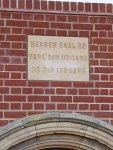
Danish. "The Lord shall preserve thy going out and coming in" Psalm 121:8 Don't know where it is
Cheers -- George
Cheers -- George
Pleinair
Member
Only one I know of, Aldeburgh, Fort Green Mill. At least I think that's what it was.Danish. "The Lord shall preserve thy going out and coming in" Psalm 121:8 Don't know where it is
Cheers -- George

Seashoreman
Well-Known Member
I haven't noticed this but I will have a look on the weekend as I will be passing.Only one I know of, Aldeburgh, Fort Green Mill. At least I think that's what it was.
You don't happen to know which side its on?
The Mill has had extensive work over the last 12 months with a new award winning tiled roof.
Certainly looks smarter, must have cost a fortune to restore.
Pleinair
Member
Its been quite a few years since I was over that way, and for the life of me, can't picture it, other than it wasn't set like the OP's photo so I assume its all been done up, your're comment kind of backs up that theory.I haven't noticed this but I will have a look on the weekend as I will be passing.
You don't happen to know which side its on?
The Mill has had extensive work over the last 12 months with a new award winning tiled roof.
Certainly looks smarter, must have cost a fortune to restore.
Charlie Boy
Well-Known Member
Danish. "The Lord shall preserve thy going out and coming in" Psalm 121:8 Don't know where it is
Cheers -- George
Boom! A very quick virtual beer to you!
Only one I know of, Aldeburgh, Fort Green Mill. At least I think that's what it was.
And to you, Sir. Well done!
Charlie Boy
Well-Known Member
I haven't noticed this but I will have a look on the weekend as I will be passing.
You don't happen to know which side its on?
The Mill has had extensive work over the last 12 months with a new award winning tiled roof.
Certainly looks smarter, must have cost a fortune to restore.
It’s on the North facing side, over a porch.
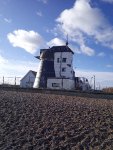
We asked a couple of electricians going in with their lunch. The exterior apparently is done but the interior has only recently become leak free so work is progressing gradually at present.

johnalison
Well-Known Member
I don’t do Danish. I got the gist of it though.

seivadnehpets
Well-Known Member
I used my German, and got close, but was a million miles out; I took Herren for men, but of course also in German it can mean God. I think in German -- Herr needs an article, but possibly not in archaic.I don’t do Danish. I got the gist of it though.
johnalison
Well-Known Member
I got 'going out and 'coming in' and put the rest together. Danish seems to be one of the least well understood languages. It appears that Swedes have more trouble with it than the Norwegians, though S-N seems fairly straightforward.I used my German, and got close, but was a million miles out; I took Herren for men, but of course also in German it can mean God. I think in German -- Herr needs an article, but possibly not in archaic.
Charlie Boy
Well-Known Member
Strange isn’t it? Danish in Suffolk. If it was in Northumberland it would seem more likely
debenriver
Well-Known Member
The Danes conquered the Anglo-Saxon kingdoms of Northumbria, Mercia, and East Anglia in 867 to 871. Reverted to Anglo-Saxon rule in 954, but were again subject to Danish rule from 991 ( Sweyn Forkbear, Canute, Harðacnut) to 1042, when it again became Anglo-Saxon (Edward the Confessor).
Probably nothing to do with a Danish inscription on an early 19thC windmill ....
Cheers -- George
Probably nothing to do with a Danish inscription on an early 19thC windmill ....
Cheers -- George
Seashoreman
Well-Known Member
I have just asked a friend who is very keen on local history. Apparently Reverend Black bought the Old Mill House in 1902. It was converted into residence for one family only. The architect was R.W.Briggs.
The Reverend married a Danish woman. Hence the inscription.
Hopefully that answers that mystery.
(I do know that the area of the carpark was part of a laundry servicing the local Hotels. The are tales and a couple of photographs of washerwomen and huge areas of hanging sheets etc. Also many of these women walked in to Aldeburgh along the Sailors Path from Snape and surrounding areas).
The Reverend married a Danish woman. Hence the inscription.
Hopefully that answers that mystery.
(I do know that the area of the carpark was part of a laundry servicing the local Hotels. The are tales and a couple of photographs of washerwomen and huge areas of hanging sheets etc. Also many of these women walked in to Aldeburgh along the Sailors Path from Snape and surrounding areas).

PeterWright
Well-Known Member
Thanks, Seashoreman for explaining that mystery.

sailorman
Well-Known Member
It has to be a toilet1 what language?
2 what does it say in English?
3 most importantly, where is it?
Other threads that may be of interest
- Replies
- 9
- Views
- 300
- Replies
- 9
- Views
- 318