What to do with end-of-life plastic boats?

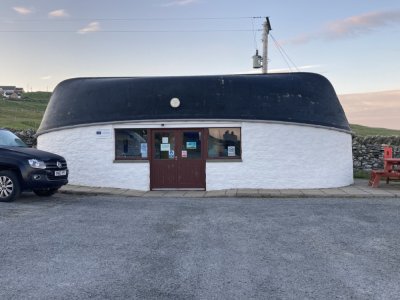
I found a upside down boat house in Burra Voe on Yell in the Shetland Islands. This is in Burra Voe and contains the marina toilet block with 2 toilets and a shower, plus a small kitchen with microwave, kettle, washing machine and tumble drier. If you use these facilities donations are requested but up to you how much you pay, if at all. The shower was very spacious. These facilities are also shared with any campers, caravans or motorhomes.

IMG_4771 1000pix.jpg
 
I found a upside down boat house in Burra Voe on Yell in the Shetland Islands. This is in Burra Voe and contains the marina toilet block with 2 toilets and a shower, plus a small kitchen with microwave, kettle, washing machine and tumble drier. If you use these facilities donations are requested but up to you how much you pay, if at all. The shower was very spacious. These facilities are also shared with any campers, caravans or motorhomes.

View attachment 190069
Well they do look a lot better than caravans.
 
The few boats I've seem scrapped are fist stripped of all the fittings which can sold, second hand or scrapped.
The GRP is then chain sawed into bits and then sent to landfill.
It's an expensive process and difficult if not impossible to make a profit on.
If the owner has disappeared, who pays to scap the boat? Becomes an issue.
 
Well they do look a lot better than caravans.
Theres a Huey helicopter on the NCKU Campus here in Tainan that I'd thought could make quite a nice Airstream-stylee caravan with a bit of surgery and polishing.

Boats might be more challenging, structure and space-efficiency wise, but they should at least be a bit more waterproof than the average old caravan.
 
A thought. Are we looking at this the wrong way on? GRP hulls etc. effectively last indefinitely. Most components such as mast and spars do also. It seems to me that the problem arises because the maintenance costs of a yacht do not decline with time, but the perceived value does, so people buy boats without recognizing that there is an ongoing cost of maintenance that may far exceed the purchase price. The boats we are talking about may NOW be end-of-life, but that is because the necessary maintenance costs haven't been met so the perishable parts of the boat such as woodwork have deteriorated beyond economic repair. The same boat maintained properly would still be sailing and going on for many years, and would retain far more of its value; a well-kept, ready-to-go boat will always fetch more.

So, could there be a mechanism to ensure that buyers recognize and accept the ongoing costs of maintenance? Perhaps some sort of indemnity scheme? It won't help with existing wrecks in the corner of boatyards, but might stop their number from increasing.

My point is that a mechanism to ensure that boats are maintained appropriately (perhaps something like the MOT?) would allow many potential wrecks to have long lives giving pleasure to those who can't afford to buy new. After all, it works for cars!
 
A thought. Are we looking at this the wrong way on? GRP hulls etc. effectively last indefinitely. Most components such as mast and spars do also. It seems to me that the problem arises because the maintenance costs of a yacht do not decline with time, but the perceived value does, so people buy boats without recognizing that there is an ongoing cost of maintenance that may far exceed the purchase price. The boats we are talking about may NOW be end-of-life, but that is because the necessary maintenance costs haven't been met so the perishable parts of the boat such as woodwork have deteriorated beyond economic repair. The same boat maintained properly would still be sailing and going on for many years, and would retain far more of its value; a well-kept, ready-to-go boat will always fetch more.

So, could there be a mechanism to ensure that buyers recognize and accept the ongoing costs of maintenance? Perhaps some sort of indemnity scheme? It won't help with existing wrecks in the corner of boatyards, but might stop their number from increasing.

My point is that a mechanism to ensure that boats are maintained appropriately (perhaps something like the MOT?) would allow many potential wrecks to have long lives giving pleasure to those who can't afford to buy new. After all, it works for cars!
See your point, but I recon the MOT has caused a lot more cars to be scrapped than it has saved. I can only recall one of my bangers failing in what I thought was a practically unfixable way (Marina with bust spring hanger when I no longer had access to welding gear) but several ran out of time and were legally executed.

Introducing such a mechanism would bring an element of regulation that I come to boating to escape from.
 
See your point, but I recon the MOT has caused a lot more cars to be scrapped than it has saved. I can only recall one of my bangers failing in what I thought was a practically unfixable way (Marina with bust spring hanger when I no longer had access to welding gear) but several ran out of time and were legally executed.

Introducing such a mechanism would bring an element of regulation that I come to boating to escape from.
But the other side of the MOT is that it has encouraged manufacturers to build cars that (for example) don't rust. In the last century, you took it for granted that a new car might start to show signs of rust within a very few years, certainly if you had a minor scrape, but no new car I've bought in this century has ever suffered even slight rust, and I take no special precautions. My oldest car is from 2003, and although I've had to replace other parts, the metalwork is all perfectly fine.

Perhaps an equivalent for boats would encourage builders to emphasize maintainability? Many tales on here show that maintainability hasn't been high on builders' priorities in the past!

I understand where you're coming from on the regulation front, but either we want to sort this problem out or we don't. One possible mechanism that doesn't entail a registration system would be to require boat sales to include some sort of indemnity insurance against the possibility of the boat becoming uneconomic to maintain; this could be enforced by the Crown Commissioners (for moorings), boatyards and marinas asking to see such insurance just as marinas and boatyards do for third party and removal of wreck insurance.

The point is to make sure that people buying boats know without any possible doubt what it costs to maintain a boat, and to take it on with their eyes open. The boats abandoned in odd corners are generally the result of someone thinking that it looked like a cheap holiday option, without recognizing that an old boat costs just as much to maintain as a new one.
 
A thought. Are we looking at this the wrong way on? GRP hulls etc. effectively last indefinitely. Most components such as mast and spars do also. It seems to me that the problem arises because the maintenance costs of a yacht do not decline with time, but the perceived value does, so people buy boats without recognizing that there is an ongoing cost of maintenance that may far exceed the purchase price. The boats we are talking about may NOW be end-of-life, but that is because the necessary maintenance costs haven't been met so the perishable parts of the boat such as woodwork have deteriorated beyond economic repair. The same boat maintained properly would still be sailing and going on for many years, and would retain far more of its value; a well-kept, ready-to-go boat will always fetch more.

So, could there be a mechanism to ensure that buyers recognize and accept the ongoing costs of maintenance? Perhaps some sort of indemnity scheme? It won't help with existing wrecks in the corner of boatyards, but might stop their number from increasing.

My point is that a mechanism to ensure that boats are maintained appropriately (perhaps something like the MOT?) would allow many potential wrecks to have long lives giving pleasure to those who can't afford to buy new. After all, it works for cars!

The only reason yachts have woodwork, fancy cabin soles and headlining is aesthetics. There is no real need for woodwork, headlining nor fancy cabin soles .... but make the decorations removable, easily and without much damage, and you have a vessel that will last as long as the GRP. Plastic dinghies (and some wooden ones, last for ever (or a long time). Change the focus of the build to longevity, remove the printed wood finish and stapled drawer joints - and then you minimise the cost of re-birthing a yacht.

The preceding paragraphs makes the case, badly, for a AWB (exterior) to an AWB in/exterior. As a sales marketing strategy I think it would sell like lead balloons.

I'm not sure I'm convinced by the car analogy - amongst the fears of 'range' and availability of recharging points is the fear that the cost of buying and installing a new battery for an EV will be so high it will be uneconomic (or impossible - BYD are building the batteries into the chassis) - and much of EVs will be converted to scrap with a lifespan much shorter than a petrol or diesel model.

Jonathan
 
I'm not sure I'm convinced by the car analogy - amongst the fears of 'range' and availability of recharging points is the fear that the cost of buying and installing a new battery for an EV will be so high it will be uneconomic (or impossible - BYD are building the batteries into the chassis) - and much of EVs will be converted to scrap with a lifespan much shorter than a petrol or diesel model.

Jonathan
VW's EVS have modular batteries with each component being individually replaceable. Also a very long warranty period!
 
The riddle inside and enigma inside a maze is a cash positive/enviro friendly way to recycle/deal with GRP.
Until then I can't see a suitable way forward sadly.In the meantime I'm keeping my 50yr old boat in as good a condition as I can and confident it'll still be sailing years from now...
 
Top