

Laminar Flow
Well-Known Member
The main factors governing horse power requirement are expected/desired speed and displacement, bearing in mind that speed is dependent on waterline length (relative speed) and resistance on displacement.
Putting speed and displacement into relationship you get the following:
To reach hull speed (relative speed of 1.34) you need 1hp per 500 lbs.
at a relative speed of 1.2 it is 1hp / 800 lbs
at a relative speed of 1 it is 1 hp / 1200 lbs
at a relative speed of 0.9 it is 1 hp / 1600lbs
at a relative speed of 0.7 it is 1 hp/ 3000 lbs
To note: this is HP at the prop. Add another 4%-6% to this number for losses due to shaft bearings, stuffing box and gear box to get hp required from the engine.
To put this into context: For our boat with a DWL of 28' and a displacement of 8.17t I need 6.7 hp at the prop, or 7hp from the engine, to reach 4kts.
We cruise at 1500 rpm, at which point we are making 5.5kts or a relative speed of 1.03 and for this we need 15 hp at the prop.
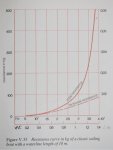
If you look at the resistance chart below, you will see why this makes eminent sense as far as economical engine use is concerned. A relative speed of 1 is the point at which the resistance curve shoots up exponentially.
Putting speed and displacement into relationship you get the following:
To reach hull speed (relative speed of 1.34) you need 1hp per 500 lbs.
at a relative speed of 1.2 it is 1hp / 800 lbs
at a relative speed of 1 it is 1 hp / 1200 lbs
at a relative speed of 0.9 it is 1 hp / 1600lbs
at a relative speed of 0.7 it is 1 hp/ 3000 lbs
To note: this is HP at the prop. Add another 4%-6% to this number for losses due to shaft bearings, stuffing box and gear box to get hp required from the engine.
To put this into context: For our boat with a DWL of 28' and a displacement of 8.17t I need 6.7 hp at the prop, or 7hp from the engine, to reach 4kts.
We cruise at 1500 rpm, at which point we are making 5.5kts or a relative speed of 1.03 and for this we need 15 hp at the prop.
If you look at the resistance chart below, you will see why this makes eminent sense as far as economical engine use is concerned. A relative speed of 1 is the point at which the resistance curve shoots up exponentially.


