
What speed does your boat motor forward at lowest rpm?

The main factors governing horse power requirement are expected/desired speed and displacement, bearing in mind that speed is dependent on waterline length (relative speed) and resistance on displacement.

Putting speed and displacement into relationship you get the following:

To reach hull speed (relative speed of 1.34) you need 1hp per 500 lbs.

at a relative speed of 1.2 it is 1hp / 800 lbs

at a relative speed of 1 it is 1 hp / 1200 lbs

at a relative speed of 0.9 it is 1 hp / 1600lbs

at a relative speed of 0.7 it is 1 hp/ 3000 lbs

To note: this is HP at the prop. Add another 4%-6% to this number for losses due to shaft bearings, stuffing box and gear box to get hp required from the engine.

To put this into context: For our boat with a DWL of 28' and a displacement of 8.17t I need 6.7 hp at the prop, or 7hp from the engine, to reach 4kts.

We cruise at 1500 rpm, at which point we are making 5.5kts or a relative speed of 1.03 and for this we need 15 hp at the prop.

If you look at the resistance chart below, you will see why this makes eminent sense as far as economical engine use is concerned. A relative speed of 1 is the point at which the resistance curve shoots up exponentially.
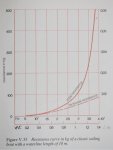
DSC_0377 (2).jpg
 
Dufour 38, in liveaboard mode, weighs about 10 tons, with a 40HP Volvo Penta 20/40, does about 1,5kt in idle.
With a saidrive well forward of the rudder need about 2kt to keep full control. Strong prop wash can be both an advantage and disadvantage moving at slow speeds.

Freeman 10m, in cruising mode, weighs about 12 tons, with 2x 300HP Sabres, does about 2kts in idle.

Twin engines/rudders well displaced give good manoeuvrability but the rudders surface area is small so use engines at slow speeds.

Totally different handling characteristics for each boat.

Truth is, in close quarters, rather than clock watch speed, I look out at the prevailing conditions and get cues to manage the boat. Fly by the seat of my pants.
 
Last edited:
A burst of throttle with my saildrive will not initially get the boat turning, even with full rudder

Full rudder may well not provide the maximum turning force. Consider whether your rudder will be acting as a foil or as a deflector (i.e. stalled). The optimum amount of rudder to maximise sideways force will depend on various factors, including how fast, if at all, you are moving forward.
 
Full rudder may well not provide the maximum turning force. Consider whether your rudder will be acting as a foil or as a deflector (i.e. stalled). The optimum amount of rudder to maximise sideways force will depend on various factors, including how fast, if at all, you are moving forward.
I think that it would be almost impossible to calculate the optimum deflection at any particular speed, especially at a time when one has other things on one’s mind. In any case, my rudder has a fairly limited range on movement, maybe 40 degrees, unlike the Sadler that would do almost ninety, so a full deflection and a burst of power when almost stationary won’t be far from optimum.
 
I think that it would be almost impossible to calculate the optimum deflection at any particular speed, especially at a time when one has other things on one’s mind.

Yes, I don't think it can be calculated - too many variables - but I think it's worth experimenting with how one's own boat reacts with different rudder angles in that situation, and was just highlighting that.
 
Yes, I don't think it can be calculated - too many variables - but I think it's worth experimenting with how one's own boat reacts with different rudder angles in that situation, and was just highlighting that.
Even when standing up I find the seat of my pants to be very sensitive.
 
On tickover in the Dutch canals my boat goes embarrasingly fast. If we are in convoy approaching a bridge or lock there is often a boat that slows down long before we get there. Typically this often happens in smaller canals like the one leading to Goes, where one always seems to crawl along.
Normally, I would be quite happy to follow in convoy, but it usually means that I have to keep dropping in & out of gear. Even though my engine ticks over at 800RPM. My Brunton Autoprop just pitches up & gives max drive.
So I usually end up overtaking the convoy, but trying to explain to the boats, that I am overtaking, that they are going too slow just makes it worse. So I end up looking like a mad Englishman. :unsure:
 
While rudder forces and angles can and are calculated, it would, in practical terms, be a pretty pointless exercise in this context. In view of the myriad of different steering and propulsion arrangements and characteristics, not to mention current and weather factors, I doubt knowing the precise kg/m for various speeds and angles would lead to any universally useful recommendations.
 
On tickover in the Dutch canals my boat goes embarrasingly fast. If we are in convoy approaching a bridge or lock there is often a boat that slows down long before we get there. Typically this often happens in smaller canals like the one leading to Goes, where one always seems to crawl along.
Normally, I would be quite happy to follow in convoy, but it usually means that I have to keep dropping in & out of gear. Even though my engine ticks over at 800RPM. My Brunton Autoprop just pitches up & gives max drive.
So I usually end up overtaking the convoy, but trying to explain to the boats, that I am overtaking, that they are going too slow just makes it worse. So I end up looking like a mad Englishman. :unsure:
The speed limit on many of the Dutch side canals is 3 km/h - quite a bit less than that of a pedestrian. Apparent English madness may not have been your only offence ...
 
We have taken part a few times in the Semaine du Golfe, a rally for classic boats, in Brittany.

For the final evening on Saturday all the boats, except the very largest square-riggers and a few specialist types, parade up the narrow canal to Vannes where we are all crammed into the basin in the town centre. There is always a delay as the harbourmaster and his overworked team try to allocate berths for everyone, and the queue of boats has to keep stopping.

One our first year there was a strong crosswind blowing from port to starboard and since my boat kicks her stern to port when reverse gear is engaged this, combined with bow windage, tries to spin me round to starboard, facing the bank.

I soon learnt to turn my boat's head to port about 30 degrees before engaging astern. Then she comes to a stop more or less parallel to the direction of the canal. When there was a long delay the danger of drifting across to starboard increased and I had to keep giving her a burst of ahead power, with the tiller over to starboard, and head towards the port bank for a few yards.

In this fashion we slowly pirouetted up the canal but by the time we got into our berth all the exhibition stands around the basin that I was keen to see, were packing up.

But we didn't waste any time heading into town for a few drinks and a good dinner!
 
The speed limit on many of the Dutch side canals is 3 km/h - quite a bit less than that of a pedestrian. Apparent English madness may not have been your only offence ...
I have only seen such a limit in a few places, such as when passing ferries in Frisland. Normally one motors at a sharp rate. My boat interacts with shallow bottoms and this can take half a knot off my speed, so it is uneconomic to press on too fast, but 5.5-6kn is fairly common. My solution to the convoy problem is to force my way to the front, and then I can go at whatever speed I wish. This often means jilling around at the next bridge for others to catch up and some stress on international relations, but this is a small price to pay for being able to go at my own speed.
 
I have only seen such a limit in a few places, such as when passing ferries in Frisland. Normally one motors at a sharp rate. My boat interacts with shallow bottoms and this can take half a knot off my speed, so it is uneconomic to press on too fast, but 5.5-6kn is fairly common. My solution to the convoy problem is to force my way to the front, and then I can go at whatever speed I wish. This often means jilling around at the next bridge for others to catch up and some stress on international relations, but this is a small price to pay for being able to go at my own speed.
If you take any side lanes away from the standing mast route you might find this (3 km/hr) to be more common. We kept our boat on a side arm near Sneek and if you went any quicker than a granny with her walker the owners would come out of their homes to wave their gardening tools at you - with the canal just wide enough for us to pick flowers either side, the threat was potentially real.

On the major canals such as the Princess Magriet the limit is 12.5 km/hr ( 6.75 kts), lesser canals are 9km/hr ( 4.8 kts), such as north of Grouw, and others are at 6 km/hr (3.23 kts) and others, again at 3 km/hr. On the Amsterdam canals it is 7.5 km/h.
On the Isselmeer and some other meers there is no limit, other than that you need a license if your boat can go faster than 20 km/h. They do check for that and we have seen boats being pulled over. Short of being dropped by a crane, we are not likely to ever reach that kind of velocity, though I'd happily pay the ticket for our Watson, just for the sake of bragging rights and to quieten all those Anderson 22 deniers.
 
Birchwood 37 with twin 269hp yanmars. Tickover on both gives around 4kts. and with small keel steers reasonably though gear twitching still occasionally. Fly by wire controls occasionally try to synch throttles and get it wrong at tickover speeds where I can do it by ear much better and without one engine promoting an unwanted, not to say unexpected, turn effect
 
Just out of interest really. My 31ft boat with 27hp engine will do nothing less than 2 knots in forward gear, in slack water. I reckon 1 knot would be far better for gingerly creeping into a marina berth. I’m just curious as to what speeds you lot get ahead dead slow?
Just under 6 knots at tickover for me.
Already stated, neutral is your friend.
In my case about 80% of the time in a marina.
 
We have taken part a few times in the Semaine du Golfe, a rally for classic boats, in Brittany.

For the final evening on Saturday all the boats, except the very largest square-riggers and a few specialist types, parade up the narrow canal to Vannes where we are all crammed into the basin in the town centre. There is always a delay as the harbourmaster and his overworked team try to allocate berths for everyone, and the queue of boats has to keep stopping.

One our first year there was a strong crosswind blowing from port to starboard and since my boat kicks her stern to port when reverse gear is engaged this, combined with bow windage, tries to spin me round to starboard, facing the bank.

I soon learnt to turn my boat's head to port about 30 degrees before engaging astern. Then she comes to a stop more or less parallel to the direction of the canal. When there was a long delay the danger of drifting across to starboard increased and I had to keep giving her a burst of ahead power, with the tiller over to starboard, and head towards the port bank for a few yards.

In this fashion we slowly pirouetted up the canal but by the time we got into our berth all the exhibition stands around the basin that I was keen to see, were packing up.

But we didn't waste any time heading into town for a few drinks and a good dinner!
Two years ago we went to the Semaine du Golfe in our new boat and not wanting to join our fleet in their planned activity this time we decided to visit Vannes and see the Ancien Petit Bateau.

Unfortunately they were all leaving in parade as we started up the canal but the harbour master insisted that we follow him against the flow pausing at the choke points. Being unfamiliar with our long keeler we had a few twisting stops as it kicked astern and I had difficulty persuading the Navigator that we could approach the U shaped sides without our keel hitting - she being used to bilg ekeels.

And of course some of the stalls had closed up by the time we laboured against the stream but we still enjoyed the visit and explored more of the town.

Both the sailing and the fest noz were sadly missed this year.
 
Steering a 70 foot canal Narrowboat in a narrow canal sorts those who can and those who cant............................

One retired working boat I hired had a 24 inch prop and never needed the old National two cylinder diesel to chuff at much more than idle.

Different, of course, when the hold had 17 ton of coal in and it was towing a butty with 25 tons in!

When we had it from Willow Wren for the week it had the hold converted for bunks, a Rayburn cooker, sink and worktop. The weather was good until the last day when we found the rotten canvas cover over the hold leaked like a sieve!
 
Steering a 70 foot canal Narrowboat in a narrow canal sorts those who can and those who cant............................

One retired working boat I hired had a 24 inch prop and never needed the old National two cylinder diesel to chuff at much more than idle.

Different, of course, when the hold had 17 ton of coal in and it was towing a butty with 25 tons in!

When we had it from Willow Wren for the week it had the hold converted for bunks, a Rayburn cooker, sink and worktop. The weather was good until the last day when we found the rotten canvas cover over the hold leaked like a sieve!
One of my cousins lives alone on a 70 foot narrowboat and handles it alone. I don't know how he manages it.
 
Top