What size my prop??

Well it looks like 8 x 10 although that sounds a bit small, depending upon engine size. Measure the diameter and if thats 8 inches then it is an 8 x 10.

If the diameter is more than 8 inches come back and tells us what the diameter is. If it's 10 inches then perhaps the figures are reversed? :confused:

Richard
 
View attachment 65886View attachment 65887


Just trying to establish my prop size. This is on my Neptunian 33.
I have some measurements somewhere but can't find them.
Can anyone guess/interpolate ??

If you clean the crud off, you will likely find it stamped on the boss, or alternatively on either the forward or aft face, which of course means removing the prop. Diameter is easy to measure - it will be either 17 or 18", but to measure pitch you need the prop off and mount it on a table to measure the angles of the blades.

Not a lot of real need to measure it though. If it works on the existing engine as I imagine it does after all these years, then it is OK.

If you go for a new engine you will almost certainly need a new prop, not least because it will likely turn the other way, although you can get reduction boxes that turn either way if your current prop is the correct size. Either Beta or your prop supplier will calculate the prop size for you and advise on the correct gearbox, both reduction ratio and rotation direction.
 
If you clean the crud off, you will likely find it stamped on the boss, or alternatively on either the forward or aft face, which of course means removing the prop. Diameter is easy to measure - it will be either 17 or 18", but to measure pitch you need the prop off and mount it on a table to measure the angles of the blades.

Not a lot of real need to measure it though. If it works on the existing engine as I imagine it does after all these years, then it is OK.

If you go for a new engine you will almost certainly need a new prop, not least because it will likely turn the other way, although you can get reduction boxes that turn either way if your current prop is the correct size. Either Beta or your prop supplier will calculate the prop size for you and advise on the correct gearbox, both reduction ratio and rotation direction.

Errrrr ..... I seemed to have missed something here Tranona. Why are you dismissing the 10 inch pitch so quickly? :confused:

Richard
 
Errrrr ..... I seemed to have missed something here Tranona. Why are you dismissing the 10 inch pitch so quickly? :confused:

Richard

Not dismissing it at all. Just don't see any mention of 10" pitch. You suggested 8*10 which means 8" diameter and 10" pitch, which is implausible so I ignored it! It could well be 18*10, but don't see how you can be accurate for pitch just looking at a photo. 18" diameter would be plausible for the engine and 10" pitch maybe, but a bit shallow.

Anyway only relevant if he wants to reuse the old prop, but that depends on which engine/box he chooses. May well need repitching even if the diameter is OK.
 
Not dismissing it at all. Just don't see any mention of 10" pitch. You suggested 8*10 which means 8" diameter and 10" pitch, which is implausible so I ignored it! It could well be 18*10, but don't see how you can be accurate for pitch just looking at a photo. 18" diameter would be plausible for the engine and 10" pitch maybe, but a bit shallow.

Anyway only relevant if he wants to reuse the old prop, but that depends on which engine/box he chooses. May well need repitching even if the diameter is OK.

Nope. I'm still confused I'm afraid. I'm just taking the pitch from the x 10 in the photo although the 8 seems wrong which is why I suggested measuring it manually. :confused:

Richard
 
Sorry. I sort of assumed he would have read that so did not look at the numbers that closely. So 18*10 is probably right.
 
Thanks everyone. It is a 4108 driving the prop. The yacht cruises at 1800 rpm at around 5 to 6 knots, 2500 gives my 'top speed' of 7 knots which I guess is about my hull speed. She will rev higher but with no increase in speed.

When I took the photos I did measure the diameter and I recall it was around 17 or 18 inches. Not too sure (early bird) about seeing the 1 as I could not really see it when I did the photo.

I will work on the assumption that it is 18x10 though. We may well be fitting another Perkins rather than a new make. We are happy with the power delivered in most situations but would anyone suggest that a different pitch would be better and if so what? The prop is getting a bit worn and brittle so a change of prop might precede a change of engine!

Thanks again
 
On further thought ( dangerous with me) does the fact that I achieve my hull speed at quite a bit less than max revs indicate that my engine is more powerful than needed?
I do notice that head winds and heading into choppy seas reduce my speed considerably would a bigger pitch give me more 'bite' in those conditions?
 
Suggest you put your boat's data into a calculator such as Propcalc on www.castlemarine.co.uk

Your current speeds sound about right, as does the prop size. 4108s were rated at different power outputs depending on the maximum revs controlled by the governor. If your engine revs higher than 2500 (check by WOT in neutral) then you are not using the full power output with the prop you have. To get the revs up you need to reduce the pitch, not increase it.
 
I'm idly re-opening this thread from almost a year ago, because it may help me understand the difference that pitch makes.

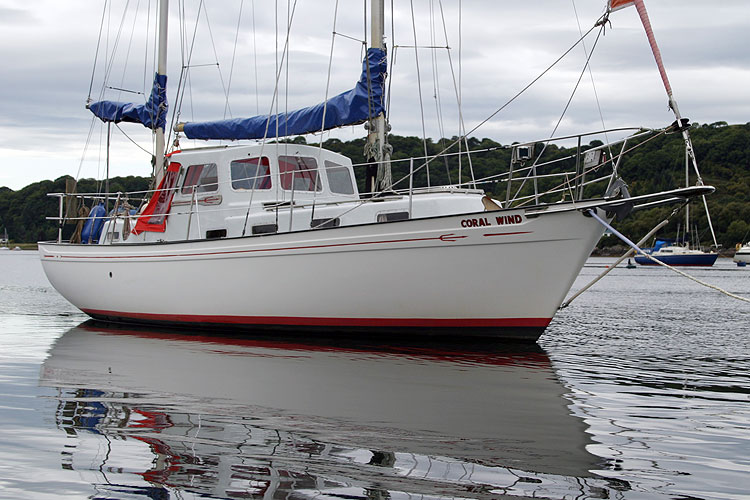
I rather admire the Neptunian's tall wheel-shelter, but I imagine it has a regrettable slowing effect, steering into a fresh headwind...

2747.jpg


...I suppose that a fairly small engine (say 25hp) could turn a high-pitched propellor fast enough to give the six-tonne Neptunian her 7-knot hull speed, on a calm day in flat water...

...but to maintain that speed against a strong wind or waves, I'm guessing a much more powerful engine would be needed, turning a much-reduced pitch propellor of the same diameter, much faster? Rather like dropping to a low gear, to climb a steep hill?

Except...the gearbox in a road vehicle makes different gradients possible for the same engine...not a more powerful one. :confused:

So...if a fairly small marine diesel, matched to the appropriate propellor for the vessel, can achieve the displacement maximum speed in flat water, isn't a reduced-pitch propellor with the same engine, a better solution for increasing thrust in hard weather?

Given that most new displacement-hulled yachts are sold with several engine options, the least of which can achieve hull speed in light conditions, while even the biggest option can never significantly exceed hull speed...what's the value of the bigger engine?

Is it illusory, to fit a bigger engine for more confident passage-making in poor weather?
 
I'm idly re-opening this thread from almost a year ago, because it may help me understand the difference that pitch makes.

I rather admire the Neptunian's tall wheel-shelter, but I imagine it has a regrettable slowing effect, steering into a fresh headwind...

2747.jpg


...I suppose that a fairly small engine (say 25hp) could turn a high-pitched propellor fast enough to give the six-tonne Neptunian her 7-knot hull speed, on a calm day in flat water...

...but to maintain that speed against a strong wind or waves, I'm guessing a much more powerful engine would be needed, turning a much-reduced pitch propellor of the same diameter, much faster? Rather like dropping to a low gear, to climb a steep hill?

Except...the gearbox in a road vehicle makes different gradients possible for the same engine...not a more powerful one. :confused:

So...if a fairly small marine diesel, matched to the appropriate propellor for the vessel, can achieve the displacement maximum speed in flat water, isn't a reduced-pitch propellor with the same engine, a better solution for increasing thrust in hard weather?

Given that most new displacement-hulled yachts are sold with several engine options, the least of which can achieve hull speed in light conditions, while even the biggest option can never significantly exceed hull speed...what's the value of the bigger engine?

Is it illusory, to fit a bigger engine for more confident passage-making in poor weather?

No.
A prop is not like the back axle on a car, so many turns per mile.
A prop which is producing any thrust slips, the blades operate at an angle of attack. The water is fluid and is pushed back while the boat goes forwards.
So for a given prop RPM, there is a graph of thrust vs boat speed.

More power with the same prop will, if necessary, develop more thrust at the same RPM.
 
Except...the gearbox in a road vehicle makes different gradients possible for the same engine...not a more powerful one. :confused:

So...if a fairly small marine diesel, matched to the appropriate propellor for the vessel, can achieve the displacement maximum speed in flat water, isn't a reduced-pitch propellor with the same engine, a better solution for increasing thrust in hard weather?

Given that most new displacement-hulled yachts are sold with several engine options, the least of which can achieve hull speed in light conditions, while even the biggest option can never significantly exceed hull speed...what's the value of the bigger engine?

Is it illusory, to fit a bigger engine for more confident passage-making in poor weather?

Bit of confusion. You start with the propeller and shaft speed as that determines how fast the boat will go. Then you match the engine power output that will turn that propeller at the right speed to achieve hull speed. The aim usually is to have the largest diameter to fit the space available and set the pitch to achieve the speed.

If the engine does not have enough power to achieve this, then the prop must be smaller to get the engine up to its maximum output which may well not be enough to achieve hull speed, and will be much less if adverse conditions require extra power.

In the past the tendency with sailing cruisers was to underpower mainly because more power equals physically larger engines for which there was no space. This changed when small high speed diesels came in and gradually larger engines that had enough power to achieve hull speed even in adverse conditions were fitted.

So, now it is common to have engines anywhere from 20-50% more powerful than actually needed to achieve hull speed in flat water, but can cruise at lower rpm and maintain speed because they have additional power available.
 
I believe all you say...just can't picture it yet.

Is there any authoritative simple guide I can look up, rather than pester the forum?

A book on yacht design like :Larrson and Eliasson is worth a read. I'm sure there are others.
Gerr wrote a book just about propellors for small boats.

Getting the diameter optimum for the engine size is important to balance efficiency against flexibility.
 
Do you know what your gear-box ratio is? My propeller specialist said that 1.9:1 and 2.1:1 Borg Warner were of no use and told me I would have to get a 2.5:1 box. I later told him I was having no luck with 2.5:1 but I mentioned offhandedly I could get a 2.9:1. Five minutes later he rang me back and asked if I could spin a 21 in. prop. I confirmed I could and he said that would be close to perfect.

(There are on-line calculators to work out size/pitch given shaft horsepower, RPM, hull speed etc.)

Clive
 
Top