
Poignard
Well-Known Member
Many a true word etc ?I’ve seen you trying to berth your Twister so fear not, no one will believe for a second that you know what you’re doing ???
(that’s a joke, for the avoidance of doubt ?)

Many a true word etc ?I’ve seen you trying to berth your Twister so fear not, no one will believe for a second that you know what you’re doing ???
(that’s a joke, for the avoidance of doubt ?)


Interesting. I remember having a rolling ruler as a school kid but don’t really recall what I used it for. It hasn’t survived my possession, unlike slide rules etc of which I still have a collection, which suggests that I didn’t think it useful. Your comment has stimulated a bit of research……I may well buy one and try it ?And nothing beats a proper rolling ruler, on a full size chart table - that really is the best but there's no room for one on a tug, let alone a small yacht!

Yes, when I had my introduction, on a sailing course in Croatia, what we used for chartwork was two 60/30 setsquares, very easy to use. No chance of coming up with a course that is 180° out, as can happen to novices using breton plotters, which is what I now use.And for a slightly different approach - at work I quite often use the two triangles method, it's very easy for plotting lat&long positions (without the slipping you get with parallel rulers as the left hand triangle stays in one place), and also for bearings and courses with the protractor printed on them. It's especially quick for radar and visual bearings.
For yacht use though where absolute accuracy is less of a priority I use a Breton plotter as it works well in a small space and only needs one hand.
And nothing beats a proper rolling ruler, on a full size chart table - that really is the best but there's no room for one on a tug, let alone a small yacht!
For that purpose, as is the standard method, I use the dividers and the scales at sides and bottom/top of chart to transfer a given latitude and longitude onto the chart, or to find the exact coordinates of a given point on the chart by transferring it onto the scales using the dividers. Doing it by eye is fine when well offshore, but the nearer to hazards you are, the more accurate you need to be. When broadcasting an SOS would be a good time to use the most exact method!I find the grid quite useful to put gps coordinates on the chart, some (ex some Imrays) have their own finely spaced grid but often there are only a few latitude/ longitude lines at round numbers, by counting the "notches" on the vertical and horizontal edges scales the coordinates can easily be located on the chart.

Interesting.From an engineering viewpoint, the square protractor should be the most consistently accurate.
Within engineering statistics, there’s a term Gauge R&R. It is a measure of process repeatability and reproducibility. One is related to the tool, the other to the operator.
Parallel rulers and Breton/Portland plotters both have moving parts so there’s an inherent variability. The square doesn’t so should always give a better result.
Who said the thread shouldn’t be contentious ?

Two setsquares my preferred tool also, though I have not actually used a paper chart for anything but overall planning for years.Yes, when I had my introduction, on a sailing course in Croatia, what we used for chartwork was two 60/30 setsquares, very easy to use. No chance of coming up with a course that is 180° out, as can happen to novices using breton plotters, which is what I now use.
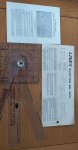

Haven't seen one of those for donkey's years! Used it a lot for map work in the 1980s, when it was a convenient way of reading latitude or longitude of a map, but in the 1990s and onward, I used digital mapping.I have a set of these which I like to leave on show on the chart table in the hope of creating the illusion that I know what I'm doing.
View attachment 127138

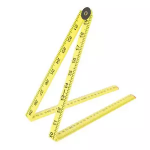
I have just started using the triangles and like them for the reasons stated above, especially the protractor printed on them for relative bearings. The plotter is what I use most in the cockpit, however, on my portable chart table - a piece of ply under the chart in a waterproof chart case.And for a slightly different approach - at work I quite often use the two triangles method, it's very easy for plotting lat&long positions (without the slipping you get with parallel rulers as the left hand triangle stays in one place), and also for bearings and courses with the protractor printed on them. It's especially quick for radar and visual bearings.
For yacht use though where absolute accuracy is less of a priority I use a Breton plotter as it works well in a small space and only needs one hand.
And nothing beats a proper rolling ruler, on a full size chart table - that really is the best but there's no room for one on a tug, let alone a small yacht!
Spot on. I’m lucky if I can steer within 5 degrees of a course in my small sailing boat, though I have the courses pre-plotted on the chart and listed for ready reference in the passage plan, also in the waterproof case. Although do I use the triangles and the plotter, there are times when it comes down to No. 1 eyeball and leaving a sensible safety margin around known hazards. I might add the fly swotter handle to my kit, however, for improved accuracy when double-reffed and water is pouring in over the lee gunwale.I used to have a little 17' 3" bilge keeler (and previously a 16' 3" centre-boarder), but travelled far and wide around the coast. (Always the smallest boat in the anchorage, and that included the dayboats and RIBS!).
Charts were used folded in a chart holder with a plastic sleeve, on my lap in the cockpit. Courses and other angles were plotted with a fly swotter's handle, which I would line up with the relevant angle on the chart's compass rose and slide it across the chart judging the angle by eye. Hardly pin-point accuracy, but then neither was our steering and leeway. We usually got where we were going, and when we didn't it wasn't the result of faulty navigation.
Later I got slightly larger boats equipped with such high-tech luxuries as table tops and Breton plotters, more recently supplemented by a digital plotter, wonder of wonders, but I remain sceptical about aiming for a spurious degree of accuracy (or is it precision?).


