What navigation instrument do you use?

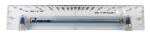
My wife was compelled to buy a Breton plotter for her day-skipper course. It has been banished from the chart table but did find its niche on one occasion when I needed a set square to align my clock and barometer.

For many years I have used Captain Fields parallel rules, until I bought a parallel rule at the boat show that operates by being connected to the table via two tapes which self-retract. The rulers stay in place on the chart table at all times, although I haven't used them in anger for several years. They have the advantage that they can be operated one-handed and can even be lifted from place to place instead of slid, which is an advantage if there is a map-fold in the way. I think that not everyone enjoys using them but I found them very reliable and quick.

Sounds interesting John, could you, or indeed anyone, post some details? Still time to add it to my Christmas wish list!
 
Interesting.

But how do you deal with variation?
On the Breton plotter you mark it with a pencil and read off the degrees at that mark. No wondering whether you should be adding or subtracting...

Mind you these days around here it's gone for the time being.
Work it out mentally using the popular mnemonics. that's what I do , even while using a Breton Plotter.
 
on the very rare occasion I do plan a journey , only managed about 20 hours since purchasing my first vessel , I use a iPad . I’ve downloaded the , navionics , boat beacon , logbook, marine traffic and the anchorage apps. The motor sailer has a plotter , old gps and radar for nav and autopilot , I switch those on as a backup . I’ve only sailed / motored on the Orwell Stour and along the Felixstowe coastline so far , but eventually I want to sail to Whitby as a starter . Get more experience under my belt and then sail to Jersey to visit family after covid . The guy who sold me the boat left his pencil and paper nav equipment so I have plotters , rules etc etc in the chart table for when I need them , and I am re learning nav as and when I get the opportunity. As a re learner , just passed the 65 threshold, ex navy I am led to believe most sailors have gone electronic ? , would you old salts say this electronic nav is safe , or as safe as the paper chart method .
Best to combine the two methods. They do say "never rely on just one source of navigational data", or words to that effect.
 
The reefer rule has probably not been made for many a year.

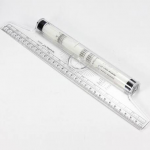
However by the magic of the internet, one seems to be available here:

Reefer Rule extending parallel rule | eBay

Quite a bargain, an old YM says they were £18.55 in 1981 ?

.
That’s the one. To fix it you insert two round-headed screws into the chart table in the far right corner. The base of the instrument slots into the two screws and is then fairly secure. The ruler, which has a protractor, rotates about its centre and locks into place with a screw. It will then hold its bearing as it is moved around the table and can be lifted rather than slid.
 
My preference is for dividers and a pair of triangles. The degree marks on the triangles are nearly 4 mm apart, much handier for precise work.

But, using finger or mouse is much faster and less error prone, so when plotting a quick visual or radar fix to verify against the GPS I'll just do that on the electronics and not faff about comparing coordinates.
 
Best to combine the two methods. They do say "never rely on just one source of navigational data", or words to that effect.
I couldn’t agree more. That is the advice given by most training courses. While I enjoy the satisfaction of getting from place to place using only my brain and a few traditional navigation tools, the addition of a small GPS plotter with its electronic charts as a double check on my position adds another measure of safety.
I do have friends who hardly ever look at a paper chart. Many skippers prefer paper charts for passage planning and use a GPS plotter aboard; some like computer software such as OpenCPN for planning, and a few stick to paper both for planning and on passage.
 

I've been known to use an iPad for navigation: obviously anything with a straight edge will let you draw a line but normally I use a Portland plotter and have a parallel ruler for longer lines

The reefer rule has probably not been made for many a year.

Was this an earlier/american version of spliff politics immortalised in 1999's "Human Traffic"?
 
I have a piece of paper that says I have attended a coastal skipper course......

But.....

What century are we living in?! Don't we have computers this century?

And anyway I never understood the nav stuff. How do you plot a course in a sailing boat if you don't know which way the wind is blowing? Obviously tides, tidal streams and rocks are to be taken into account (on an electronic chart, yes zoomed in.....) but a straight line? In a sailing boat? Maybe you all drive motor boats.

Maybe I am missing something.... ?
 
I have a piece of paper that says I have attended a coastal skipper course......

But.....

What century are we living in?! Don't we have computers this century?

And anyway I never understood the nav stuff. How do you plot a course in a sailing boat if you don't know which way the wind is blowing? Obviously tides, tidal streams and rocks are to be taken into account (on an electronic chart, yes zoomed in.....) but a straight line? In a sailing boat? Maybe you all drive motor boats.

Maybe I am missing something.... ?
While I take your point about "what century?", why would you not know which way the wind was blowing?
 
What century are we living in?! Don't we have computers this century?
An interesting point. From my own experience of a 600 nm from Peterhead to Plymouth this summer with two skippers onboard. Me a traditionalist chart and pencil skipper and my oppo a all singing all dancing electronic iPad type skipper.

We took about the same time to do a passage plan, we reviewed each others passage plan and agreed what to do if we differed. While on passage I had far more information logged in my head, my oppo was constantly referring to his iPad.

It would be interesting to hear if others have similar experiences.

Oh, on a dark and stormy night my chartplotter decided to time travel back to 2002, a software update has fixed that, while the position was correct the CP was displaying historical tides. I wonder how a pure electronic skipper would fix that?
 
why would you not know which way the wind was blowing?
Because you'd be sitting at home a week earlier planning your trip.
For me it's chart plotter all the way, work out the route and a couple of spares at home on the pc or tablet with VMH charts, save as gpx and transfer to garmin, keep a half hourly log of position/heading/speed just in case and paper charts as backup. Also have VMH charts on phone and tablet if just the plotter lets me down.
But I am a mobo....
 
I have a piece of paper that says I have attended a coastal skipper course......

But.....

What century are we living in?! Don't we have computers this century?

And anyway I never understood the nav stuff. How do you plot a course in a sailing boat if you don't know which way the wind is blowing? Obviously tides, tidal streams and rocks are to be taken into account (on an electronic chart, yes zoomed in.....) but a straight line? In a sailing boat? Maybe you all drive motor boats.

Maybe I am missing something.... ?
I think that you are missing a great deal, but first to acknowledge that not everyone agrees.

I’m of the school of thinking that navigation is an art, an enjoyable one, too.

My boat is fully loaded with electronic toys and I try to utilise their capability to the full.

For me, part of the enjoyment of being at sea lies with navigation.

Conversely, I find it hard to comprehend why people want to race their boats but I acknowledge their skill etc.

Sailing is and always will be a very broad church. There’s room for all of us to play until our hearts are content. I happen to like traditional chartwork ?‍♂️
 
Top