What navigation instrument do you use?

Skylark

Well-Known Member
Joined
4 Jun 2007
Messages
7,667
Location
Home: North West, Boat: The Clyde
Visit site
I was chatting to someone recently who swears by a parallel ruler. I think that they are the work of the devil as they are guaranteed to slip.

It is safe to assume that most use the Portland Course Plotter?

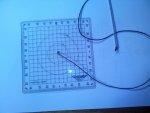
I’ve taken to using a square protractor over the last few years, for its simplicity.

Anyone use anything different?
 
I was tempted to reply - No 1 eye ball (we count headlands or lighthouses)

But Breton Plotter, parallel ruler, dividers - and a, real, metre stick (we have a real chart table)

Jonathan
 
My wife was compelled to buy a Breton plotter for her day-skipper course. It has been banished from the chart table but did find its niche on one occasion when I needed a set square to align my clock and barometer.

For many years I have used Captain Fields parallel rules, until I bought a parallel rule at the boat show that operates by being connected to the table via two tapes which self-retract. The rulers stay in place on the chart table at all times, although I haven't used them in anger for several years. They have the advantage that they can be operated one-handed and can even be lifted from place to place instead of slid, which is an advantage if there is a map-fold in the way. I think that not everyone enjoys using them but I found them very reliable and quick.
 
Parallel ruler for me plus dividers. Must admit I don't use them much now days as the MDF with vector lines has taken over. Charts are still used to 'plan' due to covering a much larger area than a 9" screen.
Never got on with a Portland or Bretton plotter.
 
My wife was compelled to buy a Breton plotter for her day-skipper course. It has been banished from the chart table but did find its niche on one occasion when I needed a set square to align my clock and barometer.

For many years I have used Captain Fields parallel rules, until I bought a parallel rule at the boat show that operates by being connected to the table via two tapes which self-retract. The rulers stay in place on the chart table at all times, although I haven't used them in anger for several years. They have the advantage that they can be operated one-handed and can even be lifted from place to place instead of slid, which is an advantage if there is a map-fold in the way. I think that not everyone enjoys using them but I found them very reliable and quick.
I too enjoyed one of those tape devices, name escapes me but loved it, in our case over a Yeoman paper plotter permanently mounted under a perspex cover on chart table., perspex matted so could draw on it with a soft pencil. As electronic plotter evolved I reverted to large square (Douglas?) protractor as a backup,
 
Thanks to all for responding. It is meant to be a lighthearted thread. I was hoping that a bit of chartwork wouldn’t be contentious as it’s not related to vessel age, hull material, overall length or cost of the anchor ?

When I was first introduced to navigation, as a diver, I bought a parallel rule as I thought that they looked like the dogs bolox. However, I’ve never really successfully used them so it’s good to see that some of you can/do.

Yesterday, I was refreshing my radar knowledge and modifying the WOA triangle of motions to assess the impact upon CPA by either altering speed or course. The parallel rules were quite useful for this.
 
This is the one I use most frequently :)


View attachment 127134
From an engineering viewpoint, the square protractor should be the most consistently accurate.

Within engineering statistics, there’s a term Gauge R&R. It is a measure of process repeatability and reproducibility. One is related to the tool, the other to the operator.

Parallel rulers and Breton/Portland plotters both have moving parts so there’s an inherent variability. The square doesn’t so should always give a better result.

Who said the thread shouldn’t be contentious ?
 
From an engineering viewpoint, the square protractor should be the most consistently accurate.

Within engineering statistics, there’s a term Gauge R&R. It is a measure of process repeatability and reproducibility. One is related to the tool, the other to the operator.

Parallel rulers and Breton/Portland plotters both have moving parts so there’s an inherent variability. The square doesn’t so should always give a better result.

Who said the thread shouldn’t be contentious ?
I find the grid quite useful to put gps coordinates on the chart, some (ex some Imrays) have their own finely spaced grid but often there are only a few latitude/ longitude lines at round numbers, by counting the "notches" on the vertical and horizontal edges scales the coordinates can easily be located on the chart. :)
 
And for a slightly different approach - at work I quite often use the two triangles method, it's very easy for plotting lat&long positions (without the slipping you get with parallel rulers as the left hand triangle stays in one place), and also for bearings and courses with the protractor printed on them. It's especially quick for radar and visual bearings.

For yacht use though where absolute accuracy is less of a priority I use a Breton plotter as it works well in a small space and only needs one hand.

And nothing beats a proper rolling ruler, on a full size chart table - that really is the best but there's no room for one on a tug, let alone a small yacht!
 
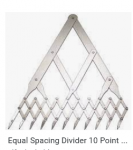
I have a set of these which I like to leave on show on the chart table in the hope of creating the illusion that I know what I'm doing. ;)

View attachment 127138
I’ve seen you trying to berth your Twister so fear not, no one will believe for a second that you know what you’re doing ???

(that’s a joke, for the avoidance of doubt ?)
 
Top