What is this green stuff?

neiloakley

Member
Joined
27 Jun 2011
Messages
37
Visit site
Seems to be leaching out the props. I've already cleaned it off once and a few days later it was back. Powdery texture.

Any ideas?
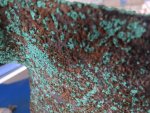

image.jpg
 
it looks like corrosion i was told to hit the props with a small hammer and listen as if it thuds it may need replacing but u should get advice
 
Perfectly normal!


No, but PCUK says its mains related so I'm pointing out there is no mains connected.


Electrical, yes - but not necessarily mains. You could have stray currents within the boat or even via a nearby boat that is connected to shore-power. Electricity flows through water - especially salty water! Worth checking all the bonding too. The prop looks like it's slowly dissolving and copper leaching out :(
 
Sorry I thought it was obvious, but the boat is not in the water and has not been in the water since I cleaned the props the first time. All that green has appeared since its been on the hrs and after I cleaned the last lot of green stuff off.
 
Bronze is mostly copper and tin. While some bronze can have a little zinc, marine bronze should not. Brass is an alloy of copper and zinc!
The greeny-blue (?) will be copper chloride resulting from electrolysis in a solution of sodium chloride (sea salt). The zinc anodes are designed to sacrifice themselves to protect the bronze. This occurs because zinc is less noble (more active) than marine bonze and copper.
You would expect that good, working zincs would prevent this
This is remembered from schoolboy chemistry so hopefully is reasonably accurate! ... K
 
Just noticed you said the boat is on the hard.
Must still be the copper content of the bronze reacting with a salt, acid or alcaline to produce a green/blue copper salt on the metal surface.
Maybe just the inevitable saline atmosphere of the marine environment? ... K
 
Thanks for the reply. But the greeny blue salts appeared several days after the boat was lifted out. They are bone dry

And reacting with the oxygen in the air .

There would have been a tiny amount of Zn in the prop alloy -that's depleted below a certain level

Also should have had some sort of catholic protection working --?? when immersed in the sea .
 
Copper reacting with oxygen (in the air) alone would produce copper oxide which is usually black, certainly not green or green/blue. The green/blue substance has to be a copper salt of some sort i.e. Copper chloride, copper sulphate, copper nitrate all will have been produced by a reaction with the appropriate acid or salt of same. If nothing has been applied to the prop surface it can really only be copper chloride from the salt (sodium chloride) content of the sea air IMHO. ... K
 
I think that's probably the answer. The damage was done in the water when the alloy was affected by electrolysis and this is perhaps moisture in the air drawing out the vulnerable copper. Try wrapping a bag around on a warm day and then see if it still happens after a few days. If it's a clear bag, you'll be able to see without removing. Does suggest they may be compromised and at the very least need a protective coating?
 
Apologies for my first response. It was meant to be conjecture, not absolute fact. I can see now that it looked definitive. Should have added a query at the end. Unfortunately something is going on but if you can find the trouble you may be able to save the props.
 
Just clean it off. If there is dezincifcation then you will see pink areas - which is the copper after the zinc has leeched out. There is a lot of misinformation in some of the above posts. Although props are made of "bronze" used in a generic sense, most cheap props are an alloy of mostly copper and zinc. Many bronze alloys do not have zinc in them, but are rarely used for props because they are expensive. Dezincification can be kept at bay by bonding to anodes which is why it is satisfactory to use these lesser cheaper alloys.

Anyway, don't think that is your problem, nor do I think it is a real problem. Ideally take the props off and dip them in brick cleaner which will get rid of all those surface deposits, including the green bits. Then you can assess their true state. You can clean them without removing by soaking in the solution, covering in a plastic bag then washing off, but not as effective as dipping.
 
Top
