
What is considered a deep v hull?

mabbs

Member
Joined
25 Jul 2017
Messages
27
Visit site
Bit of an academic question, but where is it considered a shallow v becomes a medium and likewise a “deep v”. Also where is it measured? Mines 14 degrees at the transom, old Shetland 2+2 some refer to it as a deep v, but I’d regard it as a medium?!
 
Bit of an academic question
The traditional academic answer is above 20 deg transom deadrise.

But the stress is on "academic".
I've yet to come across anyone in real life who gives a sh!t about that, on the face of how relevant you think this can be by looking at boating forums... :ROFLMAO:
 
Try this refreshingly educated forum in the link below .:)

I’d say 20 degrees is deep and your 14 is correct a medium V .
FWIW My boat closes at 23 at the transom .I did the research it’s my 2 nd mobo .First a Sunseeker slammed and we had to throttle back far too much .

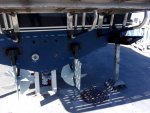
Fixed that with this . :D Pssst it has not got a griddle for prawns - shucks ! But a wonderful magic carpet ride in waves .
5A9E86EF-8753-4E94-A793-462919858E5C.jpeg
Plenty of owners forums , Magnum , Baia , Otam ,Itama and of course loadsa of American race boats talk all the time about the deadrise .You are right to dig deep into this .

Enjoy ?
Which Italian designer was the father? Theodoli, Martin or Amati? - Offshoreonly.com
 
Plenty of owners forums , Magnum , Baia , Otam ,Itama and of course loadsa of American race boats talk all the time about the deadrise.
You are right to dig deep into this .
Ok, I'll give you that: my previous statement was a bit of a sweeping generalization.
Indeed hull shape/vee depth is something that sportboat fans rave for.

OTOH, in the modern swift trawlers world we are living in, how nicely the boat cruises at 12 to 15 knots is a much hotter topic, whether we like it or not.
And obviously (rigthly, even!), for these boaters, the deadrise is the very last of their concern, because it's not even something they are aware of.
 
20 degrees or above closing aft is Deep-Vee (usually used in fast boats or small boats cause if you lift off you land softly)
Bertram 31 closed at 24 for example the Vee hull shape pioneer, and Magnum also at 24. Most Sunseekers Don Shead performing hulls close at 20-22, and Baia was more or less the same. Amati's Itama close at 22 degrees. Alfamarine used 25-26 as well. Cigarettes 24 to 26 etc
10-19 is closing aft is considered a medium-Vee (used in most motor boats) But some of the best hulls like the legendary Napier Bertram 54 close at 17, as did most of Napier hulls and as do Olesinski, though I think his best ones actually closed at 15 and do not have tunnel props. Ferretti also has most boats in the 14 to 18 range and most of them ride very well.
0-9 closing aft is considered flat-Vee. Now some people will say this is not good but there is some super hulls in this range as well. Most new Vikings above 60 close under 9 degrees and ride really well. I went in a three meter head sea on an Uniesse 57 which closes at 7 degreees and I would say it really rided like a queen.
 
20 degrees or above closing aft is Deep-Vee (usually used in fast boats or small boats cause if you lift off you land softly)
Bertram 31 closed at 24 for example the Vee hull shape pioneer, and Magnum also at 24. Most Sunseekers Don Shead performing hulls close at 20-22, and Baia was more or less the same. Amati's Itama close at 22 degrees. Alfamarine used 25-26 as well. Cigarettes 24 to 26 etc
10-19 is closing aft is considered a medium-Vee (used in most motor boats) But some of the best hulls like the legendary Napier Bertram 54 close at 17, as did most of Napier hulls and as do Olesinski, though I think his best ones actually closed at 15 and do not have tunnel props. Ferretti also has most boats in the 14 to 18 range and most of them ride very well.
0-9 closing aft is considered flat-Vee. Now some people will say this is not good but there is some super hulls in this range as well. Most new Vikings above 60 close under 9 degrees and ride really well. I went in a three meter head sea on an Uniesse 57 which closes at 7 degreees and I would say it really rided like a queen.
The 7 degree Uniesse 57 , must have been pointy forwards to ride like a “ queen “ in a head sea ….but in a following sea ??

Quote from a Naval Architect below

“[ Simply put, a hull that is too pointy forward and too flat aft will have an increased risk of broaching. Boaters should look for a hull with deadrise spread evenly — no extremes, such as a professional offshore racing boat’s sharp deadrise throughout the hull. The best boat hull for rough seas must be able to handle following seas.

“If you’re going to have fine forward sections, you’ll balance the hull by putting a lot of deadrise aft,” Peters explained. “You’re looking for recovery, a bow that doesn’t plunge and that can regain its buoyancy in a following sea.] “


The Best-Riding Center Console Boats for Rough Water
 
Sure a deep Vee is the best in a following sea. No dispute about that, but to work in other sea states, which unfortunately or fortunately is never one way it really needs a perfect balance.
How many boats are designed around balance today, possibly nearly none, with the exception of performance boats and centre consoles.

But the Uniesse 57 does not broach in following, reason is that at about 9/10 of the hull it has a center keel and is deep Vee up to about 7/10 of the hull. She is in the end a 17 meter boat, and is using the hull to get this advantage. Though it best qualities remain in head sea.

Here is the smaller 48 in head and following seas;
 
Last edited:
Nice boats Uniesse , as you say and with the architects ( if I understood them correctly) it’s the V where the water , majority of the water takes the hit the mid sections that matter most .Your 7/10 th explain’s it .

Theres a lot more than deadrise its just the starting point that’s easily recognisable to the eye ……for those that look :)
 
Some interesting points made, would a flatter bottom be more resistant to roll at anchor and less affected by weight aft?
 
Sure a deep Vee is the best in a following sea. No dispute about that, but to work in other sea states, which unfortunately or fortunately is never one way it really needs a perfect balance.
How many boats are designed around balance today, possibly nearly none, with the exception of performance boats and centre consoles.

But the Uniesse 57 does not broach in following, reason is that at about 9/10 of the hull it has a center keel and is deep Vee up to about 7/10 of the hull. She is in the end a 17 meter boat, and is using the hull to get this advantage. Though it best qualities remain in head sea.

Here is the smaller 48 in head and following seas;
Pointless video as regard seakeeping need to be filmed from chase boat to show side on view
 
No she is an independent boat, you can see his YT page Uniesse 48 Aurora.

The video is not pointless and might be a more genuine case to many since we are being on boat while he is cruising in some waves.

Anyways here is another Uniesse video in 2 meters chop
 
No she is an independent boat, you can see his YT page Uniesse 48 Aurora.

The video is not pointless and might be a more genuine case to many since we are being on boat while he is cruising in some waves.

Anyways here is another Uniesse video in 2 meters chop
The video does not relate in cruising in waves what so ever, You can only do that by "by the seat of your pants"
It is a very difficult subject that cannot be related to by text.
 
Last edited:
It’ looks like it is a chase boat to the BAGLIETTO 43M FAST .
[/
If it ain’t 24.5 degrees….it ain’t worth looking at ???
Family member has taken delivery of 37ft with stepped hull and 24 deadrise. Problem is it does level out until 31 kn no visilbilty between 10 an 31 kn (now have camera fitted)Not very good in busy waters where they are based.
So maybe a flatter stern would help. WOT 71knots!
 
What boat Stelican ?
Assuming it’s got outboards or even outdrives then you are into the CoG territory. The weights too far back .
Also your are getting into lifting pads ( see my pic ^^ post #4 ) the hull where the tin of AF is = see the pad ?
Also the the spray rails fwds morph into lifting strakes as they go aft , they go horizontal offering flat lifting area .

The sum of which means they come combined into effect at the higher end of the hulls speed range .
I get your point as my boat comes into its own north of 24/25 knots .From then onwards it kinda has a second lift up and the nose dips .No flap needed the bow just drops on its own to a optimal less than 4 degree running angle .
But the crucially the difference ( if I am right about your relatives boat weight at the back ?,) is my boat the engines are in the middle of the boat .This means the CoG and CoL - centre of lift are together or close .
Your relatives boat must by definition of the excess bow high “ no visibility “ either has a massive distance between the CoG and CoL or / and insufficient alternatives to stern lift other than a shallow deadrise ie a pad or strips .

As it goes faster the lift apparatus as you say starts to come into play and the bow drops / stern lifts to overcome theses discrepancies.

Its designed to run fast ( 70;knots WOT you say ) which in bigger seas means a bigger deadrise which it does , but it all comes back to square one choose a boat for its intended purpose , if it’s spending too much time in “ busy waters “ whereby its not feasible to exceed 31 knots and get it bow down to safely see over, then frankly it’s the wrong boat for purpose.

Remember too much extreme of one factor is not good the thing needs to balanced in more ways than one ☝️
 
Family member has taken delivery of 37ft with stepped hull and 24 deadrise.
Problem is it does level out until 31 kn no visilbilty between 10 an 31 kn (now have camera fitted) Not very good in busy waters where they are based.
So maybe a flatter stern would help. WOT 71knots!
Hunton, possibly? That's all pretty normal, anyway.
I had a Fountain with similar behaviour, and I experienced that also on other boats of the same ilk.
They are not designed to enjoy cruising, they are designed to enjoy driving them. And they have a very low beam to length ratio, which is as necessary as the deep vee to avoid breaking both the boat and the crew's backs, at very high speed.
The drawback is an insufficient hull lift at low/medium speeds.
It all comes with the territory, and I'm afraid that if your relative was interested in cruising busy waters at 20kts he got the wrong tool for the job.
 
Thank you both for your input.
The boat is used purely for fishing out of Montauk where the waters get quite busy.
You are correct Porto, A lot of weight aft 3 outboards and a seakeeper maybe needs bigger tabbs.
Guess they could put a tower on it !
 
Last edited:
Top