What filtered water tap to buy?

Seagull. Yes, the filter elements are costly, but you don't have to change them every year.
The recommended filter change period is once a year, or sooner if you notice degradation, for Seagulls isn't it? One of my reasons for trying out the Water2 was that the filter specs were the same as Seagulls, including recommended change period, but they cost less.
 
Just a little clarification:

  • Sanitizing chemicals including chlorine in various forms improve the taste of water by oxidizing organic chemicals and most significantly, by oxidizing sulfides (rotten egg smell/taste) to sulfate. Also your main barrier to disease, since even ROs can have a tiny leak and bypass a few bugs, which then multiply in the tank.
  • Carbon can improve taste by absorbing chemicals, but it's capacity is very limited.
  • Carbon removes chlorine sacrificially by being oxidized itself. The chlorine removal capacity is MUCH greater than the taste/odir removal capacity.
Thus, the most effective way to improve taste is very light chlorination (2-3 ppm residual) followed by carbon to remove leftover chlorine. Always clean the tank first to improve chlorine contact and to reduce chlorine reaction residuals. Likewise, filter (particles) incoming water to keep the tank clean of dirt; don't expect miracles from a dirty tank by any filter.

Ideally, water treatment is a multi-step process. The tap filter is the last step.
 
The recommended filter change period is once a year, or sooner if you notice degradation, for Seagulls isn't it? One of my reasons for trying out the Water2 was that the filter specs were the same as Seagulls, including recommended change period, but they cost less.
I've reread the manual, and you're right.

I change mine every 2 or 3 years and never had a problem, but this is worth thinking about.
 
I strongly recommend the General Ecology units. They are brilliant, they remove e-coli and any other pathogens. The filters are expensive and you only need to replace them when the flow is unacceptable. The water tastes like mineral water you won't get any tank taint. I think it is a matter of getting what you pay for.
 
The change interval is going to vary orders of magnitude by ...
  • How much water.
  • How physically clean? IS there dirt that can clog the filter, or is the tank clean and the feed pre-filtered?
  • How much chlorine? None will use up the absorption capacity more quickly (because there is more organic material there). Too much will burn up the carbon. Just right (2-3 ppm residual) will give the longest life, because there is just enough chlorine to burn the organics out of the carbon pores.
It's common practice to put in fresh filters in the spring, but it really is not required. If you winterize, remove them and let them dry. There is no need to change the filter unless the flow drops or you don't like the taste (but you probably have another problem causing it). The protection against spores (giardia etc.) is not really age-related, it is pore size related and won't change.

Yes, they want to sell you filters. Yes, General Ecology is good, but other 0.5 micron carbon block filters are the same thing, with less hype. Hype is expensive. I've used and tested both types.
 
That's an interesting point about the pathogen filtration not being affected by age.

I have wondered whether my Water2 filter onboard really needs changing after the year given how little water flow it takes, but did wonder if there was a risk that anything nasty could develop in it if it just sits with water in it over winter (I don't tend to take the boat out of the water over winter). Would love to know what the actual risks are with filters being used past the recommended change period, and whether any of those are risks to health (vs just taste etc.)

Interestingly I did this week question Water2 about why they have changed some of the messaging on their UK website (which no longer mentions 0.5um filtration, removal of pathogens, or asbestos filtration). I originally chose the filter based on the additional pathogen filtration (and although I'm not worried about asbestos, did take this to mean it would also filter out any other fibre nasties of similar size to asbestos like fibreglass etc.) which made it comparable with the Seagull filters.

Apparently they are changing the filter design in the UK in response to feedback about what is most important to the UK market - switching from the 0.5um filter to a larger charcoal filter than can support higher flow rate. This would actually change the Water2 filter as a comparison to something like the GE Seagull.
 
I strongly recommend the General Ecology units. They are brilliant, they remove e-coli and any other pathogens. The filters are expensive and you only need to replace them when the flow is unacceptable. The water tastes like mineral water you won't get any tank taint. I think it is a matter of getting what you pay for.
Words like "canisters employing our proprietary "Structured Matrix" technology with the strength and endurance of modern materials" is just marketing bullshit.

To charge £240 for a 3u paper filter in a standard 10" plastic housing and over £100 for replacement papee filters is a rip off compared to products sold by tap makers like Grohe.

No wonder they use fancy words like "aqua polishing" in their blurb. Screwfix sell BWT stuff at under half the price.
 
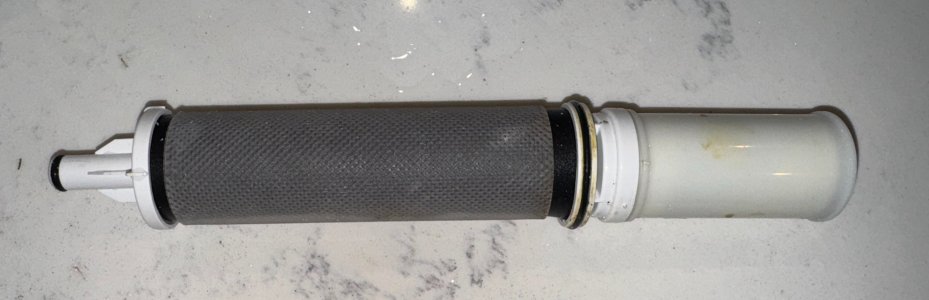
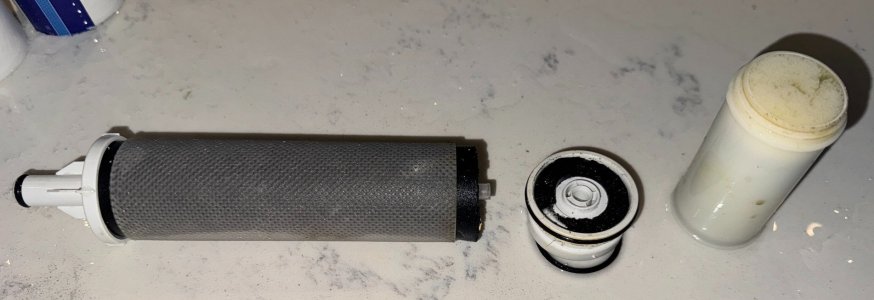
There was some interest in seeing inside the Water2 filter, which I've now gotten round to cutting open. (@lustyd)

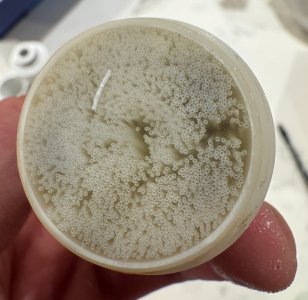
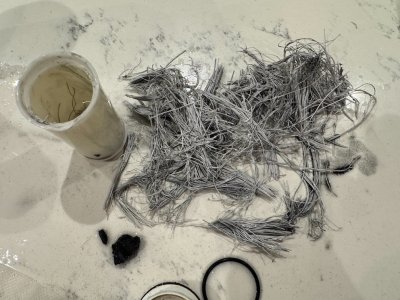
I have to say I don't completely understand how it actually works, so any insight is very welcome! There seems to be a charcoal upper section, and then some kind of lower section with lots of little capillary tube things. Not clear to me what they're made of or what they're doing!

IMG_6913.JPG

IMG_6914.JPG

IMG_6926.JPG

IMG_6918.JPG

IMG_6920.JPG

Also, I had an interesting conversation with Water2 customer services recently, as I noticed that they had changed the messaging on their UK website to remote references to the small ultrafiltration membrane to filter bacteria, viral, parasitic filtration, asbestos fibres etc. At the time, they were still using the older messaging on their US website.

They told me that they have indeed changed their filter design in response to feedback from UK customers as they had seen significant water pressure drop for some customers as a result, so have updated the Pod 2.0 design

"so it no longer targets bacteria and parasites in the same way. Instead, it uses a denser carbon block, which enhances reductions of chlorine, lead, trihalomethanes, and other chemical contaminants, while also improving flow rate and taste."

Since then, I note that their US website seems to be in a state of half-working and has a message that they are 'closed for the time being'. I presume for some reason they have had to stop selling in the US.

Apparently if you order replacement capsules for now you will still get the design with the UF membrane, however new Pod 2.0s are being sold with the new filter design without the UF membrance.
 
Thanks for sharing. The tubes are effectively an RO style filter like you get for camping. These should be sealed so no water can bypass the filter. Given there isn’t any drop in water flow I’m suspicious as to whether this is actually doing its job as I would expect slower delivery.
The carbon filter looks to be the same size as standard fridge units. On day one this will work but the fridge units are rated three months and their effectiveness fades over that time. A Britta tap filter is much larger, rated for 6 months, but slows the flow to a tiny stream in a smaller outlet than the main tap.

Personally I’d conclude that this does something on day one but the marketing is much more effective than the product possibly could be.

Removal of the fine RO style filter leaves you with a carbon filter. I pay £20 for four which lasts a year. Filters on Amazon
 
Last edited:
The tubes are effectively an RO style filter like you get for camping. These should be sealed so no water can bypass the filter.
Ah - so this does look legit in terms of their ultrafiltration claims? Looking at the design, it does indeed look like, with the rubber seals pictured, the water was forced through the RO style membrane and back up the central tube.

Given there isn’t any drop in water flow I’m suspicious as to whether this is actually doing its job
Although it was their original marketing claim that it didn't affect water flow, I don't think it's held true in reality. It was the reason they quoted for moving to a new filter capsule design without the ultrafiltration membrane and with a larger charcoal block.

My personal observation has been that it does reduce the water flow, but not enough that it felt like it was a problem for us. We just accept it takes an extra 10 seconds to fill up the kettle.

I think I've come to the same conclusion as you, though, in that for what is essentially a large charcoal filter there are much cheaper options out there, and I'm suspicious of it having a year lifespan. I've put a new capsule into ours at home now, because I had it sitting there and I had detected the change in taste in the water - but I am not convinced I will pay £70 for another one in a year's time...

I also need to decide what to do about the Water2 I have fitted on the boat, as I put it on there for 2 main reasons: 1) ease of fitting and relatively compact size, and 2) the ultrafiltration membrane which gave me some peace of mind that any biological nasties or particles in the tank would be filtered out. If all it is doing is providing a charcoal filter in the future, there are much cheaper options to install on the boat, or better quality options that offer ultrafiltration.

They have told me over email that if I order a replacement capsule now, I will still get one with the ultrafiltration filter included. So that might be the answer for next season, and then reconsider options.
 
Thanks for sharing. The tubes are effectively an RO style filter like you get for camping. These should be sealed so no water can bypass the filter. Given there isn’t any drop in water flow I’m suspicious as to whether this is actually doing its job as I would expect slower delivery.
The carbon filter looks to be the same size as standard fridge units. On day one this will work but the fridge units are rated three months and their effectiveness fades over that time. A Britta tap filter is much larger, rated for 6 months, but slows the flow to a tiny stream in a smaller outlet than the main tap.

Personally I’d conclude that this does something on day one but the marketing is much more effective than the product possibly could be.

Removal of the fine RO style filter leaves you with a carbon filter. I pay £20 for four which lasts a year. Filters on Amazon
I use a similar filter on the tap in the apartment I use in Hong Kong, where such filters are common.

It isn't RO, because that would involve some water being rejected, with a higher concentration of impurities, just as in a desalination setup. Such low pressure RO is used, but for every litre of purified water, about a litre is rejected and is either collected separately or plumbed into the drain. It would be terribly wasteful on a boat.

The fine tubes are simply a VERY fine filter, with the length providing a massive surface area. The enormous surface area allows a high flow rate. The instructions on mine say to change the filter when the tubes turn coffee coloured! It will remove pretty much all particulate impurities (including bacteria and viruses) but won't touch dissolved impurities.
 
I use a similar filter on the tap in the apartment I use in Hong Kong, where such filters are common.

It isn't RO, because that would involve some water being rejected, with a higher concentration of impurities, just as in a desalination setup. Such low pressure RO is used, but for every litre of purified water, about a litre is rejected and is either collected separately or plumbed into the drain. It would be terribly wasteful on a boat.

The fine tubes are simply a VERY fine filter, with the length providing a massive surface area. The enormous surface area allows a high flow rate. The instructions on mine say to change the filter when the tubes turn coffee coloured! It will remove pretty much all particulate impurities (including bacteria and viruses) but won't touch dissolved impurities.
That makes sense!

Something else I've wondered is the risk of bacterial growth within the filter, in particular when using it on a boat.

For instance, I have gone maybe 6 weeks without running any water through the filter on board. When I last visited, I ran the tap and was fairly sure I detected a faint smell at first. Made me wonder whether leaving it sitting without water flowing every few days is actually more of a health risk (given that it will have removed whatever chlorine / treatment might have been in the water at the point that the water is flowing through the membrane etc.

No idea if simply running the water through for a minute or so would be enough to clear anything out, or there's a real chance that leaving it without water flow could end up making it unusable.
 
That makes sense!

Something else I've wondered is the risk of bacterial growth within the filter, in particular when using it on a boat.

For instance, I have gone maybe 6 weeks without running any water through the filter on board. When I last visited, I ran the tap and was fairly sure I detected a faint smell at first. Made me wonder whether leaving it sitting without water flowing every few days is actually more of a health risk (given that it will have removed whatever chlorine / treatment might have been in the water at the point that the water is flowing through the membrane etc.

No idea if simply running the water through for a minute or so would be enough to clear anything out, or there's a real chance that leaving it without water flow could end up making it unusable.
I only spend about 2 or 3 months a year in Hong Kong; no-one else uses the apartment, so the filter is unused for 9 or 10 months. I've never noticed an issue. Obviously I check the filter before using it, but so far it hasn't been an issue. Of course, that's on mains water where running a tap for a minute isn't a big deal.

I think HK water is more highly chlorinated than UK water, but the flip side is that the temperature is MUCH higher! So I guess it balances.
 
For instance, I have gone maybe 6 weeks without running any water through the filter on board. When I last visited, I ran the tap and was fairly sure I detected a faint smell at first. Made me wonder whether leaving it sitting without water flowing every few days is actually more of a health risk (given that it will have removed whatever chlorine / treatment might have been in the water at the point that the water is flowing through the membrane etc.
Possibly not for the filter, but we get dirt in the tap as chlorine has been stripped out so we occasionally clean the spout.
 
Although it was their original marketing claim that it didn't affect water flow, I don't think it's held true in reality.
Much of my reasoning in not trusting them was size of device vs claims made. My mum fitted one and flow rate was entirely unchanged, and for me that would either do nothing or need a bigger housing. Life straws for hiking aren’t much smaller so my conclusion was BS. As AP says with surface area it is possible to keep flow rate, but then the claims requiring a carbon filter that lasts a year couldn’t also be true as there simply wasn’t room.
If the claim was for a month I would never have questioned them but a year seemed absurd given the compact size. Even if they change the claims and design, I’m afraid they’ve shown their colours as a business who’d rather spend on marketing than development.
 
Not sure I would drink any water which had those spaghetti soaking in it, whatever they are, actually I definitely wouldn't :)
It’s just fine tubes only open at one end (hence folded in half) and set in resin. These are the filter AP mentioned.
 
Just a little clarification:

  • Sanitizing chemicals including chlorine in various forms improve the taste of water by oxidizing organic chemicals and most significantly, by oxidizing sulfides (rotten egg smell/taste) to sulfate. Also your main barrier to disease, since even ROs can have a tiny leak and bypass a few bugs, which then multiply in the tank.
  • Carbon can improve taste by absorbing chemicals, but it's capacity is very limited.
  • Carbon removes chlorine sacrificially by being oxidized itself. The chlorine removal capacity is MUCH greater than the taste/odir removal capacity.
Thus, the most effective way to improve taste is very light chlorination (2-3 ppm residual) followed by carbon to remove leftover chlorine. Always clean the tank first to improve chlorine contact and to reduce chlorine reaction residuals. Likewise, filter (particles) incoming water to keep the tank clean of dirt; don't expect miracles from a dirty tank by any filter.

Ideally, water treatment is a multi-step process. The tap filter is the last step.
We use UV after the watermaker before the water enters the tank. Any residual bacteria is dealt with. UV is particularly appropriate used after RO as the solid content of RO water being so low, leaves little for bugs to hide behind when being zapped by UV
 
We use UV after the watermaker before the water enters the tank. Any residual bacteria is dealt with. UV is particularly appropriate used after RO as the solid content of RO water being so low, leaves little for bugs to hide behind when being zapped by UV
If the RO is actually working then there won't be anything bigger than a molecule left so "residual bacteria" is the wrong way of thinking about it. Any bugs are coming from the water storage and plumbing system. which should be regularly cleaned through since the water doesn't have chlorine.
Not saying UV is the wrong answer, just clarifying that RO removes all bacteria and viruses if it's working. What it cannot remove is heavy metals, so a carbon filter is definitely required, alongside sensible water sourcing (for instance, never use one in the Fal as it's full of arsenic!)
 
Top