What does my boat weigh?

let's be practical about this. You have pretty good, consensual and reliable info that the all up weight is going to be no more than a tonne.

If you go for a trailer with that designed load, then you could leave the odd banana or length of chain in the boat while trailering it, with no adverse effects.

Get a trailer - loads on ebay. If you are worried about the spec or anything, ask again here for someone to take a look at it. Take it to the nearest weighbridge, weigh it, get a ticket (should cost you about a £5, or a beer if you use your local scrappy's yard).

Get the boat out on the trailer; and repeat the exercise.

Subtract one from 'tother, and you will know to a kilo what the boat and its contents weigh.

Provided it's a trailer rated for 1 tonne load , you will be OK - just check the car towing limit.


I think that having your own trailer is going to be a great advantage, and in the long term will reduce your costs quite dramatically. It may be a bit daunting at first to manhandle a 500 kg boat on and off the trailer , but you soon get used to doing it safely and quickly. Honestly ! :)
 
Last edited:
Not to lose sight of my original question, can anyone tell me how to calculate the weight of my boat???

Yes, measure the dimensions of the immersed part of the hull [as determined from the waterline when out of the water] and from them calculate the volume in cubic metres. A cubic metre will weigh a tonne. I know it's not that easy but that's the best way to CALCULATE it.
 
my shetland 498 wieghs 500kg and the engine another 60kg. triler is 250kg. all weighed on local council weigh bridge
i cant see your boat weighing much more as its the same size.
 
That's a good guide. The Shetland is probably a heavier boat (I had a Sheltie) than the Mariner. (I got my figure by Googling; Marina 16GT, displacement)
Still need to be looking at a trailer with at least 1000Kg GTW. But most decent cars will tow that legally.

It's interesting to note that although the unbraked maximum weight for towing is 750Kgs vehicle manufacturers will often rate their vehicles much lower than that (for unbraked trailers).

Not that it matters in this case as a braked trailer will be needed.
 
Yes, measure the dimensions of the immersed part of the hull [as determined from the waterline when out of the water] and from them calculate the volume in cubic metres. A cubic metre will weigh a tonne. I know it's not that easy but that's the best way to CALCULATE it.

Which of us owns a boat which can be accurately measured, like that?!! :D

The curves turn that method into pretty wild guesswork. A Westerly Centaur and a Fisher 25 aren't that different in dimensions, but substantially different in displacement.
 
with my old trailer the all up weight was 820kg on an unbraked trailer.
my new trailer was specced to take a max weight of 1000kg and tows very well and was £1500 brand new so O.P may be able to get a used one at half that price.
 
Yes, measure the dimensions of the immersed part of the hull [as determined from the waterline when out of the water] and from them calculate the volume in cubic metres. A cubic metre will weigh a tonne. I know it's not that easy but that's the best way to CALCULATE it.

You are about right. You will also need to take into account the block coefficient of this hull and also assume that quoted draft is for fresh water density.
An approximate estimate is:

Waterline length: 4.70m, waterline beam: 2,m draught 0.16m and block coefficient 0.5
4.7x2x0.16x0.5= 752 kgs
 
Or pay a yard to haul it for weighing.

IIRC any lifting gear like a crane or sling has to be able to weigh what it is carrying or am I tlaking BS?
 
It's interesting to note that although the unbraked maximum weight for towing is 750Kgs vehicle manufacturers will often rate their vehicles much lower than that (for unbraked trailers).

Not that it matters in this case as a braked trailer will be needed.

I seem to recall that the law limits unbraked trailers to half the weight (kerb weight I think) of the tow car or 750 kg, whichever is less, which is why the manufactures quoted numbers tend to be less than 750 kg. As you say, rather academic as the OP will almost certainly need a braked trailer.
 
Thank you all very much for the information.

Vic and Lakesailor - could you tell me where you found those weights? I hope I'm not missing something obvious but am reading / typing on the Q.T. at work!

The boat came with the name Moxon - I beleive it was the family name of a previous owner.

I have also misled you about the engine - mine is a 7.5 H.P.

Stephen.

The weight I quoted for the Marina Fisherman came from Indespension's Trailer Manual ( 1981 edition) You are excused if you do not have a copy of that on your bookshelf!
I tried Google but did not have the same luck that Lakey had! ( found it OK now though!)

The weight for the outboard came from a 1984 Evinrude brochure.
FWIW that gives 25.4kg as the weight of standard shaft 6 and 8hp models..

When towing it makes sense to transfer as much weight as possible from the boat to the towing vehicle. That can include a 7.5 hp outboard since its small enough to handle, the fuel tank, the battery if you have one and the anchor and chain.
Looks like you may not need a trailer with quite the capacity suggested previously but it makes sense not to cut it too fine ... boats usually end up weighing more than you think!

A good source of info regarding all the legal aspects of towing is the NATIONAL TRAILER & TOWING ASSOCIATION website.
 
Yes, measure the dimensions of the immersed part of the hull [as determined from the waterline when out of the water] and from them calculate the volume in cubic metres. A cubic metre will weigh a tonne. I know it's not that easy but that's the best way to CALCULATE it.

Even though it was not meant as a practical proposition isn't that what I said in post #11 !
 
The Block Coefficient is more like 0.35-0.4 for something like this...

If you really want to calculate it, you need to use 'simpson's multipliers'... A pretty simple caculation using the area of the sections. The difficult bit is getting that info...

If you're super keen you could take the sections off the boat (not many curves on this one!)

You can also work out the Cb by comparing similar hulls where you know the LWL, BWL and draught and displacement... That will give you a reasonable estimate.
 
Last edited:
The Block Coefficient is more like 0.35-0.4 for something like this...

If you really want to calculate it, you need to use 'simpson's multipliers'... A pretty simple caculation using the area of the sections. The difficult bit is getting that info...

If you're super keen you could take the sections off the boat (not many curves on this one!)

You can also work out the Cb by comparing similar hulls where you know the LWL, BWL and draught and displacement... That will give you a reasonable estimate.

I'd accept the figure Lakesailor has found!
 
I remind myself that this is the Practical boat owners' forum....:)

Ah well if you want a practical method .. accurate too

Take one tank large enough to float boat in and fitted with an overflow pipe a few inches down from the top.

Fill tank with water up to the level of the overflow.

Lower boat gently into tank until it floats whist catching the water overflowing.

Measure the volume of the water that overflows ... Weight of boat in kg = volume of overflowed water in litres


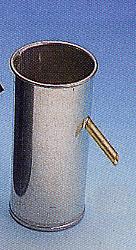
Like a giant version of one of these:

Displacement_can.jpg
 
Agreed, that method should indeed be impressively accurate. :)

Only needs the boat to be taken to the tank... :(

...umm...you might need a trailer, for that. So, be sure to find out how heavy the boat is, before you start... :mad:
 
The plod are unlikely to stop you as long as it looks a reasonably sound outfit and all is in order. (Ties-downs, lights, red bag on outboard leg, safety chain etc).
The insurance company could (would) refuse to pay out if a claim was made and it was found that you were towing illegally.
So don't have an accident and make it all look tidy and compliant.
 
Top