
Welding a Yanmar saildrive or....

SvenH

Well-Known Member
Joined
28 Mar 2011
Messages
388
Location
The Netherlands
Visit site
A few years back I discovered damage to my Yanmar saildrive: The bottom bolt hole for the prop shaft (picture further down) had cracked open and was subsequently repaired by fixing everything with sikaflex....
It had held for quite some time probably but it was not how I want my stuff to be fixed.

I decided on fixing the broken off bit with durafix, a sort of medium temperature solder.
Now 9 years or so later, it seems to be deteriorated so far that I'd like to get it repaired in a better way.

I found a welder who is able and willing to weld something like this but before committing I'd like some opinions of forumites who may be more deeply in to welding aluminium castings.

Have any of you had welding done on a saildrive?
Or used alternative ways to repair?
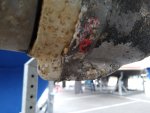
sd20.jpg
The thread has been fitted with a helicoil (I think at the factory)
 
A thought

A metal filled epoxy such as JD weld might have made a better , longer lasting repair , than Sikaflex but it might be too far gone now . Cant tell from the picture how bad it is
 
A TIG welder would certainly be able to remove the lug to above the level of the existing threaded hole and the weld a new piece of ally block onto the bottom ready for re-tapping, probably not needing a helicoil. You could then fair-in the new piece yourself with a small power sander although that would really only be for cosmetic reasons.

I think that would be better than welding the broken piece back into place.

Richard
 
A contact of mine was able to build up a new blob of aluminium which was then drilled, tapped and helicoiled.
It seems that helicoils are fitted as standard.

So after a bit of painting all should be better then when I bought the boat.
 
A thought

A metal filled epoxy such as JD weld might have made a better , longer lasting repair , than Sikaflex but it might be too far gone now . Cant tell from the picture how bad it is
You could use a metal 2 pack industrial epoxy repair product called Belzona 1111, I made a repair to my VP saildrive using this. The difficult bit is getting the repair product to stick. You need to grind back to good metal then apply the Belzona which forms a chemical bond. When it has cured, worth leaving a good time, then machine, drill and tap a new hole. Can clean up the outside to fair in. Check out their website. There local agent even visited me at my marina and detailed a repair procedure for me to do myself, he offered to put on his boiler suit and came help me as well, at no cost. Highly recomeded. Check out their website, Mr Google is your friend.
Angus
 
The fact that it has been reasonably well repaired with Sikaflex and durafix would indicate that it is not an especially stressed attachment.
As mentioned, by building up or cutting off and replacing with a solid piece of metal it can be repaired back to full strength.
If in doubt send it the the blokes in this video. They'll handle it.
gary
 
The fact that it has been reasonably well repaired with Sikaflex and durafix would indicate that it is not an especially stressed attachment.
As mentioned, by building up or cutting off and replacing with a solid piece of metal it can be repaired back to full strength.
If in doubt send it the the blokes in this video. They'll handle it.
gary
It was repaired with inert gas welding, presumably similar to the video. :unsure:

Richard
 
I had my aluminium heat exchange welded up by building the damaged seal faces with aluminium weld I then sanded and filled back to the required shape.

Aluminium can be welded with TIG but needs an AC machine but aluminium can also be welded with a MIG set using a DC machine with a MIG gun mounted spool of aluminium.

When welding Aluminum both MIG and TIG use argon as the inert gas.

It I am building up a profile I prefer to use my MIG set.
 
When welding Aluminum both MIG and TIG use argon as the inert gas.

It I am building up a profile I prefer to use my MIG set.
My inert gas cylinder contains 2% oxygen as that produces the best results. When I mentioned this on a Lounge thread, I got seriously slammed by the other DIY inert gas welders on there and told that I know nothing about welding, even when I put up link to dedicated welding websites which also advocate the use of small amounts of oxygen for improved welding. I don't know why the oxygen works but I was banned for pasting some text from the welding websites, even though I included the links as well, so the issue was never resolved. :unsure:

Richard
 
My inert gas cylinder contains 2% oxygen as that produces the best results. When I mentioned this on a Lounge thread, I got seriously slammed by the other DIY inert gas welders on there and told that I know nothing about welding, even when I put up link to dedicated welding websites which also advocate the use of small amounts of oxygen for improved welding. I don't know why the oxygen works but I was banned for pasting some text from the welding websites, even though I included the links as well, so the issue was never resolved. :unsure:

Richard

Must admit never herd of that but I not doing to disagree with you.

What inert gas is the other 98%.

I use argon to both tig welding stainless steel and a mixture of argon and CO2 for MIG welding Mild steel and stainless , Stainless has a lower amount of CO2.

As I already have 100% argon for tig welding I use it for MIG welding Aluminium and stainless.

Which welding forum are you posting on I look at Mig-welding.co.uk sometimes.

The info I have is Mild steel 25%Co2 75% argon.

The consensus I have seen for welding Aluminium is to have no CO2 as its too rective for aluminium it has been suggested argon / helium could be used as
both are non reactive.

Would love to know what the O2 would do as O2 is quite reactive and I used to use Acetylene and Oxygen for gas welding until I started TIG.

Here's some info on Argon O2 mix

Handbook - Shielding Gases.

Seems lots of different gas mixes for different applications.


More info

Shielding Gas Library

MIG Welding Gas Comparison
 
From what I gathered, aluminium in a marine environment on the outside and greasy on the inside can get heavily contaminated, making it difficult to weld.
Maybe having a bit of oxygen in the gas helps in taking away the contaminants during welding.
 
It's 2% Oxygen, 93% Argon and 5% Carbon Dioxide.

These are the cylinders I use: Hobbyweld Product Range | Hobbyweld 5 MIG Welding Gas

Richard

Yes but what material are you welding mainly.


Yes that designed for welding thinish mild steel for structure mild steel Hobbyweld recommend Hobbyweld 15 with 15% CO2

But pure argon is generally used for TIG welding most materials including Aluminium this is because aluminium is a very reactive metal when molten so you need a very inert gas to weld it. O2 added to the Argon for welding aluminum may be too reactive.
 
From what I gathered, aluminium in a marine environment on the outside and greasy on the inside can get heavily contaminated, making it difficult to weld.
Maybe having a bit of oxygen in the gas helps in taking away the contaminants during welding.

For the best welding all contaminants must be removed before welding especially with aluminium that is very reactive and produces a very protective oxide very quickly. the oxide will affect the quality of the weld.
 
Yes but what material are you welding mainly.

Yes that designed for welding thinish mild steel for structure mild steel Hobbyweld recommend Hobbyweld 15 with 15% CO2
I'm welding steel although my MIG welder has a spool gun for aluminium. The 2% Oxygen mixture is recommended for steel up to 7mm thickness but I certainly wouldn't call that thinnish in relation to DIY garage requirements. Even chassis thickness is going to be less than 5mm.

Richard
 
I'm welding steel although my MIG welder has a spool gun for aluminium. The 2% Oxygen mixture is recommended for steel up to 7mm thickness but I certainly wouldn't call that thinnish in relation to DIY garage requirements. Even chassis thickness is going to be less than 5mm.

Richard


Compared with some of the structural steelwork I have and an invoice with 7mm can be considered smallish.

Steel rolling mills and power station conveyor let alone the conveyor in Car/truck assembly plants we would not use less than 6mm steel sections.

Its all relative to what you are used to.
 
I have been working on my SD20 today. If yours is the same model then the "bolt" is an 8mm allen screw which holds the prop shaft assembly in place. The prop assembly seals inside the housing using two o rings and the two allen screws ( the one in the picture and the one above it) are under drive tension when the saildrive is in reverse. As the assembly is held in alignment by the housing I expect you have been able to get away with one screw capable of taking the load but it you are right its a good idea to get it welded up to give strength.
 
Top