Weather helm

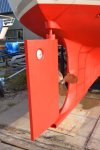
Yes the rudder looks horrible (hydrodynamically speaking) No balance and very small aspect ratio. No wonder you have trouble steering in strong winds.
As said WH comes most obviously from being over pressed and heeling. Reduce sail area reduce heeling reduce WH. However the ability of the rudder to counteract WH is important. We all tend at times to sail a bit over pressed especially if only in gusts. Referring to other post about steel rudder I would say extend the rudder down to level with the bottom of the keel. Possibly cut the rudder back at the trailing edge to reduce the leverage of the rudder load. What would really work well would be to extend the rudder down lower than the keel and have area forward of the pintles. This provides balance so reduces tiller load while getting lift (turning power). This area below could be made of GRP perhaps thin that would be sacrificial in a grounding. In any case with the rudder make it wider and foil shaped for greater efficiency (more lift less drag.) ol'will
 
Yes the rudder looks horrible (hydrodynamically speaking) No balance and very small aspect ratio. No wonder you have trouble steering in strong winds.
As said WH comes most obviously from being over pressed and heeling. Reduce sail area reduce heeling reduce WH. However the ability of the rudder to counteract WH is important. We all tend at times to sail a bit over pressed especially if only in gusts. Referring to other post about steel rudder I would say extend the rudder down to level with the bottom of the keel. Possibly cut the rudder back at the trailing edge to reduce the leverage of the rudder load. What would really work well would be to extend the rudder down lower than the keel and have area forward of the pintles. This provides balance so reduces tiller load while getting lift (turning power). This area below could be made of GRP perhaps thin that would be sacrificial in a grounding. In any case with the rudder make it wider and foil shaped for greater efficiency (more lift less drag.) ol'will
I researched this subject ad nauseam when redesigning the steering setup of our own boat. We had all the same issues as the OP with uncontrollable WH and the rudder stalling out in relative benign conditions. Unlike our situation the OP's deadwood is properly faired and, as far as I can see from the photo, the rudder does have some profile and is not just a flat plate.

I agree that the aspect ratio could be better and that the rudder should extend all the way down to the bottom of the skeg.

I disagree about cutting off the trailing end of the rudder. To put it simply, the rule of thumb is this: the faster the boat, the smaller the rudder. The slower the boat, the larger the rudder. The shallower the draft, the longer the rudder. High aspect, narrow rudders have a lower stall angle, particularly when highly loaded. Long shallow rudders have a high stall angle. The Op's Spray has a relatively shallow draft.

A balanced rudder reduces helm load i.e. the power necessary to move the rudder. It does not reduce WH which is caused by imbalance. The OP did not mention having any problems operating his rudder. His complaints were in regards to high rudder angles and lack of control (in spite of high rudder angles) going downwind.

There are other means of improving rudder efficiency in shallow draft applications.
a) End plates or fence at top and bottom of rudder.

b) Becker rudder, here on a LM motorsailer
flettner 2.jpg
c) Small pressure wedge at trailing edge of rudder, 2.5% of cord. It improves lift by 17% with a 20% increase in drag (peanuts). We used this with complete success.
reduced rudder.JPG
 
I researched this subject ad nauseam when redesigning the steering setup of our own boat. We had all the same issues as the OP with uncontrollable WH and the rudder stalling out in relative benign conditions. Unlike our situation the OP's deadwood is properly faired and, as far as I can see from the photo, the rudder does have some profile and is not just a flat plate.

I agree that the aspect ratio could be better and that the rudder should extend all the way down to the bottom of the skeg.

I disagree about cutting off the trailing end of the rudder. To put it simply, the rule of thumb is this: the faster the boat, the smaller the rudder. The slower the boat, the larger the rudder. The shallower the draft, the longer the rudder. High aspect, narrow rudders have a lower stall angle, particularly when highly loaded. Long shallow rudders have a high stall angle. The Op's Spray has a relatively shallow draft.

A balanced rudder reduces helm load i.e. the power necessary to move the rudder. It does not reduce WH which is caused by imbalance. The OP did not mention having any problems operating his rudder. His complaints were in regards to high rudder angles and lack of control (in spite of high rudder angles) going downwind.

There are other means of improving rudder efficiency in shallow draft applications.
a) End plates or fence at top and bottom of rudder.

b) Becker rudder, here on a LM motorsailer
View attachment 95519
c) Small pressure wedge at trailing edge of rudder, 2.5% of cord. It improves lift by 17% with a 20% increase in drag (peanuts). We used this with complete success.
View attachment 95520
I would call that a gurney flap on the trailing edge, a good way to increase rudder power, and I like the recessed anode
 
Yes the rudder looks horrible (hydrodynamically speaking) No balance and very small aspect ratio. No wonder you have trouble steering in strong winds.
As said WH comes most obviously from being over pressed and heeling. Reduce sail area reduce heeling reduce WH. However the ability of the rudder to counteract WH is important. We all tend at times to sail a bit over pressed especially if only in gusts. Referring to other post about steel rudder I would say extend the rudder down to level with the bottom of the keel. Possibly cut the rudder back at the trailing edge to reduce the leverage of the rudder load. What would really work well would be to extend the rudder down lower than the keel and have area forward of the pintles. This provides balance so reduces tiller load while getting lift (turning power). This area below could be made of GRP perhaps thin that would be sacrificial in a grounding. In any case with the rudder make it wider and foil shaped for greater efficiency (more lift less drag.) ol'will

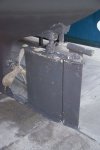
I agree that the rudder is IMHO small and inadequate ... BUT its always a trade-off ...

You need surface area and chord to give turning moment, but as you increase area of the rudder - you also increase the back-force against you controlling it.
Adding fwd section to a rudder to 'balance' .. to give a small increase in turning moment to assist you on the helm - can create loads on the rudder mountings. An unbalanced rudder just tries to resist due to flow over it ... to equalise pressure either side ... but a balanced rudder adds a force ahead of the mounts that is trying to push the rudder bodily rearwards ...

Back to OP's boat - it appears to suffer the older boats problem ... weather helm due to sail set-up and small blade rudder. There are plenty of older boats with this similar problem .... curing is a difficult exercise.

I know with my boat - I have considered adding a bow sprit and moving my genny forward. (I also think Bow sprits on older boats look good !!)
 
I agree that the rudder is IMHO small and inadequate ... BUT its always a trade-off ...

You need surface area and chord to give turning moment, but as you increase area of the rudder - you also increase the back-force against you controlling it.
Adding fwd section to a rudder to 'balance' .. to give a small increase in turning moment to assist you on the helm - can create loads on the rudder mountings. An unbalanced rudder just tries to resist due to flow over it ... to equalise pressure either side ... but a balanced rudder adds a force ahead of the mounts that is trying to push the rudder bodily rearwards ...

Back to OP's boat - it appears to suffer the older boats problem ... weather helm due to sail set-up and small blade rudder. There are plenty of older boats with this similar problem .... curing is a difficult exercise.

I know with my boat - I have considered adding a bow sprit and moving my genny forward. (I also think Bow sprits on older boats look good !!)
Let's put the balanced rudder argument to rest and agree that a larger rudder increases the forces on the shaft and bearings both laterally and by torsion. A larger rudder, regardless of design, increases rudder moment which the OP's boat seems to be lacking.

My understanding, from the OP's description, is that the builder of his boat lengthened it by some 3'; from looking at pictures of other B. Roberts Sprays he appears to have modified the rudder as well by shortening the span and hence the aspect ratio, thus making the rudder not only smaller, but less efficient.

To make up for the lack of steering effectiveness the OP has three options:

a) increase speed as it factors in with the square of the speed; not a likely scenario.

b) increase the surface area of the rudder.

c) improve the effectiveness of the rudder by changing to a better profile or design, higher aspect ratio etc,

In a properly designed boat the rudder can be enlarged safely by some 20% (Brewer, actually one of his recommendations for curing an imbalanced boat) The average safety margins in rudder design are generally in the order of 400%

Adding a bow sprit or in the OP's case, increasing the length of it will not improve downwind steering control.

The OP's best bet is to consult with B. Roberts, the designer of his boat. In view of the modifications carried out, Roberts is of course no longer responsible for the poor performance, but he might be able to point him in the right direction.
 
Another question - how's the fouling? A weedy boat is horrible to steer.

Whilst I agree on the rudder's design I'd concentrate on getting the sails right first. I'd almost forgotten that genoas of more than about 110% existed! Whilst the CE of a genoa is theoretically up front, as soon as sheets are freed that far it'll be all over the place. So yes, roll it up, try that and you may find that you can use the main again. Get the trim under control and the rudder becomes less of a concern.

Lastly, it occurs to me that you may have hydraulic steering on a boat like that? If you do then constant helm loads aren't the problem and a balanced design isn't really necessary.
 
Thanks all, some fantastic advice.

I'm really glad i joined the forum just wish i'd joined sooner as may have saved me from learning the hard way on other issues.

I have been in email contact with Bruce today and he has sent me some drawings through to help. Turns out she is a Spray 40 stretched to 48 and not what i was told previously. That said he pretty much said all of what you have stated above and suggested a larger rudder with a better airfoil design.

This rudder has been used on another Bruce Roberts design the C45 and he stated that if i couldn't quite get the surface area due to the shallower draft to increase the for and aft measurement. This design also comes to the bottom of the skeg. Do you think if I am going to end up producing another rudder I should also look to recess the anodes?
 
How brave are you feeling? If I were going to increase the chord of the rudder I'd be highly tempted to move its axis back by moving the tube and lengthening the supporting skeg strap. It could be really simple for the right fabricator, but equally might also be a nightmare in it's effect on the rest of the steering setup and also on the accommodation.

(And, as I said, if it's hydraulic steering, helm weight's not such a big deal).

EDIT. The point of moving the axis back is to be able to build in some balance forward of it.
 
Do you think if I am going to end up producing another rudder I should also look to recess the anodes?
Sounds like a plan. In the other thread that has been mentioned, the OP had already opted to buy a new galvanised mild steel rudder. Given everyone's input about creating an aerofoil from foam and laying it over a solid core, I suggested that he used the new (flat profiled) rudder as the core. I think you don't need to start from scratch. You can add an extension plate on the bottom of the current rudder, using bar to stiffen it. Then you can construct an aerofoil in foam, adhere it over the steel core and then glass over it and fair it out.
 
Thanks all, some fantastic advice.

I'm really glad i joined the forum just wish i'd joined sooner as may have saved me from learning the hard way on other issues.

I have been in email contact with Bruce today and he has sent me some drawings through to help. Turns out she is a Spray 40 stretched to 48 and not what i was told previously. That said he pretty much said all of what you have stated above and suggested a larger rudder with a better airfoil design.

This rudder has been used on another Bruce Roberts design the C45 and he stated that if i couldn't quite get the surface area due to the shallower draft to increase the for and aft measurement. This design also comes to the bottom of the skeg. Do you think if I am going to end up producing another rudder I should also look to recess the anodes?
I'm glad for you, that seems at least a positive step in the right direction.
Regarding the anodes; I would treat myself to the streamlined variety and place them in the last third of the rudder, avoiding the high pressure/lift areas of the profile.

Hope things work out for you, best of luck and let us know how you made out.
 
Thanks all, some fantastic advice.

I'm really glad i joined the forum just wish i'd joined sooner as may have saved me from learning the hard way on other issues.

I have been in email contact with Bruce today and he has sent me some drawings through to help. Turns out she is a Spray 40 stretched to 48 and not what i was told previously. That said he pretty much said all of what you have stated above and suggested a larger rudder with a better airfoil design.

This rudder has been used on another Bruce Roberts design the C45 and he stated that if i couldn't quite get the surface area due to the shallower draft to increase the for and aft measurement. This design also comes to the bottom of the skeg. Do you think if I am going to end up producing another rudder I should also look to recess the anodes?
That's good news; I too had to contact the Bruce Roberts design office and they were very helpfull; good luck.
 
How brave are you feeling? If I were going to increase the chord of the rudder I'd be highly tempted to move its axis back by moving the tube and lengthening the supporting skeg strap. It could be really simple for the right fabricator, but equally might also be a nightmare in it's effect on the rest of the steering setup and also on the accommodation.

(And, as I said, if it's hydraulic steering, helm weight's not such a big deal).

EDIT. The point of moving the axis back is to be able to build in some balance forward of it.
Hmm... a German designer and Prof of yacht design, Scharping, warns specifically of that type of set-up where you have a detached, balanced rudder behind a long keel /deadwood. In his words: "this situation is hydrodynamically difficult to evaluate."
This statement caused me quite some concern as it exactly described the arrangement on my own boat. In the end it all worked out, but then the original design of our boat's steering was so poor that just about anything would have been an improvement.

Fortunately for the OP, he has already received suggestions and drawings from B. Roberts on how best to proceed.

I wish him all the best.
 
Comparing your underwater pic to other images of similar Sprays there seems to be a substantial section of rudder "missing" at the bottom end of yours. The top part is directly affected by the turbulence of the immersed transom and will be contributing very little if any lift, while the bottom part should extend down to just short of the bottom of the skeg, thus reducing the effective rudder area by approx 25%. I would check with B. Roberts on this.
N.B. taller rigs require more "lead" than short stumpy ones, as they cause the CE to shift further forward when on the wind; this will be exasperated by the somewhat greater lee way angle to be expected by the Spray design.

Edit added: The rudder for a long keel boat should be between 8-9% of lateral area or expressed as a portion of SA: for a SA of 100sqm between 1.5 - 2sqm (Kinney & Guetelle)
To add to this, the rudder looks to be a flat plate, which is never very good, and it's all trying to work with about 80% of it in the turbulence behind a bloody great fat-bladed propellor.
I know of a boat with similar probelms, it was improved by a variable pitch prop. Not cheap, but I'm told it was worth it.

Definitely worth looking into maxing uot the rudder depth and fairing it into some semblance of an aerofoil section IMHO.

Regarding the root causes of weather helm, the big neglected one is often heeling the boat. Most boats, if you heel the mast to the right, the boat will want to turn left, even without any sails.
Laser dinghy sailors know this, they don't have good rudders, so they try not to use them, instead steering by weight. Not directly helpful on a big yacht, but if you can limit the heel you have an easier problem.

I think Slocum's Spray spent a lot of time sailing dead down wind with the rudder lashed and a jib sheeted from the bowsprit to the foot of the mast?
Dunno what his rudder was like but I don't think he had a prop...
Could be wrong, before my time TBH.
 
To add to this, the rudder looks to be a flat plate, which is never very good, and it's all trying to work with about 80% of it in the turbulence behind a bloody great fat-bladed propellor.
I know of a boat with similar probelms, it was improved by a variable pitch prop. Not cheap, but I'm told it was worth it.

On a boat like this ... expensive change for little or no benefit. My honest opinion.

Definitely worth looking into maxing uot the rudder depth and fairing it into some semblance of an aerofoil section IMHO.

Again hardly worth it because the rudder does not 'fly' straight but is in constant angle of attack to work ... all you do is delay the breakaway turbulence .... its same with flat pate wings etc.

Regarding the root causes of weather helm, the big neglected one is often heeling the boat. Most boats, if you heel the mast to the right, the boat will want to turn left, even without any sails.
Laser dinghy sailors know this, they don't have good rudders, so they try not to use them, instead steering by weight. Not directly helpful on a big yacht, but if you can limit the heel you have an easier problem.

Here we agree ... healing a boat alters its water borne profile such that it wants to tun INTO the circle. You can even detect this when under power and do a hard turn ... as the turn starts - the boat literally starts to take over the turn and tighten.
 
Dear Refueler,
Your responses to the first two points made by TernIV may indeed be your opinion, but I'm afraid they are not correct.

Our boat has an underwater profile similar to the OP's Spray. It had a flat steel plate rudder that was too small to boot, an unfaired deadwood and a big 3-blade.
The WH on this boat was impossible to control, the rudder angles were ridiculous, the rudder would stall out at the least provocation and usually when we needed it most.

We faired in the deadwood, profiled the rudder, (NACA 0015) added a small pressure wedge and kept the 3-blade.

The difference that made was extraordinary. The rudder is very responsive, has, subsequently not stalled out once, the boats can now be tacked, even at low speeds, runs down wind like on rails, WH was virtually eliminated or at least can handle the load. Hell, we can even steer her in reverse now. Running down wind at hull speed or above and in a quartering sea (25-33kt), rudder angle when countering is well under 4degr (less than a quarter turn of the wheel). We have sailed our boat some 10,000 miles, 4,000 with the new set up and in every condition from ghosting to a F9. We have since added a bowsprit and increased sail area and she now will self-steer to weather (1300 miles with this set up).

The difference is simply incomparable.

Both the OP's rudder and ours are essentially a free-standing blade. 7degr. of leeway plus 3degr weatherhelm and you are already in or at stall with a flat blade. A flat blade is simply crap, it may be economical, but it is even poor at that.
 
On a boat like this ... expensive change for little or no benefit. My honest opinion.


Again hardly worth it because the rudder does not 'fly' straight but is in constant angle of attack to work ... all you do is delay the breakaway turbulence .... its same with flat pate wings etc.

....
The OP seems to have handling problems with his boat.
What do you suggest, tie it up as a houseboat?
Or look for improvements?
 
Top