Weather helm

Going downwind in a following sea is the most difficult course to steer. On the wind a boat is inherently aerodynamically stable. Downwind the rolling forces and those of a quartering sea can easily put demands on the rudder that are 300% above normal. Some rudders are not able to cope with this and beamy boats are more likely to experience an imbalance when heeling (rolling).

I do not know how efficient your rudder is, but we had all the same issues with our boat which has similar design characteristics to yours and they have been solved.
These included excessive (uncontrollable) weather helm and very high rudder angles that would lead to an early stall of the ineffective rudder profile.
Once we had modified the rudder and deadwood, even our 40 year old decrepit rags were able to cope with what was an inherently unbalanced sail plan.
Last year we added a bowsprit and increased our sail area to well over twice that of the standard model. She now will self steer to windward without us having to touch the helm.
Downwind we ran for some 70miles under spinnaker and mizzen in a rising and quartering sea with our old wheel pilot at the helm. We were doing well over hull speed and it was blowing between 25 and 30 kts. The max rudder correction when the steep following seas caught us was under 4 degr.

To increase lift in an existing rudder and without modifying it you have 2 variants: angle of incidence and speed. Lift increases with the square of the speed. Rudder angles over 5 degrees are slowing you down. I might pay to have a long, close look at the rudder profile and deadwood/rudder gap and transition.
Also, it has been often found that cutting out the turbulence generated by a fixed prop over the rudder, by switching to a feathering or folding type, has either removed or lessened the effects of persistent weather helm.

If you have trouble steering downwind with just the genny set, perhaps you need to increase your speed.

The bagginess of the sails has no bearing on weather helm when going down wind.

The Spray design has been made to sail with any number of rigs and ol' Josh's sails would have been super baggy by contemporary standards. The Spray model, with it's blunt, buoyant bow and easy run should be the perfect candidate for fast downwind runs and a number of replicas have been clocked at over 12kt doing just that.

I used to own a large cruising cutter and the key to performance was the correct setting of the stay sail. It is very easy to oversheet this sail and the correct trim is not necessarily intuitive. I found this would noticeably increase crease weather helm and make the boat cranky. Downwind I found the rig less effective as one or the other head sail would end up being blanketed.

On the wind. To move CE forward, try flattening the main, take some rake out of the mast or even rake it slightly forward, if you have to. Open up the stay sail just a bit more than you might think is right.

Generally sails should be trimmed for performance rather than purely for balance. Conversely, it has been argued that an imbalanced boat can't be fast.

A boat as beamy as a Spray probably wants to be sailed upright.

Some pics of her underwater configuration and rig might be helpful.
 
Hi, hopefully I have posted this in the right place.

I have a Bruce Roberts Spray 48 staysail Cutter Rig and have a few questions regarding balancing and weather helm. All information I have read up on says to counter act weather helm I need to shift the CE forward. However to do this and use less than 10% rudder I have to furl In a large proportion of the main upwind.
Going Downwind today with just Genoa set she still wants to turn up to the wind and I’m still using 15 - 20 degrees of rudder to stop her turning into the wind. With winds today around 25 knots I also have rolling seas hitting the stern and trying to turn the bow up to wind. Is this normal or am I missing something?

Any help appreciated

Thanks
I recently learned what seems a powerful explanation for weather helm upwind, and there's more to it than CofE/CLR.

Imagine looking at a beating boat on port tack from the "wind's eye". The rig is on the left; it "looks" as though the wind would push the rig backwards but in fact the rig is generating forward power. It should be! That forward power is trying to turn the boat into the wind.

Hence the need to keep the boat at a sensible heel angle.

Another factor is the rudder. A deep efficient spade has its advantages. An unbalanced rudder can compound the above effect as well as being hard hard work.
 
I recently learned what seems a powerful explanation for weather helm upwind, and there's more to it than CofE/CLR.

Imagine looking at a beating boat on port tack from the "wind's eye". The rig is on the left; it "looks" as though the wind would push the rig backwards but in fact the rig is generating forward power. It should be! That forward power is trying to turn the boat into the wind.

Hence the need to keep the boat at a sensible heel angle.

Another factor is the rudder. A deep efficient spade has its advantages. An unbalanced rudder can compound the above effect as well as being hard hard work.

Indeed there is a lot more to balance (weather helm/ lee helm) than simply CE/CLR, in particular as both positions change depending on speed, course to wind, sail trim, angle of lee way, angle of heel, aspect rato of the rig, type of rig, hull trim, size and shape of superstructure, etc.
Nor are the geometric centres of sail area/lateral plane anywhere near the actual centres of force/lift.
Sail balance generally means balance when on the wind and there are a number of methods for finding an "approximation", frequently by using a number of assumptions and to a degree a bit of "black magic" or "secret" numbers to fudge the outcome. Designers, consequently, do not always get it right.
Unfortunately, none of this helps out our OP, who would be well advised to take someone with him with a deal of experience in these matters, to see what can be done with what there is at hand, before making major changes to the rig or hull/rudder.

A balanced rudder does not make any imbalance go away, at best it may mask the issue.

I do find it curious that the OP is experiencing these problems with a design praised (one could say idolized) for it's exceptional balance and self-steering abilities.
 
I should add that if you mean that the boat was being rolled by the quartering waves - that causes a different problem. The tidy little drawings showing sail/keel balance don't apply. Your rig is hanging miles over the side of the boat and now has a much larger lever around the keel with which to round the boat up. Take that to the limit and you get the classic broach when the rudder stalls. Because you've already got bad weather helm the rolled effect will be that much more marked.

You're right about the waves too, but it's not just the stern floating away sideways in response, the whole front face of the wave is rolling downwards disrupting the flow over the rudder - particularly at the top. This means that you need to wind in more helm to get the same effect.
Thanks and yes the quartering waves was an additional factor. Short of a bigger rudder/more sail area forward what else can i do?
 
I don't think I can help you directly, but the late David Sinnett-Jones who built his Bruce Roberts Spray himself, and then completed a circum-navigation in it (Zane Spray) sailed out of Aberaeron and was a long time member of Aberaeron Yacht Club.
I never sailed with Dave, although like all members of AYC I knew home quite well, but I don't remember him ever commenting on severe weather helm.
Unfortunately most of those who sailed regularly with him are no longer with us, but I will ask down at the club to see if any of the current members did sail with him on Spray, and remember any modifications that Dave may have introduced to reduce WH.
I am trying to remember if he mentions anything in his book 'Not All Plain Sailing', unfortunately I gave my signed copy to the club for a raffle prize ages ago so can't check.
It was a sad end to Zane Spray, she sunk in the Irish Sea and despite attempts to raise her she is still there, Dave said that the reason she sank was he had welded a couple of bilge keels on before the last voyage, and one of these must have been slightly out of alignment as it appears to have ripped away leaving a large hole in the hull.
Oh dear sounds bad. Would appreciate any help you can give , sounds like a great guy who would have had some helpful stories so a shame he is no longer with us.
 
Thanks, of course.
Thanks, i can confirm she has a substantial bowsprit. The furling gear for the staysail at the beginning and the furling gear for the genoa right at the end. The main is a very big sail and the boom runs almost to the backstay which is why i dont need a lot of it out without getting significant WH
 
Thanks and yes the quartering waves was an additional factor. Short of a bigger rudder/more sail area forward what else can i do?
If the wind is close enough to being coming from truly astern, then I don't think the genoa alone is a good idea. The applied force will be off the centreline of the boat and will pull you askew. On a run wing-on-wing is a good setup. The sails won't act as aerofoils in this configuration, but will work more like the sails of the old square riggers, pushed from behind.
 
Fozzy83,
I was just trying to get a better idea of your rig, as I was surprised that 48 foot Spray wouldn't be a ketch. I looked up Bruce Roberts' website, and they don't have a Spray 48 listed. Could you help me out?

Bruce's Spray page.
 
My boat is significantly shorter than yours but I have similar problem that Weather Helm is there even with main out of the way ... but I know why !

My Genny adds to the main and causes the WH ... its a trick question I have on the boat ... how to curb the WH and of course its normal people say reduce or let out the main .... fine but it doesn't reduce the WH significantly ... so I roll in a few turns of genny and voila - she's far better and in fact I can improve her speed and general sailing by balancing the reef of both main and genny.

It took me several years to figure out the same thing. For years I would reef the main expecting the weather helm/rounding up to decrease, it didn't. Then I started reefing by taking a couple of rolls in the genny, the boat was transformed. It would now steer itself to windward, helm free, probably better than I could by hand steering. The 140% genny is on a masthead rig. Although it's counter-intuitive, it works for me on my boat.
 
Trim will also affect weather-helm. Too much weight forward, ballast too far forward,or even too narrow forward sections or too wide sections aft (someone above mentioned modifications to the design are common) will contribute to it.

Of course, it may just be the mast has been mounted too far aft (not an unusual problem).

In the meantime, for the cost of a few small fittings I would have thought eliminating the existing mast aft-rake, and even trying some forward rake would be worthwhile.
 
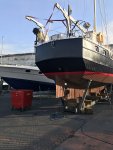
4191A1B3-1E21-41D4-AC0B-E5B90FADB230.jpeg
77B9B390-A8B5-4599-97B1-4438907166E2.jpegHopefully this helps, best pictures I have a little time apart, top ones more recent but bottom is last time out the water in 2019
 
Fozzy83,
I was just trying to get a better idea of your rig, as I was surprised that 48 foot Spray wouldn't be a ketch. I looked up Bruce Roberts' website, and they don't have a Spray 48 listed. Could you help me out?

Bruce's Spray page.
Hi I believe it was based on a Spray 45 design extended with some extra ballast added by the builder
 
Reducing or dropping the main, the weather helm should have gone; it appears that your genoa must be very big and comes well past the mast. If this is the case, by furling the genoa (and the main if need) you may reduce the weather helm. The other alternative is to consider re-cutting/re-shaping your sails. I had a Bruce Roberts in the early 90's, very seaworthy designs
The Genoa is 150% so you may have a point
 
Hi I believe it was based on a Spray 45 design extended with some extra ballast added by the builder
I hope it was run past Bruce first. You can't just add a bit on and expect the balance to remain as designed. If the mast wasn't moved aft it could have some bearing on your upwind situation. You could drop Bruce a line to check things out; he really does answer his e-mails.
 
I hope it was run past Bruce first. You can't just add a bit on and expect the balance to remain as designed. If the mast wasn't moved aft it could have some bearing on your upwind situation. You could drop Bruce a line to check things out; he really does answer his e-mails.
Yes the previous owner and builder had spoken to Bruce. It was where he got the calculations for the ballast from. It was something i asked when i originally purchased the boat.
 
View attachment 95491
View attachment 95492Hopefully this helps, best pictures I have a little time apart, top ones more recent but bottom is last time out the water in 2019
Comparing your underwater pic to other images of similar Sprays there seems to be a substantial section of rudder "missing" at the bottom end of yours. The top part is directly affected by the turbulence of the immersed transom and will be contributing very little if any lift, while the bottom part should extend down to just short of the bottom of the skeg, thus reducing the effective rudder area by approx 25%. I would check with B. Roberts on this.
N.B. taller rigs require more "lead" than short stumpy ones, as they cause the CE to shift further forward when on the wind; this will be exasperated by the somewhat greater lee way angle to be expected by the Spray design.

Edit added: The rudder for a long keel boat should be between 8-9% of lateral area or expressed as a portion of SA: for a SA of 100sqm between 1.5 - 2sqm (Kinney & Guetelle)
 
Last edited:
Top