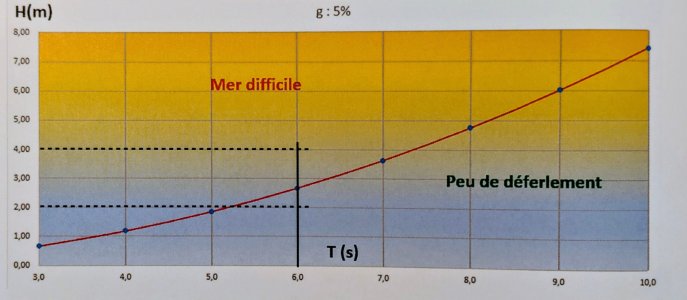
Wave height 10m period 11 seconds

To be sure, in Northern European waters and with the current status of weather reporting, there is absolutely no reason, short of downright stupidity, for the recreational sailor to be caught out in something even remotely similar to the conditions posted.

To put things into a statistical, not to say realistic, perspective, 95% of all recreational sailing is done in winds under 6 Bft. Of this, another 80% is done in winds under Bft 5.

We, fairly regularly make passages of 200 miles or more, often over 100 miles from the next possible shelter. If Windy has more than even the faintest tinge of yellow to it, we most certainly think twice about heading out.

It also bears to remember, that a breaking wave of about a third of a boat's length is sufficient to roll said boat.

As usual, much discussion arises around this subject matter, particularly around brands with a populist reputation of being "incredibly seaworthy" (perhaps incredulously might be the better term). I have been accused of being overly pessimistic, when pointing out and in the context of a 23 footer, that such a boat would need little more than a seven foot breaking sea to capsize it, no matter how remarkably seaworthy it supposedly is.

At the other end of the spectrum we might find the proponents of the planing type, who assure me that in any dire conditions they would simply scurry away, downwind, at incredible speeds. I often have the impression that such assurances are based on the successful viewing of some YouTube videos, rather than actual experience.

A few moments ago, there was a discussion on a German forum, this in regards to the practice of heaving to, based on a video of someone doing it on a lake in what amounted to a near calm. Subsequently, a Gentleman reported how he successfully managed to heave to in a Pogo 40, in 35 kts of wind and a 2m sea. Ostensibly, so that the crew could take a bathroom break while running off at 15 kts. This took place in the Baltic, where wave height was limited by the available fetch. Based on this experience, he expounded on what he would do in conditions where wind speeds were up to 50 or more knots, i.e. run off at speeds between 15 kts and 20 kts.

There are a few things to unpack here.
In the open sea a 2m wave can be had in wind speeds of an upper third of a Bft 4.
Waves, in the open sea, when not interfered with by fetch, currents, cross swells, overlaying or changes in sea depth, etc. follow fairly clear physics and their speed is governed by their wave length.

A 2m wave, indeed, runs at a speed of about 16 kts, regardless of wind speed. At 35 knots however and in the open, probable medium(!) wave height is more likely 23' and they are now traveling at something like 25 kts.
I'm not sure I'd be heaving to with anything around 40', nor would I consider running off at something like 25 kts, even if the boat could. The waves are not always all that regular and tidy.

At 50 kts, frankly, the whole idea gets to be rather ridiculous. Now the medium wave height has grown to 49' with significant heights of 78'. The seas are now racing up from behind at just over 35 kts. Good luck!

I took a few things away from this. What might work in the relatively restricted sea room between the Danish isles is one thing. Making inference from this experience, as to how one could handle much worse conditions in another theatre altogether, is quite something else.
Other then when crossing a Northern or Southern ocean, the probability of having to try this out, and by contemporary weather reporting standards, converges on nil.
Also, to use the heads on a Pogo in 2m seas, it is advisable to heave to, apparently.

I have been at sea in small boats and in winds over 50 kts. A few times. Right now, I'm happy to watch it from shore, a ways up from shore in high wave conditions, to be sure, or go for a hike up a mountain, sample the fares of the next distillery and keep a close watch on Windy & co before heading out again.
 
Was 10m and 11s a forecast or an observation?

I remember reading that most wave height observations come from deepwater moored buoys.
I wonder if the new generation of commercial synthetic aperture radar satellites will make such buoys obsolete - they can produce 3d video of streams of cars moving on streets (e.g. resolution of less than 1m), so wave dimension and motion statistics with much finer tolerances should be easily possible.

For the ramblings that follow, please don't consider any of it advice or expertise - I am just thinking out loud (feel free to correct my sums!).

Ken Endean's "Coastal Turmoil" book has a table linking wavelength, period and phase velocity (speed of the wave crests), assuming the waves are in water that's deeper than half the wavelength.

For 11 seconds, that gives a wavelength of about 185m, so if the sea depth is/was greater than 90m (would it have been for the quoted wave conditions?) then 10m waves would not (mostly) be breaking. Endean writes that the steepness (height over length) needs to be about 1/7 to get substantial breaking to occur, but also that breaking in deep water is not as impressive to look at as the tubes surfers fantasize about.

I've never seen any properly breaking sizeable waves at sea (as opposed to just the crests being blown off by wind; exciting things happening when waves collide/intersect; and a couple of close encounters with overfalls) - I am happy to remain inexperienced.

I've read in various places that fully developed breaking waves with height equal to half of the beam of a sail boat might be sufficient to roll it. I've definitely experienced >2m swell waves in the north sea and english channel (nominally enough to do for our 4m beam), but their periods were all more than 8s, so I nowhere near the 1/7 steepness ratio "required". ~1m waves with short wavelengths can be much more unpleasant (for me mostly encountered when mistiming headlands such as dungeness).

Breaking, in other words significant shearing of the near-surface flow field, is what seems the most threatening aspect of big waves to small craft.

10m/185m is much less than 1 in 7, so no bulk breaking of the big waves - you'd just be going up and down every 10 seconds - if the wave profile were sinusoidal (real waves look quite a lot sharper at the top than at the bottom) that would imply peak acceleration of +/-1.6m/s2 - so no need for suction to pull you down at the wave crest even if that figure is out by a factor of two. Rollercoasters, even gentle ones produce much greater accelerations.

185m wavelength every 11 seconds implies a crest speed of more than 30kts, so most small craft's speed isn't going to make a huge difference to the wave passing frequency and consequent vertical accelerations: I can't see my boat surfing fast enough to bury its bowsprit in the back of the next wave and pitchpole.

Presumably there'd be plenty of smaller, shorter wavelength waves in the mix in weather like this - maybe they're the ones to be scared of?

If I were unlucky/unwise enough to get caught in such conditions, keeping the boat pointing downwind would seem like a good idea if there was enough sea room in that direction - it would reduce the wave passing frequency a bit, softening the motion. My greatest concern would be finding the minimum sail area (if any) needed to keep control of the boat while keeping everyone safe. Our storm staysail requires some foredeck work to deploy, and this thread is impressing on me that we need more practice at rigging it.
 
Presumably there'd be plenty of smaller, shorter wavelength waves in the mix in weather like this - maybe they're the ones to be scared of?

If I were unlucky/unwise enough to get caught in such conditions, keeping the boat pointing downwind would seem like a good idea if there was enough sea room in that direction - it would reduce the wave passing frequency a bit, softening the motion. My greatest concern would be finding the minimum sail area (if any) needed to keep control of the boat while keeping everyone safe. Our storm staysail requires some foredeck work to deploy, and this thread is impressing on me that we need more practice at rigging it.
If it were only a question of the sea moving up and down, then of course it wouldn't be a problem.
Unfortunately, things are not that tidy. The movement (wave system) of the boat in itself can cause a following sea to break, as can any of the factors I previously listed.
As to keeping up speed to maintain control: the relative speed of the boat goes to nil or negative ahead and in the crest of a following sea. Furthermore, the aeration in a spilling crest reduces rudder efficiency and promotes rudder stall.

There are other aspects to consider as well. The acceleration in a breaking crest is magnitudes higher than the already considerable speed of the wave itself and while we are at it: ship stability is significantly reduced on the crest, just as the risk of broaching is the greatest and ship control at it's most precarious.

Having been caught out in such conditions, some 1500 miles out, I'm happy to give it a miss in future.
 
There were plenty of folk still out there at about 19.30, when it really started to build here. See attached.
French fisherman still at it, a few showing as "dodging" on AIS.

Local NCI station showed 50-55, gusts to 88mph. But from NW, so in S Cornwall not as bad as it might have been?

Seems to have tracked thru quickly? Appears to be dropping here already...
As mentioned on the other thread, Falmouth seems to have been hit relatively hard. Presumably by the high wind speeds coming down the river valleys rather than heavy seas?

We had similar here, NW wind blowing down the valley but a little damage to greenhouses and fences shows we were probably luck with alignments?
 
The other factor to consider in UK coastal waters and especially where the OP sails is tidal effects and water depth. I use the offshore M2 weather buoy in the Irish Sea to assess things but the reality near headlands, races and in shallow waters can be brutal as the wave period shortens.

The long period swell after an Atlantic storm rolling up the Irish Sea can become a short period occassionally breaking wave as the waters shelve to 15m deep or so in Cardigan Bay, providing entertainment or terror depending on the associated wind conditions. In a separate thread it probably explains why RCD "A" only 'covers' up to F8 and 4m waves.

The swell estimates in Windy are of use but I would definitely consider the effects of current and depth in addition to the forecast.
 
All I'm going to say about it is that I've got one story that starts, "The windex gave up at 55 knots". I have no desire for another.
You never forget, as a novice I clocked 58mph on my nasa wind instrument whilst travelling at 7knots with the wind on my tail. I can still see the waves behind me as I held on for my life. Would have be a great youtube moment but I was too scared to film anything.
 
All I'm going to say about it is that I've got one story that starts, "The windex gave up at 55 knots". I have no desire for another.
I know the feeling..crossing the straights of Gibraltar, S to N on a Rival 38 the round wind speed dial was up against the stop, the stop being just passed the 70 max on that dial.
Fortunately not big sea, but visibility restricted due to spray.
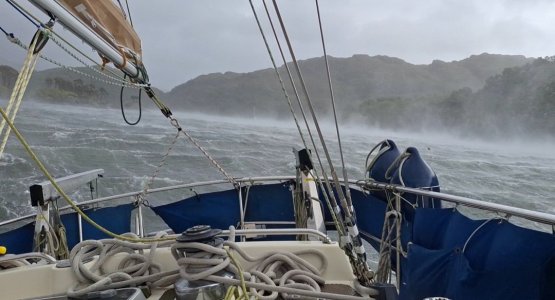
 
I know the feeling..crossing the straights of Gibraltar, S to N on a Rival 38 the round wind speed dial was up against the stop, the stop being just passed the 70 max on that dial.
Fortunately not big sea, but visibility restricted due to spray.
The noise got me, I kept looking up thinking a helicopter was above my head.
 
Agree about the noise. Two other learnings I had were that the boat heeled further at anchor (30-40 degrees) than I ever achieve when sailing (15-20 degrees). And that the amount of flapping and loosening of ropes and fabric creates more noise and damage. The zips on my sailcovers burst apart. A coiled rope blew overboard. There is a whole new level of thinking and preparation needed to deal with 60knt+ winds, even at anchor.

I was not filming at the peak of this, just staying alive. The mess of ropes had managed to unravel themselves in the wind.Screenshot_20260111_121448_Gallery.jpg
 
Top