Water leak

Thedigger

Active Member
Joined
18 Jun 2020
Messages
51
Visit site
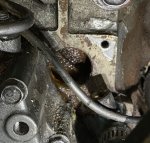
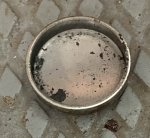
Hi yanmar 10 single cylinder. I noticed a leak behind the hose above the impeller pump when I turned the engine. There is a button the size of a 2p piece fell out of the engine block behind the hose. I can see the hole where the button sits. I don’t know what this is. Any explanation?
Regards
 
Core plug ?

Blocks a hole that is part of the block casting process

Sometimes incorrectly called "freeze plugs" because they can be pushed out if the water in the block freezes it is thought thereby preventing the block cracking

Two common types
A shallow cup or dish shape which is just pressed into the hole
A slightly domed disc that is fitted then expanded to make it a tight fit by striking the domed ( outer ) face (known as Welch plugs)
 
Last edited:
I would say the same as Vic, however it raises the question of why a core plug would fall out.

I would guess that corrosion is probably the issue which suggests that your engine is directly cooled by seawater as an indirectly cooled engine would have antifreeze/anticorrosion added to the coolant and such corrosion would be very unlikely.

If the edges of the casting hole are corroded that badly, then I doubt whether simply replacing the plug with the same size will suffice. You may need to consider re-finishing the hole and fitting a larger plug and/or using a suitable sealant. Fitting a non-standard plug or using sealant is not something that I have ever had to do but others might have some experience.

Richard
 
Core plug ?

Blocks a hole that is part of the block casting process

Sometimes incorrectly called "freeze plugs" because they can be pushed out if the water in the block freezes it is thought thereby preventing the block cracking

Two common types
A shallow cup or dish shape which is just pressed into the hole
A slightly domed disc that is fitted then expanded to make it a tight fit by striking the domed ( outer ) face

Thanks, I have the plug im guessing the plug goes back in with the bevel facing outwards. I notice underside of it is clean and the outer side is a brown dirt colour. So I should be able to push the plug back in the hole. And tap it in with a prod of some sort? I fear it might leak if I don’t put some sort of grease or glue around the diameter. Shining a torch into the hole I can see rust colour inside the back of the block which im guessing is the cavity which fills with sea water to keep the engine cool with raw sea water. Im using a backer of tap water and a hose rubbing into the water pump.
 
I would say the same as Vic, however it raises the question of why a core plug would fall out.

I would guess that corrosion is probably the issue which suggests that your engine is directly cooled by seawater as an indirectly cooled engine would have antifreeze/anticorrosion added to the coolant and such corrosion would be very unlikely.

If the edges of the casting hole are corroded that badly, then I doubt whether simply replacing the plug with the same size will suffice. You may need to consider re-finishing the hole and fitting a larger plug and/or using a suitable sealant. Fitting a non-standard plug or using sealant is not something that I have ever had to do but others might have some experience.

Richard
 

Attachments

  • 1DAF09BB-6D65-4E5D-BB54-BD452383E9BC.jpeg
    1DAF09BB-6D65-4E5D-BB54-BD452383E9BC.jpeg
    282.1 KB · Views: 12
That seems odd to me. Neither the casting hole nor the ejected core plug look particularly corroded so I can't understand why the plug appears to have fallen out.

Core plugs should not really be re-used as they are designed to fit tightly by flexing and, once fitted, will have already been flexed. You should be able to buy a new one very cheaply as they are pretty standard but measure the diameter to ensure that you are getting the right size.

If you want to try re-fitting the old plug, or even with a new plug, I would suggest to use a suitable sealant. Loctite make several sealants designed for core plugs so a search online should help. If you do re-fit the old plug with sealant, just keep a very close eye on it until you are sure that it is secure. Unlike an indirectly cooled engine, there is not a lot of pressure so the sealant may well do the trick.

Richard
 
Thanks, I have the plug im guessing the plug goes back in with the bevel facing outwards. I notice underside of it is clean and the outer side is a brown dirt colour. So I should be able to push the plug back in the hole. And tap it in with a prod of some sort? I fear it might leak if I don’t put some sort of grease or glue around the diameter. Shining a torch into the hole I can see rust colour inside the back of the block which im guessing is the cavity which fills with sea water to keep the engine cool with raw sea water. Im using a backer of tap water and a hose rubbing into the water pump.
Attached pic of hole
It is impossible to judge the amount of corrosion around the mating faces of the hole and the plug.. If the hole is not too badly corroded it should be possible to fit a new plug with just a smear of sealant. I would not reuse the old plug.
It fits with the side you show in the photograph outermost and should be tapped in with a block of wood or something that bears on the rim
 
Last edited:
I would say the same as Vic, however it raises the question of why a core plug would fall out.

I would guess that corrosion is probably the issue which suggests that your engine is directly cooled by seawater as an indirectly cooled engine would have antifreeze/anticorrosion added to the coolant and such corrosion would be very unlikely.

If the edges of the casting hole are corroded that badly, then I doubt whether simply replacing the plug with the same size will suffice. You may need to consider re-finishing the hole and fitting a larger plug and/or using a suitable sealant. Fitting a non-standard plug or using sealant is not something that I have ever had to do but others might have some experience.

Richard
Not as unlikely as you think - I’ve been using an indirectly cooled engine for 10 years and filling it up with tap water. Only realised from a comment on this forum a couple of months ago that there is such a thing as coolant.
 
Not as unlikely as you think - I’ve been using an indirectly cooled engine for 10 years and filling it up with tap water. Only realised from a comment on this forum a couple of months ago that there is such a thing as coolant.
I am surprised the owners manual did not ell you to use antifreeze
 
I am surprised the owners manual did not ell you to use antifreeze

I was quite surprised when I fitted new Betato my old boat that the owners manual stated in bold type, 50% antifreeze, not so much to prevent freezing, more to prevent corrosion and cooling.

(additional comment) I have only ever experienced once a core plug dropping out of an engine and that was on my old 1.6 diesel Escort, I would have thought tha this is a fairly rare occurence.
 
Last edited:
I was quite surprised when I fitted new Betato my old boat that the owners manual stated in bold type, 50% antifreeze, not so much to prevent freezing, more to prevent corrosion and cooling.

(additional comment) I have only ever experienced a core plug dropping out of an engine and that was on my old 1.6 diesel Escort, I would have thought tha this is a fairly rare occurence.
It was more common before the 1970's because many drivers in those days did not use any antifreeze/anticorrosion additive and, at the first serious freeze up, core plugs would be popping out. I've not heard of it in the last 40 years.

Richard
 
Araldite will achieve a seal which will last.
I had a slightly different problem - a partial bore that corroded through.
After tidying the hole and ensuring it was dry, I applied Araldite.
After many years there never a drop of leakage.
I was quite surprised - with hot water behind and temperature cycling.
 
Boat alongside quay - loading up to depart across Baltic ...
Once all done - started the Perkins 4-107.... before casting off ... noticed water .... opened up engine box - two core plugs had given out. One near injection pump - other in a really bad access place ! Basically they had corroded.

What to do ??? Went to Car shop to see if I could get replacement plugs but being an old Perkins - were imperial. Only ones I could find were metric and no way to fit. Steve (crewing) and I decided that its a sail boat - so if necessary we sail !!
Bought the Epoxy Resin sticks that you squeeze and handle to mix the two parts of 'putty' .... Plastic Metal designed as repair to various such as holes in exhaust etc.
We took a flexi piece of thiock plastic and filled the corroded plugs and overlapped around ... ( we'd cleaned up and dried as best we could ) .... it set within about 10 mins ... but we had a pint while it cured ... so gave it at least 30 mins ...
Started engine ... no leaks at all ....

10 days later after Baltic cruise - still holding ..... in fact it was at least a month later that I managed to get correct plugs sent to me from UK ... and fitted them..

I know they usually tell you to fit by tapping on the 'rim ' to avoid distorting the plug. But these were difficult to access - so a short wood dowel that was reasonably tight diameter fit was used ... the plugs rim was noted as not 90 deg to the flat centre but angled out slightly. That gave me reasonable confidence that fitting would be OK.

The problem was getting the old ones out .... the Epoxy was hard !! but I kept working at it with a sharpened nail till the corroded plug gave out and let the Epoxy fillet come away. Then judicious use of a bent nail to remove the old plug remains.

I had to replace another last year - lucky that I back in 2011 - I bought a few !

My engine is raw water cooled ... so it is a job that comes up ... but not one I enjoy fixing.
 
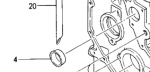
It is listed as PLUG 30 part number 105311-01090. I would guess it is 30mm diameter. Somewhere like French Marine can probably supply a Yanmar part at a price or you could find it cheaper elsewhere.
1623872626312.png
 
Okay thanks for that. One thing bothers me if you look at the hole in the casing there is a threaded hole just above it to the right and much smaller. The colour of the casing looks as though something might have been there but is now gone. Or is that just a threaded hole with no purpose?
 
Okay thanks for that. One thing bothers me if you look at the hole in the casing there is a threaded hole just above it to the right and much smaller. The colour of the casing looks as though something might have been there but is now gone. Or is that just a threaded hole with no purpose?
Nothing there on my engine either so it must be for different engine configuration.
 
Top