
Water intake

PabloPicasso

Well-Known Member
Joined
12 Feb 2010
Messages
2,916
Visit site
I'm thinking about adding a water intake as an alternative to the sail drive water route (The narrow tubes on the sail drive can get blocked and are impossible to clear ). Does a sailing boat need the scoop type thru hull fitting, or would an ordinary mushroom head type on be ok? image.jpegimage.jpeg
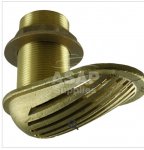
 
An ordinary skin fitting would be OK, as you presumably have an inboard raw water filter, which is accessible to clear if any weed gets in.

Note that the "scoop type" fitting should be installed with the slots facing aft.
 
There is no filter/strainer on the sail drive intake, neither is one specified by Volvo Now I'm not denighing it would seem to be a good idea to fit one, but is it really necessary? Why fit the scoop facing aft?
 
There is no filter/strainer on the sail drive intake, neither is one specified by Volvo Now I'm not denighing it would seem to be a good idea to fit one, but is it really necessary? Why fit the scoop facing aft?

My Volvo saildrive has an inboard raw water strainer, fitted as standard by that renowned shoddy boatbuilder Bavaria. I haven't seen Volvo's installation instructions, but I'd be surprised if they don't recommend a raw water strainer.

As for the scoop, the generally accepted wisdom is that the slots face aft. If you want to fit it the other way round, fine.
 
There is no filter/strainer on the sail drive intake, neither is one specified by Volvo Now I'm not denighing it would seem to be a good idea to fit one, but is it really necessary? Why fit the scoop facing aft?

If the blunt end is forward it will tend to deflect large bits of debris which might blanket the strainer away
 
As per PVB ... advise is to have slots facing aft ... and of VicS debris comment.

Here's ZFmarines explanation : (https://www.zfmarinepropulsion.com/wp-content/uploads/Strainers127_02.pdf)

Quote from that >>>
There’s a downside to that characteristic of scoop strainers: Because the scoop is a passive device always attached to the hull, it drives water into the raw-water system it serves whenever the vessel is moving forward and even when it’s moored in a strong current, regardless of whether the system needs water at the time. The scoop may be pushing water into gear that’s not operating, such as a generator, a wing engine, a sailboat’s auxiliary, or a trailing inoperative engine on a twin-screw boat. Under ideal circumstances, the blades of the raw-water impeller prevent the water from being pushed into an idle engine. But if the blades are damaged, missing, or weak, raw water can push past the pump and ultimately into the exhaust system, where it can, depending upon the design, accumulate until it reaches the exhaust manifold. Most exhaust risers and elbows are no match for such flooding. Remember, the water is under pressure, so it will push uphill above the waterline. Once water reaches the exhaust manifold, it will flow into any open exhaust valve in the cylinder head, and then into the cylinders.

Its surprising the pressure that can be exerted by even a sailboats forward motion into a scoop and many boats the engine is quite low in relation to waterline.
 
My Volvo saildrive has an inboard raw water strainer, fitted as standard by that renowned shoddy boatbuilder Bavaria. I haven't seen Volvo's installation instructions, but I'd be surprised if they don't recommend a raw water strainer.

As for the scoop, the generally accepted wisdom is that the slots face aft. If you want to fit it the other way round, fine.

I work on sail drive equiped yachts from various builders, with various makes of engines, i cannot recall seeing one without an internally fitted strainer, it would be extremely bad practice to not fit one, IMO.
 
Extract from the VP D series installation manual ;

Cooling system Seawater intake. Always install a shut-off valve on the water intake. Two hose clamps for each connection should be used.

Seawater inlet If a scoop pickup is used on a sailing boat the water intake should be facing backwards to avoid water to be pushed into the exhaust system during sailing. Internal hose diameter:MS10,15 19 mm (3/4")MS25, HS25 32 mm (1 1/4")130S 19 mm (3/4")150S 32 mm (1 1/4")

Seawater filterThe seawater filter should be installed minimum 100 mm and maximum 200 mm (4–8") above the static water line level.
 
My X-302 didn't have any form of strainer until I fitted one. Scandinavian quality is something of a marketing gimmick IMHO.
 
All very interesting As Always , I'm learning . Any disadvantage to using a mushroom type through hull?
Mushroom type, yes, for a sailboat, but without any form of bars or grill on the outside. Mount the internal strainer directly above the seacock/ballvalve, above the waterlevel so you can open the lid of the strainer and rod through.

Www.solocoastalsailing.co.uk
 
Mushroom type, yes, for a sailboat, but without any form of bars or grill on the outside. Mount the internal strainer directly above the seacock/ballvalve, above the waterlevel so you can open the lid of the strainer and rod through.

Www.solocoastalsailing.co.uk

My strainer is directly fitted to the valve at hull. Close valve - open strainer ... lift out gauze .. clean ... put back ... close strainer .. open valve.
If needs clearing the actual inlet ... close valve ... open strainer, lift out gauze ... quickly open and shut valve ... same as if you need to clear a log ...
 
I have an old Vetus strainer with my saildrive. Judging by the muck that it picks up, it would be very unwise not to have one. Mine is very accessible and I check it every time I go out. If I were starting again, I would fit two strainers in parallel with a changeover valve. This is because we have often had to motor for twelve hours or more and I like to check the filter at least once in this time, and being able to do this without stopping the engine would be a great advantage.
 
Top