Water in Rudder

Sailfree

Well-Known Member
Joined
18 Jan 2003
Messages
21,672
Location
Nazare Portugal
Visit site
Last year after lift out rudder seemed to be continually draining water.

I think its where the GRP sheathing meets the stock as this joint must work.

What would you do? Its a Jeanneau 43DS. I am assuming the inner rudder frame attached to the stock is SS.

I can drill, drain, dry out and reglass and try to strengthen top connection but cannot help but feel it would be a waste of time and if rudder is flexing on shaft sufficient to leak it will continue to do so. I am sure that to thoroughly dry out the rudder I will have to split off one half of the GRP sheaths.

Boat is 7yrs old. Fill with closed cell foam?

Any advice?
 
My Bav did the same...

Drilled a small hole near the rudder post and placed it upside down. After 2 weeks, I sanded blasted the entire rudder then filled the hole and epoxied the entire thing.

My rudder is hollow with a SS frame.

GL
 
I have had the same problem on two boats with hollow rudders, a Westerly and a J. As you surmise the water gets in where the stock enters the blade.
The concensus of opinion I have received is that "they all do it" and to largely ignore it. Whatever you do the joiunt will work and water will get in. All I have done is drill holes in the blade to let the water out, foul smelling it is too! Then plug the holes and relaunch. This winter I noticed that the J's rudder hada crack at the top so I have put a glass and epoxy strap over the top to hold the two halves together.
I am not sure what the corrosion effects would be on the frame within the blade. Something to worry about.
 
You need to find out how it is getting in. Could be cracks in the bond between the two halves or more likely where the shaft goes into the moulding. The latter can be solved by grinding out a groove and epoxy in an O ring. Other cracks ned to be ground back and filled.

Probably have to accept there is no complete cure as the minutest crack can let in a lot of water over time. Might even be worth drilling and tapping for a drain plug at the bottom to let the water out each year.
 
Last year after lift out rudder seemed to be continually draining water.

I think its where the GRP sheathing meets the stock as this joint must work.

What would you do? Its a Jeanneau 43DS. I am assuming the inner rudder frame attached to the stock is SS.

I can drill, drain, dry out and reglass and try to strengthen top connection but cannot help but feel it would be a waste of time and if rudder is flexing on shaft sufficient to leak it will continue to do so. I am sure that to thoroughly dry out the rudder I will have to split off one half of the GRP sheaths.

Boat is 7yrs old. Fill with closed cell foam?

Any advice?

A few years ago I copied a set of instructions from forumite oldsaltoz (IIRC): in essence, empty/dry the blade, then grind a little of laminate around the shaft, put a couple of o-rings or other type of elastic seal, then laminate again around it.
If he does not show up here send him a PM, his instructions were very detailed.

I'll try to dig into my archives but cannot promise anything.
 
A few years ago I copied a set of instructions from forumite oldsaltoz (IIRC): in essence, empty/dry the blade, then grind a little of laminate around the shaft, put a couple of o-rings or other type of elastic seal, then laminate again around it.
If he does not show up here send him a PM, his instructions were very detailed.

I'll try to dig into my archives but cannot promise anything.

That "O" ring idea looks a bit hit and miss to me. For starters how do you cut a precise groove that will apply an even pressure onto the rubber of the ring with a hand held cutter. The pressures are also quite immense as the rudder flexes and is squashed in it's working environment.

Mine has this same problem but as my rudder blade extends quite a bit above the waterline, I don't think that the stock/blade joint is to blame. My problem is a manufacturing fault in the lower aft tip of the blade leaving a slit which has been exacerbated by a couple of groundings onto Ionian quaysides due to clumsy neighbours leaving.

I drilled a few holes in the blade and pushed my endoscope in. This revealed a dry interior except for the bottom few inches which were damp. When this lower area was drilled into, the swarf was wet and clingy whereas that from holes further up was dry dust.

I have re-filled all these holes with epoxy filler but drilled two vertical holes up from the foot of the blade into the void and left it like that over a Corfu winter. In April I will decide whether to fill the holes completely or to only fill one and tap the other, fit it with an sealed A4 screw and leave this as a drain for the future.

A surveyor recommended filling the whole of the blade with epoxy but I considered this to be bad advice as I'm not sure that the framework would cope with the much increased mass. Neither would I fill the blade with foam. This is going to hold water onto the inside surface, causing wicking and the foam itself will make any attempts to dry it out much more difficult.

Chas
 
Last edited:
Well this is what I did on my last boat. Doubtless a very bad idea that will weaken the whole assembly and incur the wrath of experts all round etc etc. I rejected the O-ring and the slather-it-with-epoxy routes...

If you are dexterous I would suggest machining a groove 3mm x 3mm around the contact area at rudder top (Dremel and wee cutting discs and a wee hand chisel constantly resharpened on a grinder) to create a square trench then fill this with one of the polyurethane sealants, whose adhesion, tenacity and modulus of elasticity will outweigh the torque flexure between blade and shaft.

NOTE: If 3mm depth takes you right through the grp and into the foam core then you will have to build up what is questionably an absurdly thin top section of laminate.

As always, the nagging worry with doing nothing is the effect of anaerobic water lying against the stainless tangs within, I suppose.
 
my rudder was as yours and I tried several remedies including drilling drain holes, epoxy coating and stripping the surface gelcoat and applying new. I was not to concerned about the drips when hauled out but the osmotic blisters did not look good and they usually reappeared after two seasons, This time I am paying for the job and they have cut away one side of the rudder and removed all the foul smelling degraded foam, they will then rebuild the rudder with new "memory" foam (not sure what that is), seal the joint properly where the shaft enters the at the top and rebuild the removed part. Surprisignly there was no strengthening web in the rudder so I suppose in time it would have deformed with only the shell holding the shape. A web is being fitted retro fitted. The old rudder might have gone on for ever but it might have deformed at any inconvenient time. I'm glad it's being sorted.
 
A very common complaint.

I would be tempted to leave it and monitor the situation. If the welding has been well done and you are sure there is no mild steel in there (has been known, you should be fine with your young boat) you will probably be ok for a few years yet.

If your boat happens to be the oldest in the fleet, or you are planning some serious offshore stuff, it might be worth considering your plan of action in the next couple of years.

My boat has had similar treatment to Biscay36 above. Cutting out windows ard adding extra tangs really needs to be done with reference to the original drawings so you first plan of action might be to try and get hold of them - might be easier said than done. The GRP work, closed cell foam/resin filling and making good is a DIY job if you feel inclined. Beware though, that rudder will be very heavy.
 
Well this is what I did on my last boat. Doubtless a very bad idea that will weaken the whole assembly and incur the wrath of experts all round etc etc. I rejected the O-ring and the slather-it-with-epoxy routes...

If you are dexterous I would suggest machining a groove 3mm x 3mm around the contact area at rudder top (Dremel and wee cutting discs and a wee hand chisel constantly resharpened on a grinder) to create a square trench then fill this with one of the polyurethane sealants, whose adhesion, tenacity and modulus of elasticity will outweigh the torque flexure between blade and shaft.

NOTE: If 3mm depth takes you right through the grp and into the foam core then you will have to build up what is questionably an absurdly thin top section of laminate.

As always, the nagging worry with doing nothing is the effect of anaerobic water lying against the stainless tangs within, I suppose.

Looks like a very good scheme to me so long as the groove was completely filled leaving absolutely NO airgaps and the sealant was appropriate for underwater use.

Chas
 
There's an earlier thread here which may be of interest. I had water in the rudder of my Seawolf 26 and eventually the tangs failed so I had to open it up to repair it. I used a modified O-ring method to seal the stock originally suggested by Oldsaltoz and the rudder is now dry. Pictures of the repair are here.
 
In part your action might depend on how well the rudder was constructed in the first place. I took on a 1978 Rival 34 a couple of years back with a wet rudder and minor evidence of osmosis. I opened up a couple of inspection holes and was pleased to find no evidence of corrosion, in part because the whole tang / stock area had been encased in a resin / filler mix from new and which I very carefully made good again. I did add some o-rings and epoxy on the way out. Who knows how long it had been wet for but the initial construction had clearly been robust.
 
Last edited:
Glassing in an O-ring will NOT work. Yes it will seal against the rudder stock because it will be a tight fit on that but you cannot get a tight fit between the fibreglass and the O-ring so water will just flow past. An O-ring has to be compressed to form a seal.

The best way as suggested by Blueboatman is to grind out a trough in the glass around the rudder stock and fill this with sealant. You can use Sikaflex but I would suggest CT1 as it sticks to anything even when wet, is flexible and can be used satisfactorily underwater.

This flexible seal is necessary to absorb any slight movement between the rudder stock and the main blade. The CT1 will stick to both the glass and the SS. Fibreglass/epoxy/whatever does not stick to SS, however once you have the flexible seal in place you can glass over it if need be for neatness. Personally I would leave it open for future access.
 
I drilled a few holes in the blade and pushed my endoscope in.
Endoscope, huh ? There's one here at a fair price is that similar to the one you use ? I have had a surveyor's recommendation to inspect my rudders' armature before going far offshore and was looking at cutting one of the skins off but a small hole + an endoscope sounds like a much better idea.

Any recommendations for kit or process much appreciated...

Boo2
 
Endoscope, huh ? There's one here at a fair price is that similar to the one you use ? I have had a surveyor's recommendation to inspect my rudders' armature before going far offshore and was looking at cutting one of the skins off but a small hole + an endoscope sounds like a much better idea.

Any recommendations for kit or process much appreciated...

Boo2


Mine is optical so doesn't need to be hooked up to a computer like that one. It also is much longer and thinner making it more versatile.

It was around £190. My wife bought it as a Christmas present for me three years ago from Nauticalia. I use it for many (NON-MEDICAL!) purposes both around properties, cars and boats.

Chas
 
In part your action might depend on how well the rudder was constructed in the first place. I took on a 1978 Rival 34 a couple of years back with a wet rudder and minor evidence of osmosis. I opened up a couple of inspection holes and was pleased to find no evidence of corrosion, in part because the whole tang / stock area had been encased in a resin / filler mix from new and which I very carefully made good again. I did add some o-rings and epoxy on the way out. Who knows how long it had been wet for but the initial construction had clearly been robust.

Hello RivalRedwing
I'm new to the ybw forum, I'm not even clear on etiquette yet (I joined today).
I read your comment referring to your experience with a Rival 34 rudder with interest, and I wonder if you could expand on your knowledge. I'm preparing a Rival 34 for her spring launch and have discovered a split in the rudder. I'd like to find out how these rudders were constructed, and form an idea of how we could repair it.
Is it appropriate to discuss this here? Or should I raise a new topic? - I can't see a way to alert you to my post if I were to raise a new post . . .
Thanks
G
 
I'd be very careful when considering the repair to a rudder which has salt water in it. SS is only corrosion resistant in the presence of oxygen. If it has been left in stagnant salt water over a long period, the tangs are likely to be corroded, especially where they are welded to the stock, because it is difficult to control the composition of the weld, and the weld will probably be more likely to corrode. This will ultimately lead to rudder failure.
The exception to this is when the SS within the rudder has been fully encapsulated in epoxy resin, protecting it from any water ingress, as per post #12.
Over the years I've seen a good number of rudders being repaired because the welds have failed.
I'd fix the tiller or wheel and then push and pull the rudder with all the force I could muster to test it. Not an infallible test, but at least it will tell you if a failure is imminent.
 
I'd be very careful when considering the repair to a rudder which has salt water in it. SS is only corrosion resistant in the presence of oxygen. If it has been left in stagnant salt water over a long period, the tangs are likely to be corroded, especially where they are welded to the stock, because it is difficult to control the composition of the weld, and the weld will probably be more likely to corrode. This will ultimately lead to rudder failure.
The exception to this is when the SS within the rudder has been fully encapsulated in epoxy resin, protecting it from any water ingress, as per post #12.
Over the years I've seen a good number of rudders being repaired because the welds have failed.
I'd fix the tiller or wheel and then push and pull the rudder with all the force I could muster to test it. Not an infallible test, but at least it will tell you if a failure is imminent.

Thank you very much for your reply Ian.
That was just what we needed to give us the confidence to get this repair going - really very useful.
We ran that test with the fixed rudder and found there to be a limited amount of rotational movement between the blade and the shaft - enough to know that we wouldn't be happy until we'd seen inside the blade (probably spongy packing between the tangs and the casing). An hour's work later and the rudder was on a work bench being dissected - it's nearly ready to prise open, I'll pop back on here with the results a bit later.
Meantime, thanks again for sharing your experience.
G
 
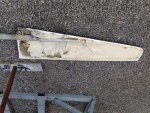
I used to get water in the rudder & was told that there was no problem
I had a light grounding on a shallow, sloping, sandy, bank in very calm water, a mile from Kessok bridge.
One can see the voids & corrosion down the shaft
Shortly after floating off the rudder split down the middle & one side floated away
This is what was left:-
rudder(600 x 448).jpg
I now have a Jefa rudder which I am confident is full of foam & properly made
 
Last year after lift out rudder seemed to be continually draining water.

I think its where the GRP sheathing meets the stock as this joint must work.

What would you do? Its a Jeanneau 43DS. I am assuming the inner rudder frame attached to the stock is SS.

I can drill, drain, dry out and reglass and try to strengthen top connection but cannot help but feel it would be a waste of time and if rudder is flexing on shaft sufficient to leak it will continue to do so. I am sure that to thoroughly dry out the rudder I will have to split off one half of the GRP sheaths.

Boat is 7yrs old. Fill with closed cell foam?

Any advice?
Most rudders collect water via the stock entry point. Nobody wants to talk about it of course. Some articles warn of impending doom unless all water is removed and the rudder resealed; I've even seen recommendations to slice the rudder open refill, check and rebuild the tangs, refit and reseal; for what? The rudder will not fail for being wet inside but if you want to drill holes and reseal every year, have fun - which it isn't of course.

PWG
 
Top