
You are using an out of date browser. It may not display this or other websites correctly.
You should upgrade or use an alternative browser.
You should upgrade or use an alternative browser.
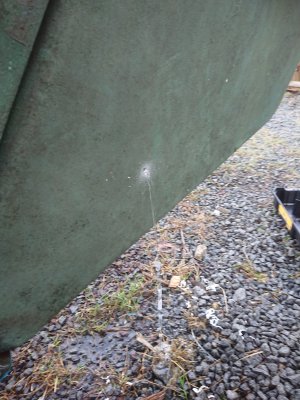
Water in rudder, thoughts anyone.
- Thread starter IanCC
- Start date

RunAgroundHard
Well-Known Member
From my research, amateur, and not statistically relevant, it appears that most water ingress comes from the shaft to GRP interface, if there is no obvious damage.
You could try compressed air, but the fact that the rudder is full of water means that you have a potential problem. Lots of You Tube videos on repairing this and some have good ideas for improving the seal at the shaft. There will be some form of steel webbing I would have thought to hold the GRP to the shaft, hence corrosion may have happened, as well as failure of any foam infill.
I found these two videos informative if you want to repair.
You could try compressed air, but the fact that the rudder is full of water means that you have a potential problem. Lots of You Tube videos on repairing this and some have good ideas for improving the seal at the shaft. There will be some form of steel webbing I would have thought to hold the GRP to the shaft, hence corrosion may have happened, as well as failure of any foam infill.
I found these two videos informative if you want to repair.
IanCC
Well-Known Member
No shaft. It's all fibreglass.From my research, amateur, and not statistically relevant, it appears that most water ingress comes from the shaft to GRP interface, if there is no obvious damage.
You could try compressed air, but the fact that the rudder is full of water means that you have a potential problem. Lots of You Tube videos on repairing this and some have good ideas for improving the seal at the shaft. There will be some form of steel webbing I would have thought to hold the GRP to the shaft, hence corrosion may have happened, as well as failure of any foam infill.
I found these two videos informative if you want to repair.

TSB240
Well-Known Member
Our Bendytoy 40 cc rudder is all gf including rudder shaft.
We had it in two pieces after it was cut away during recovery from an unplanned beaching!
No signs of any damage to shaft or water penetration in a 25 year old design.
Most rudders are not constructed from gf materials only and seem to suffer corrosion of dissimilar construction materials especially stainless steel in an enclosed cavity.
Is water penetration in an all gf rudder a problem?
It would be for a typical build with a combination of metal and gf.
Water in rudders is common for many boats just ask a surveyor!
Some boats have deliberately incorporated drains in their build Eg Amel
Personally I would keep the drain hole open when the boat is on the hard and plug it before next launch.
A hammer will detect any weakness in the underlying hard and solid gf structure. A good inspection of the joint between shaft and rudder sections would be advised.
My rudder has been rebuilt without the need of a welder!
We had it in two pieces after it was cut away during recovery from an unplanned beaching!
No signs of any damage to shaft or water penetration in a 25 year old design.
Most rudders are not constructed from gf materials only and seem to suffer corrosion of dissimilar construction materials especially stainless steel in an enclosed cavity.
Is water penetration in an all gf rudder a problem?
It would be for a typical build with a combination of metal and gf.
Water in rudders is common for many boats just ask a surveyor!
Some boats have deliberately incorporated drains in their build Eg Amel
Personally I would keep the drain hole open when the boat is on the hard and plug it before next launch.
A hammer will detect any weakness in the underlying hard and solid gf structure. A good inspection of the joint between shaft and rudder sections would be advised.
My rudder has been rebuilt without the need of a welder!

Concerto
Well-Known Member
If you have no rudder shaft, then I would check where the leak is by using an air line and soapy water. The leak will show as bubbles. This is how my water tank was tested after a rusty weld was repaired.
The water should do no harm in the blade unless it freezes, the expansion of the ice could split the blade apart.
The water should do no harm in the blade unless it freezes, the expansion of the ice could split the blade apart.
IanCC
Well-Known Member
Good thinking.If you have no rudder shaft, then I would check where the leak is by using an air line and soapy water. The leak will show as bubbles. This is how my water tank was tested after a rusty weld was repaired.
The water should do no harm in the blade unless it freezes, the expansion of the ice could split the blade apart.

dunedin
Well-Known Member
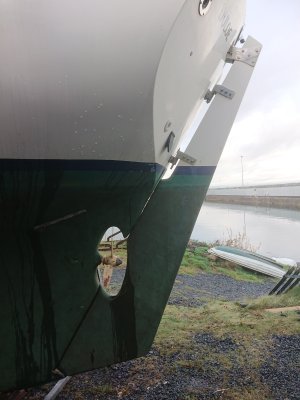
Perhaps a wide picture of the rudder may help. Is it a stern hung rudder if no shaft? Otherwise how is it steered?No shaft. It's all fibreglass.
IanCC
Well-Known Member
Perhaps a wide picture of the rudder may help. Is it a stern hung rudder if no shaft? Otherwise how is it steered?
Attachments
dunedin
Well-Known Member
Does that mean the only likely source of water ingress could be the bottom pintle fittings (assuming no huge cracks in the rudder GRP skin)?
IanCC
Well-Known Member
That i don't know. I can't see any cracks when rudder off. Yet water doesn't run out of bottom of rudder and i imagine rudder heel to be very solid make up. Tasted salty.Does that mean the only likely source of water ingress could be the bottom pintle fittings (assuming no huge cracks in the rudder GRP skin)?

Boathook
Well-Known Member
Quite interesting and a few ideas to remember when I do fibreglassing. One thing I did notice was that a lot of sanding, grinding and cutting was done without use of a vacuum cleaner so there would have been a lot of dust blowing around.From my research, amateur, and not statistically relevant, it appears that most water ingress comes from the shaft to GRP interface, if there is no obvious damage.
You could try compressed air, but the fact that the rudder is full of water means that you have a potential problem. Lots of You Tube videos on repairing this and some have good ideas for improving the seal at the shaft. There will be some form of steel webbing I would have thought to hold the GRP to the shaft, hence corrosion may have happened, as well as failure of any foam infill.
I found these two videos informative if you want to repair.
RunAgroundHard
Well-Known Member
You have drilled a hole, so fit a tapered adaptor for a dinghy pump inflation outlet into the hole, then pressurise up and use soapy water, or gas system leak detection fluid to test for leaks in the obvious places: pintal and gudgeon screw holes, heal pivot, leading and trailing edges.
if you don't find a leak, scratch head. Your choices are do nothing, which to me, without any metal inside, would be my choice. That then raises the question, should you even bother to look for a leak. Just drain off and reseal later before launch.
if you don't find a leak, scratch head. Your choices are do nothing, which to me, without any metal inside, would be my choice. That then raises the question, should you even bother to look for a leak. Just drain off and reseal later before launch.
Boathook
Well-Known Member
Possibly worth drilling some more holes to drain out the water and see what the construction is. The rudder does look of the age where a wooden former may have been used and then covered in GRP.

Refueler
Well-Known Member
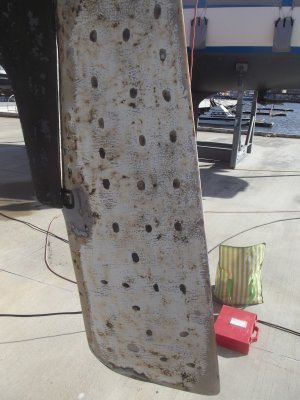
Rudder of my 38 ... after removing old Antifouling ... it would appear that rudder may have suffered water in past and they drilled plenty of holes to dry it out ?? But only one side ...
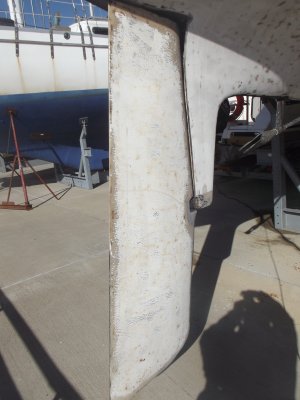
Photos are 2023 - 2024 Winter lift.
When we lifted 24-25 ... we did not see any water evidence ... but this lift (25-26 Winter lift) - we noted a small hole in rudder bottom and after standing - a damp patch .. but not water dripping or running out.
KevinV
Well-Known Member
Mine's a similar idea, and seems to be made of two halves glued together - possibly with a foam or balsa core (water leaked out slowly over days). Lots of wall thickness and even if it split completely the pintel fittings would hold it together, so I chose to "monitor" (ie do nothing)

lustyd
Well-Known Member
In that case, anytfoul it and go sailing. There’s water on the outside regardless.No shaft. It's all fibreglass.
rogerthebodger
Well-Known Member
On my ferro boat I has a GRP rudder with a stainless steel shaft and lower pintal
water would seep in via the GRP that was a little hydroscopic or vis the shaft GRP joint
My steel boat has a steel fabricated rudder with a stainless steel shaft and the steel covering welded on. I then pressure tested the rudder internal structure and then filled the rudder with old engine oil no issues since
Even though I painted the GRP rubber with epoxy tar it still absorbed some water the steel rudder as I said filled with old engine oil finally painting with epoxy tar no issues with water in rudder
I do now question is GRP the best material for manufacturing of boat rudders especially when you can also get rudders being chomped by dolphins and the corrosion inside due to water ingress corrosion due to water
I built an auxalizary rudder for my self steering gear from stainless that works
water would seep in via the GRP that was a little hydroscopic or vis the shaft GRP joint
My steel boat has a steel fabricated rudder with a stainless steel shaft and the steel covering welded on. I then pressure tested the rudder internal structure and then filled the rudder with old engine oil no issues since
Even though I painted the GRP rubber with epoxy tar it still absorbed some water the steel rudder as I said filled with old engine oil finally painting with epoxy tar no issues with water in rudder
I do now question is GRP the best material for manufacturing of boat rudders especially when you can also get rudders being chomped by dolphins and the corrosion inside due to water ingress corrosion due to water
I built an auxalizary rudder for my self steering gear from stainless that works
lustyd
Well-Known Member
None have actually failed due to being wet though, it's just something surveyors say to justify their fee.I do now question is GRP the best material for manufacturing of boat rudders
rogerthebodger
Well-Known Member
I have seen discussions on the forum and experiences it myself about water in rudders causing corrossion in the stainless tangs of a GRP rudder and if it's not very obtain why is there some issues and it cannot be just surveyors justify their feeNone have actually failed due to being wet though, it's just something surveyors say to justify their fee.
lustyd
Well-Known Member
Yes, I agree that many people, on the word of their surveyor, have split their rudder and found some surface rust on the stainless before rebuilding the rudder which gets wet immediately. Most of them made YouTube videos to document their folly.
Next you'll be telling me that osmosis is a serious problem
Next you'll be telling me that osmosis is a serious problem
Other threads that may be of interest
- Replies
- 4
- Views
- 228
